
therapies · education ·
Do Cold Plunges Actually Work? What The Research Shows & What It Doesn't
One camp calls it fake toughness. The other promises a free antidepressant. The studies say something narrower, and more useful, than either.
You have seen the reel. Ice tub, gasping, and a promise that your whole personality changes by Thursday.
You have also seen the backlash: cold plunging is theatre, suffering for a camera, and it does nothing a hot shower could not.
Both are wrong, and in the same way. They are arguments about a vibe. There is actual physiology here, and it is narrower and more interesting than either camp is selling.
What the numbers actually say
In a controlled trial, young men sat in water at three temperatures for an hour each, head out, while researchers measured what their blood was doing (Sramek et al., European Journal of Applied Physiology, 2000).
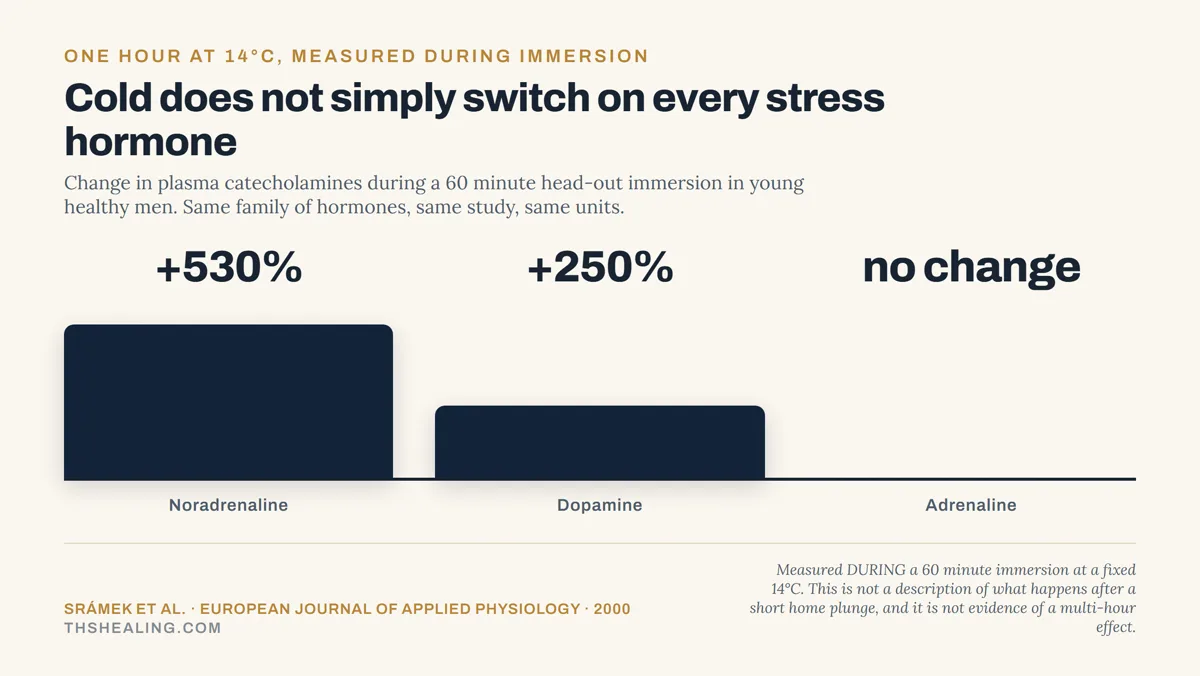
At 14 degrees Celsius, which is about 57 Fahrenheit, plasma noradrenaline rose about 530% and dopamine about 250%. Metabolic rate went up 350%. Heart rate and blood pressure rose modestly, by 5 to 8%.
So yes, something real is happening. That is not a small signal.
Now the part the reels leave out. Adrenaline did not change at all. Cortisol, the stress hormone everyone expects to spike, actually tended to decrease. The response is more specific than “cold stresses you out.”
The honesty fence around that number
Those measurements were taken during a 60 minute immersion at a fixed 14 degrees, in young healthy men.
That is a research dose. It is not two minutes in a stock tank before work.
You will hear that cold plunging gives you a dopamine high that lasts for hours. That specific claim does not come from this study, and we have not found a study that establishes it. What this trial shows is what your blood looks like while you are sitting in cold water for an hour, which is a different sentence.
We are pointing this out on a page that could have just run “COLD PLUNGES RAISE DOPAMINE 250%” and collected the clicks. The number is real. The story built on top of it usually is not.
What about mood?
Short head-out cold immersion has been linked to improvements in positive mood, with corresponding changes in how brain networks interact (Yankouskaya et al., Biology, 2023).
That is early human work on affect, and it is worth knowing about. It is not a depression protocol, and we are not offering it as one. If your mood is genuinely heavy, that belongs with a clinician, not a bathtub. Cold can be a discipline that helps some people feel clearer. It is not a treatment.
The part that will annoy the gym
If you lift weights and you plunge straight afterward, the evidence gets awkward.
Regular cold water immersion after resistance training appears to work against the adaptations you were training for, with attenuated muscle growth reported in this literature. One study looked at the machinery underneath that, finding cold immersion at 10 degrees after a lifting session altered the cellular apparatus that processes certain regulatory molecules, compared with normal recovery (D’Souza et al., Physiological Reports, 2023).
We will flag that one honestly, because a draft of this article got it wrong. That study measured miRNA export and maturation machinery, not muscle protein synthesis directly, and the authors say plainly that the downstream gene targets did not differ between conditions and that the physiological relevance needs further investigation. It is a mechanism paper pointing in a direction, not proof of a lost gain.
The practical version stands either way: feeling recovered and adapting well are not the same measurement. If you are chasing size and strength, plunging immediately after every session is worth a rethink. If you are managing heat after a long effort in summer, that is a different question with a different answer.
The risk nobody puts in the reel
This is the section we care most about.
Cold water immersion has been reviewed across its whole range, from hazard to treatment, and the conclusion was that the evidence base varies enormously by claim, with some popular ones resting on little more than anecdote (Tipton et al., Experimental Physiology, 2017).
The specific danger is worth naming. Going into cold water triggers the cold shock response, an involuntary gasp and a burst of fast breathing driven by the sympathetic nervous system. Putting your face in water, or holding your breath, triggers the diving response, which does the opposite and slows the heart through the parasympathetic side.
Fire both at once and you get what researchers named autonomic conflict: two opposing systems pulling on the same heart simultaneously. Their proposal is that this accounts for arrhythmias seen in healthy volunteers, and that in vulnerable people it may be behind deaths that were recorded as drowning or hypothermia (Shattock and Tipton, The Journal of Physiology, 2012).
That gasp is also a drowning mechanism in open water, independent of anything cardiac.
So: if you have a heart condition, an arrhythmia, a channelopathy, or you are pregnant, this is a conversation with your doctor before the first plunge, not after. And nobody plunges alone in open water.
Where the design shows up
The cold shock response is not a design flaw. It is an alarm system, and it works: your body is trying very hard to keep you alive in water that could kill you.
What is interesting is that it can be trained. Repeated exposure blunts the gasp. The alarm learns the difference between a threat and a Tuesday. That capacity to adapt to a stress you choose on purpose is the same machinery behind getting stronger, fitter, and more heat tolerant.
“Be strong and courageous, do not be afraid or tremble at them, for the LORD your God is the One who goes with you.” Deuteronomy 31:6, NASB
The verse carries the conviction. The trials carry the number, including the ones about arrhythmia.
What to do this week
Finish one shower cooler than usual. Thirty seconds. That is the whole assignment.
You do not need a chest freezer to find out whether you panic or breathe. A cooler shower tells you most of what you need to know about your own reaction, and it costs nothing.
If you want the ladder that goes from there, the companion piece has it, including the temperatures and the stop rules.
And if cold does not appeal to you at all, nothing here is a reason to force it. Cold is a layer on top of the things that decide most of your health. It is never a substitute for them.
Read this next: the practical half of this pair, with the temperatures, the timing and an eight week ladder that starts in your shower: how cold and how long. For the heat side of the same coin, what a hot bath does, and why fitness beat both.
Sources
- Srámek P, Simecková M, Janský L, Savlíková J, Vybíral S. “Human physiological responses to immersion into water of different temperatures.” European Journal of Applied Physiology, 2000;81(5):436-442. https://pubmed.ncbi.nlm.nih.gov/10751106/
- Yankouskaya A, Williamson R, Stacey C, Totman JJ, Massey H. “Short-Term Head-Out Whole-Body Cold-Water Immersion Facilitates Positive Affect and Increases Interaction between Large-Scale Brain Networks.” Biology, 2023;12(2):211. https://pubmed.ncbi.nlm.nih.gov/36829490/
- D’Souza RF, Figueiredo VC, Markworth JF, et al. “Cold water immersion in recovery following a single bout resistance exercise suppresses mechanisms of miRNA nuclear export and maturation.” Physiological Reports, 2023;11(15):e15784. https://pubmed.ncbi.nlm.nih.gov/37549955/
- Tipton MJ, Collier N, Massey H, Corbett J, Harper M. “Cold water immersion: kill or cure?” Experimental Physiology, 2017;102(11):1335-1355. https://pubmed.ncbi.nlm.nih.gov/28833689/
- Shattock MJ, Tipton MJ. “‘Autonomic conflict’: a different way to die during cold water immersion?” The Journal of Physiology, 2012;590(14):3219-3230. https://pubmed.ncbi.nlm.nih.gov/22547634/
Article metadata retrieved from PubMed. Scripture quoted from the New American Standard Bible.
Educational content from True Health Solutions. We do not diagnose or prescribe, and nothing here is a substitute for care from someone who knows your history. The body heals. We write about what supports that design.
Questions people ask
- Do cold plunges actually work?
- For some things, in specific conditions. A one hour immersion at 14 degrees raised plasma noradrenaline about 530% and dopamine about 250% during the immersion. Short immersions have been linked to improved positive mood in early research. What is not established is that a two minute plunge produces a multi-hour high, or that cold treats any condition.
- Does cold water raise dopamine?
- In the Sramek trial it rose about 250%, measured during a 60 minute immersion at 14 degrees Celsius in young healthy men. That is a during-immersion measurement at a research dose, not a description of what happens after a brief home plunge.
- Is a cold plunge good after lifting weights?
- It depends what you are training for. Research suggests habitual cold immersion straight after resistance training may work against muscle growth, even while it makes you feel recovered. If size and strength are the goal, the timing is worth a second look.
- Is cold plunging dangerous?
- It can be. Cold shock causes an involuntary gasp and rapid breathing, which is a drowning risk in open water. Researchers have also described autonomic conflict, where cold shock and the diving response fire at once and can trigger dangerous heart rhythms, particularly in people with heart conditions.
- Who should not cold plunge without medical clearance?
- Anyone with a known heart condition, an arrhythmia or a channelopathy, anyone pregnant, and anyone who has been told to avoid sudden cardiovascular stress. This is a conversation for whoever manages your care, before the first plunge rather than after.
