
education · therapies · heat ·
No Sauna? Here's What A Hot Bath Can & Can't Do For You
Finnish men who used a sauna most often died less often. Then researchers put a hot bath up against supervised exercise, and the result is worth your attention.

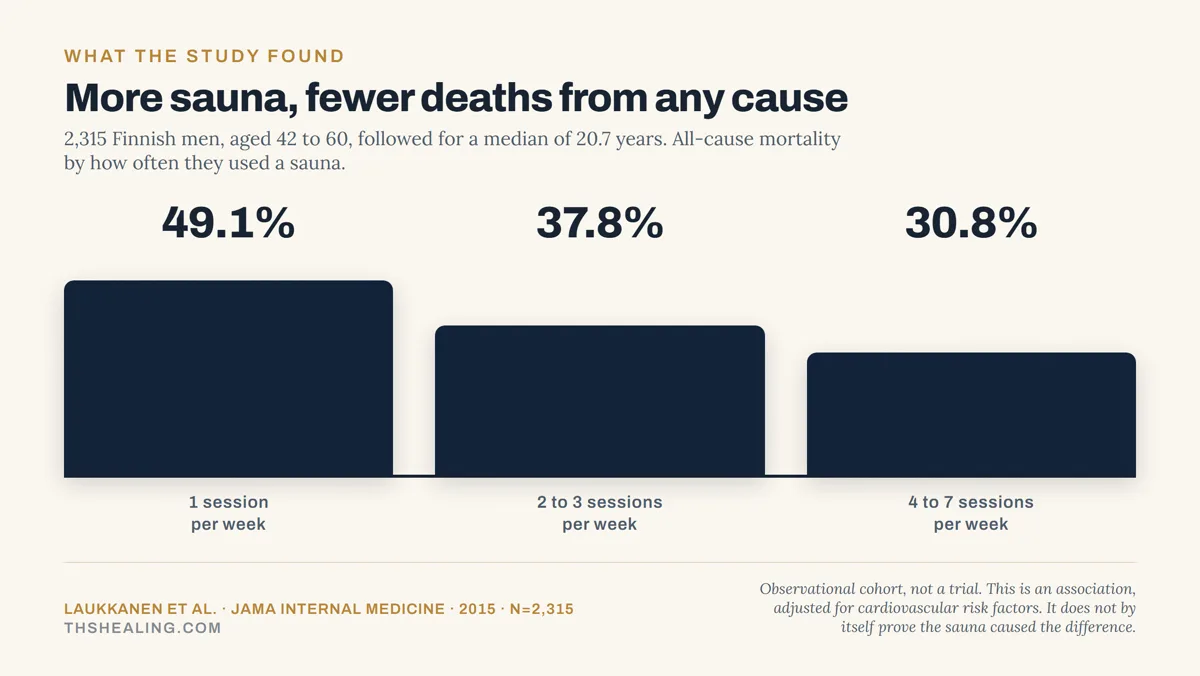
In Eastern Finland, researchers recruited 2,315 middle-aged men in the 1980s and asked them, among many other things, how often they used a sauna. Then they waited.
A median of 20.7 years later, 929 of those men had died.
The men who used the sauna most often had died least often, and the gap is not small.
What the Finnish numbers actually say
All-cause mortality across the follow-up: 49.1% among men who used a sauna once a week, 37.8% at two to three times a week, and 30.8% at four to seven times a week (Laukkanen et al., JAMA Internal Medicine, 2015).
For sudden cardiac death specifically, after adjusting for cardiovascular risk factors, men using a sauna four to seven times a week had a hazard ratio of 0.37 compared with once a week, with a confidence interval of 0.18 to 0.75.
Session length mattered too. Compared with sessions under 11 minutes, sessions longer than 19 minutes carried a hazard ratio of 0.48 for sudden cardiac death. That duration relationship held for fatal heart disease outcomes but, notably, not for all-cause mortality.
This is an observational cohort. Nobody assigned anyone to a sauna schedule. Men who sauna four times a week in Finland may differ from men who sauna once a week in ways no adjustment fully captures.
The study that tells you two things at once
Here is the part the sauna enthusiasm usually skips, and it comes from the same research group.
They took 2,277 men from the same population, measured cardiorespiratory fitness directly with respiratory gas analysis rather than asking, and followed them a median of 26 years (Kunutsor et al., Annals of Medicine, 2017). Then they looked at fitness and sauna use together.
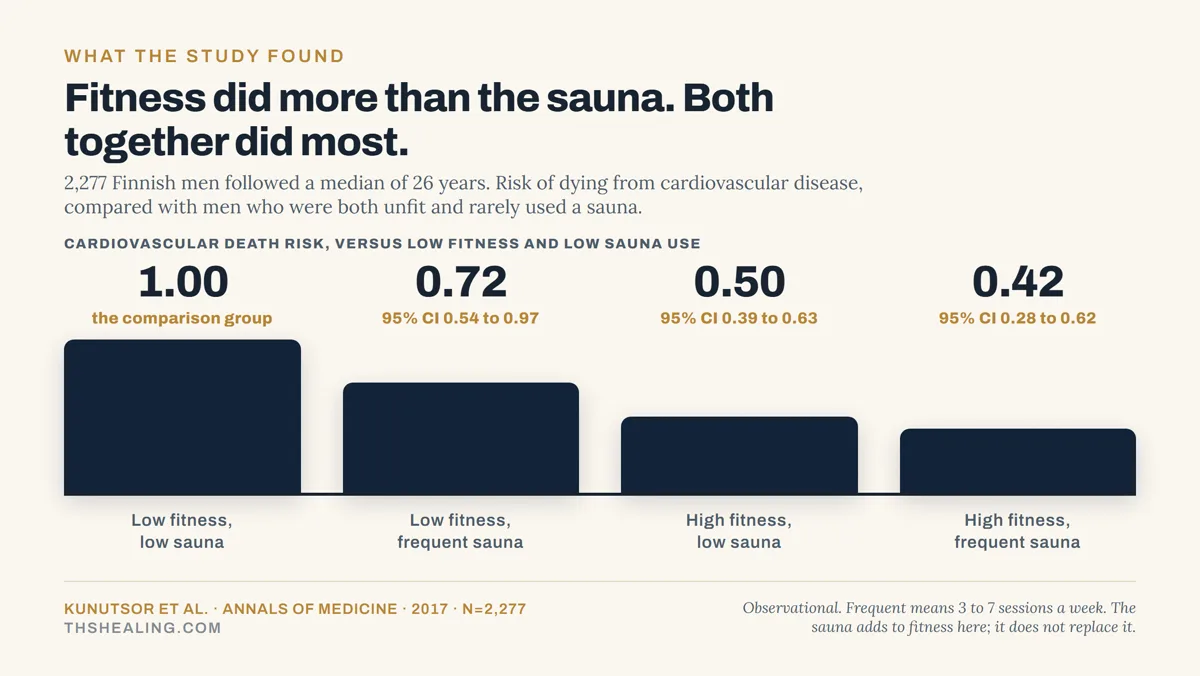
The first thing it tells you is that heat is a real tool. Men who used a sauna frequently but were not fit still had a cardiovascular death risk of 0.72 against the men who did neither. That is a meaningful reduction from sitting in a hot room. Sauna is not a spa amenity with a wellness story attached. It is doing something, and the number says so.
The second thing it tells you is that no tool, however good, replaces the life. Men with high fitness and little sauna use sat at 0.50. Fitness alone beat frequent sauna alone, and it was not close.

Both together landed at 0.42, the lowest of the four groups. So these are not competing. They stack. But they stack in an order, and the order is not the one the heat therapy industry would prefer.
This is the whole thesis of what we are building, sitting in one table of hazard ratios. There is no therapy, no supplement, no protocol and no piece of equipment that substitutes for how you eat, how you move and how you sleep. Every serious tool we will put in that building works on top of those things. None of them works instead of them.
We are going to have a sauna at the healing center, and we are telling you this anyway. A site that only publishes the findings that flatter what it sells is not worth reading, and a healing center that sells you a chamber while your fundamentals are falling apart is taking your money.
Does any of this apply to women?
A fair question, and the article you are reading could not answer it until now.
Both studies above are men. The 2015 cohort was 2,315 men. The fitness study was 2,277 men. That is a real limit and it is the kind of thing that quietly gets left out.
A later cohort fixes it. Researchers followed 1,688 people with a mean age of 63, of whom 51.4% were women, for a median of 15 years, recording 181 fatal cardiovascular events (Laukkanen et al., BMC Medicine, 2018).
Against one session a week, cardiovascular mortality hazard ratios were 0.71 for two to three sessions and 0.30 for four to seven. After adjusting for established risk factors plus physical activity, socioeconomic status and incident coronary heart disease, the four-to-seven figure was 0.23, confidence interval 0.08 to 0.65.
The relationship was linear with no threshold, and duration in minutes per week tracked the same way. So the pattern is not a male finding.
What might be doing it?
One plausible mechanism has its own study, and it is the most likely candidate.
Researchers followed 1,621 Finnish men who did not have high blood pressure at baseline, for a median of 24.7 years (Zaccardi et al., American Journal of Hypertension, 2017). During that time 251 developed hypertension.
Against one session a week, the hazard ratio for developing hypertension was 0.76 at two to three sessions and 0.54 at four to seven. Adjusting further for glucose, creatinine, alcohol, heart rate, family history, socioeconomic status and cardiorespiratory fitness barely moved it: 0.53.
That matters because it is upstream. If regular heat exposure makes people less likely to develop high blood pressure in the first place, that is a straightforward route to fewer cardiovascular deaths two decades later, and it is consistent with what a single session does to blood pressure acutely.
Still observational. Still Finland. But it is a mechanism with its own evidence rather than a story told after the fact.
So can a bathtub do it?
Nobody has run a head-to-head trial of sauna versus bath. But somebody did put a hot bath up against nothing at all for eight weeks and then measured the arteries, which answers a more useful question anyway.
Twenty young sedentary adults were randomized to either hot water immersion or a thermoneutral sham bath, ten in each group. The heat group sat in a 40.5 degree Celsius bath four or five times a week for eight weeks, staying in long enough each session to hold core temperature at or above 38.5 degrees for a full hour (Brunt et al., Journal of Physiology, 2016).
| What was measured in the heat group | Before | After |
|---|---|---|
| Flow-mediated dilation, how far an artery can widen | 5.6% | 10.9% |
| Aortic stiffness, metres per second | 7.1 | 6.1 |
| Carotid wall thickness, millimetres | 0.43 | 0.37 |
| Mean arterial pressure, mmHg | 83 | 78 |
Nothing moved in the sham group.
Flow-mediated dilation is the one worth explaining, because it is the closest thing we have to a fitness test for a blood vessel. A technician squeezes a cuff tight enough to stop the blood in your arm, waits a few minutes, lets go, and measures how much the artery opens to let the rush through. A healthy artery opens wide. A stiff one barely moves. After eight weeks of hot baths, these arteries roughly doubled how far they opened, and the two stiffness measures and the blood pressure moved with them.
The authors were not shy about the size of it.
The magnitude of changes are on par or greater than what is typically observed in sedentary subjects with exercise training.
Brunt et al., Journal of Physiology, 2016
Read that protocol again before you rearrange anything, though, because it is harder than the word “bath” makes it sound. An hour with your core temperature held above 38.5 degrees, four or five times a week, is a demanding session that happens to take place in a bathtub rather than a relaxing soak that happens to be good for you. And twenty young sedentary people is a small, specific group.
Then there is the trial that matched heat against actual exercise.
Researchers in New Zealand randomized 22 people with peripheral arterial disease, a condition where narrowed leg arteries make walking painful, to 12 weeks of either heat therapy or supervised exercise (Akerman et al., American Journal of Physiology, 2019). The heat group did spa bathing at about 39°C, three to five days a week, up to 30 minutes, followed by light calisthenics. The exercise group did up to 90 minutes of supervised walking and gym work, one to two days a week.
Both groups improved their six-minute walking distance by about 41 metres. Pain-free walking distance improved by about 43 metres in both. Systolic blood pressure fell 7 mmHg in the heat group and 3 mmHg in the exercise group.
There were no significant differences between heat and exercise on the functional or blood pressure outcomes.
Now the limits, because they are real. Twenty-two people. Average age around 75. A specific circulatory condition, not healthy adults. And the heat group also did calisthenics, so it was not heat alone. The researchers also found no significant change in blood volume, ankle-brachial index, or their measures of vascular health.
What it supports is modest and still worth having: in this population, hot water immersion was a viable alternative for people who could not stick to walking programs, and adherence to it was excellent.
How solid is the sauna evidence, really?
Worth knowing before you rearrange your week.
A systematic review gathered every study of regular dry sauna bathing from 2000 onward and found 40 clinical studies covering 3,855 participants (Hussain and Cohen, Evidence-Based Complementary and Alternative Medicine, 2018). Most reported beneficial effects.
But only 13 of the 40 were randomized controlled trials, and most studies had fewer than 40 participants. The outcome measures were heterogeneous, meaning everyone measured something different, which makes them hard to pool.
Their conclusion was that regular dry sauna bathing has potential health benefits, and that more data of higher quality is needed, including on how often adverse effects occur.
One adverse finding did turn up: a single small study of ten men reported disrupted sperm production, which reversed when they stopped.
So the honest summary is a promising body of work resting on one very good cohort and a lot of small studies.
What to do this week
If you have a bathtub, you have the intervention. Use it.
Hot water, roughly as hot as you can comfortably stay in, 20 to 30 minutes, a few times a week. The Finnish duration finding and the New Zealand protocol both landed in that range.
Common sense that is not optional: drink water before and after, stand up slowly because your blood pressure drops in heat, and do not do this after drinking alcohol. If you are pregnant, have unstable heart disease, or have had a recent heart attack, this is a question for your doctor rather than for an article.
And the thing this article has been pointing at the whole time: if you only fix one variable this month, make it the one the data says did more.
Read this next: the companion to this piece walks through what is happening in your body during a session and how to have a first one safely: the first sauna session, and what your body is actually doing. Heat sits on top of the fundamentals, not instead of them, and those are in The Five Pillars of Owning Your Health. For the cheapest version of the fitness half, see how researchers cut blood sugar spikes with three-minute walks.
Sources
- Laukkanen T, Khan H, Zaccardi F, Laukkanen JA. “Association between sauna bathing and fatal cardiovascular and all-cause mortality events.” JAMA Internal Medicine, 2015;175(4):542-548. https://pubmed.ncbi.nlm.nih.gov/25705824/
- Kunutsor SK, Khan H, Laukkanen T, Laukkanen JA. “Joint associations of sauna bathing and cardiorespiratory fitness on cardiovascular and all-cause mortality risk: a long-term prospective cohort study.” Annals of Medicine, 2017;50(2):139-146. https://pubmed.ncbi.nlm.nih.gov/28972808/
- Akerman AP, Thomas KN, van Rij AM, Body ED, Alfadhel M, Cotter JD. “Heat therapy vs. supervised exercise therapy for peripheral arterial disease: a 12-wk randomized, controlled trial.” American Journal of Physiology: Heart and Circulatory Physiology, 2019;316(6):H1495-H1506. https://pubmed.ncbi.nlm.nih.gov/31002283/
- Laukkanen T, Kunutsor SK, Khan H, Willeit P, Zaccardi F, Laukkanen JA. “Sauna bathing is associated with reduced cardiovascular mortality and improves risk prediction in men and women: a prospective cohort study.” BMC Medicine, 2018;16(1):219. https://pubmed.ncbi.nlm.nih.gov/30486813/
- Zaccardi F, Laukkanen T, Willeit P, Kunutsor SK, Kauhanen J, Laukkanen JA. “Sauna Bathing and Incident Hypertension: A Prospective Cohort Study.” American Journal of Hypertension, 2017;30(11):1120-1125. https://pubmed.ncbi.nlm.nih.gov/28633297/
- Hussain J, Cohen M. “Clinical Effects of Regular Dry Sauna Bathing: A Systematic Review.” Evidence-Based Complementary and Alternative Medicine, 2018;2018:1857413. https://pubmed.ncbi.nlm.nih.gov/29849692/
- Brunt VE, Howard MJ, Francisco MA, Ely BR, Minson CT. “Passive heat therapy improves endothelial function, arterial stiffness and blood pressure in sedentary humans.” The Journal of Physiology, 2016;594(18):5329-5342. https://pubmed.ncbi.nlm.nih.gov/27270841/
Article metadata retrieved from PubMed.
Educational content from True Health Solutions. We do not diagnose or prescribe, and nothing here is a substitute for care from someone who knows your history. The body heals. We write about what supports that design.
Questions people ask
- What did the Finnish sauna study actually find?
- Following 2,315 middle-aged men for a median of 20.7 years, all-cause mortality was 49.1% among men using a sauna once a week, 37.8% at two to three times a week, and 30.8% at four to seven times a week. It is an observational cohort, so it shows association rather than cause.
- Is a hot bath as good as a sauna?
- Nobody has run that head-to-head trial. What exists is bath-specific evidence of its own. In 20 sedentary adults randomized to 8 weeks of 40.5C baths or a thermoneutral sham, flow-mediated dilation rose from 5.6% to 10.9% in the heat group with no change in the sham. A separate 12-week trial in 22 people with peripheral arterial disease found no significant difference between hot water immersion and supervised exercise on walking distance.
- How long should a sauna session be?
- In the Finnish cohort, sessions longer than 19 minutes were associated with lower risk of sudden cardiac death compared with sessions under 11 minutes. That duration relationship held for cardiac outcomes but not for all-cause mortality.
- Can a sauna replace exercise?
- No, and the same study shows both halves of that. In 2,277 men, frequent sauna use with low fitness was still associated with lower cardiovascular death risk than doing neither, so heat is a real tool. But high fitness with little sauna use did better, and the two together did best. They stack, in that order.
- Do the sauna findings apply to women?
- The two most-quoted studies are men only. A later cohort of 1,688 people, 51.4% of them women, followed a median of 15 years, found cardiovascular mortality hazard ratios of 0.30 for four to seven sessions a week against one, and 0.23 after full adjustment. The pattern is not male-specific.
- How good is the sauna evidence overall?
- Mixed. A systematic review found 40 clinical studies covering 3,855 participants, but only 13 were randomized controlled trials and most studies had fewer than 40 people. The authors concluded there are potential benefits and that better data is needed.
