
fundamentals · education · blood sugar ·
A 3-Minute Walk After Meals Cut Blood Sugar Spikes By 39%
A randomized trial found 3-minute walking breaks cut post-meal glucose exposure by 39%. Why muscle contraction clears blood sugar, and how long to walk.
We have all had that lunch. Not perfect, but decent. And then by two o’clock you are reading the same paragraph for the fourth time, doing the math on whether a second coffee is worth what it will cost you at eleven tonight.
Almost every piece of advice about that wall is about the food. Less bread. More protein. Try this powder.
So here is a room full of adults with type 2 diabetes, and researchers cutting the blood sugar response after meals by 39 percent without touching the meal. Same food. Same portions. Same people.
They changed what happened in the half hours around it.
Bottom line. Light activity meaningfully reduces the rise in blood glucose after eating. In one trial of adults with type 2 diabetes, three-minute walking breaks every 30 minutes across the day cut post-meal glucose exposure by about 39 percent on identical meals. Separately, research on walking soon after a meal finds it works better than the same walk taken before eating. Those are two different strategies, and you can use either.

How 3-minute walks cut the day’s glucose response by 39%
Twenty-four adults, average age 62, spent three separate eight-hour days in a lab eating identical meals.
One day they sat, the way most of us sit.
The other days, every thirty minutes, they got up and walked for three minutes at about two miles an hour. That is a stroll to the mailbox. It is not exercise in any sense you would brag about.
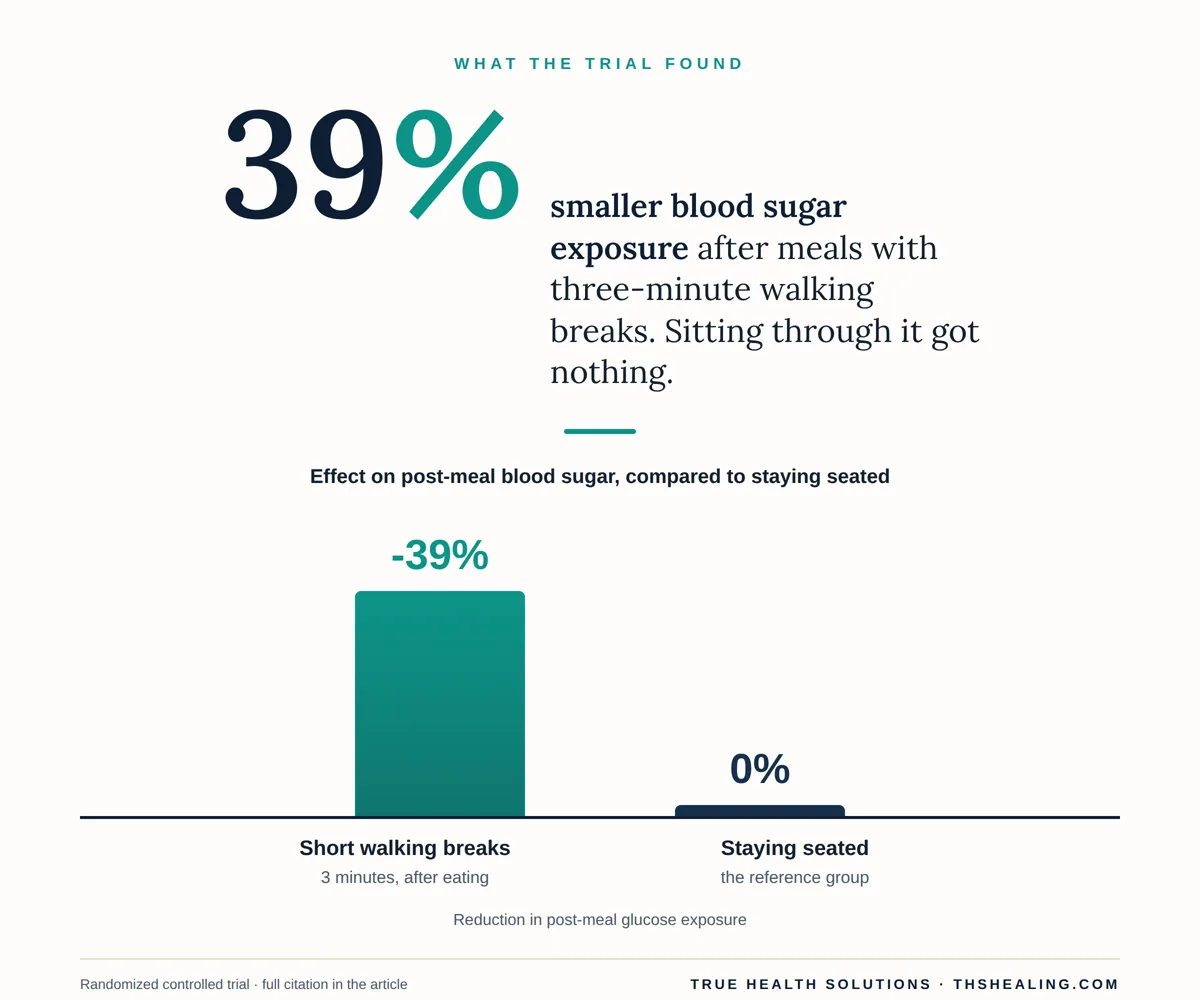
Worth being precise about what that 39 percent is. It is the whole day’s glucose exposure, in a lab, where someone got up every half hour for eight hours (Dempsey et al., a randomized crossover trial in Diabetes Care). It is not what one walk after dinner does. The same lab had earlier run a lighter version, two-minute walks every twenty minutes, and found the same shape of result (Dunstan et al., Diabetes Care).
Two minutes. Every twenty. That was the whole intervention.
Why walking lowers blood sugar: the second door into muscle
Sugar cannot wander into muscle on its own.
Glucose needs a transporter, GLUT4, to move up to the surface of the muscle cell before anything can get in. Think of GLUT4 as a door that has to be unlocked from the inside.
You have been told one thing unlocks that door. Insulin.
That is half true, and the other half is the good half. Here is the full sequence most people are taught:
You eat, blood glucose rises, the pancreas releases insulin, insulin signals the muscle, GLUT4 moves to the cell surface, glucose goes in. When that chain works, blood sugar comes down on its own and you never think about it.
Insulin resistance is what happens when the muscle stops answering that signal properly. Same insulin, less response, glucose stays in the blood longer.
But muscle has a second route to the same door, and it does not involve insulin at all. When a muscle fibre contracts, a separate set of signals fires and moves GLUT4 to the surface anyway.
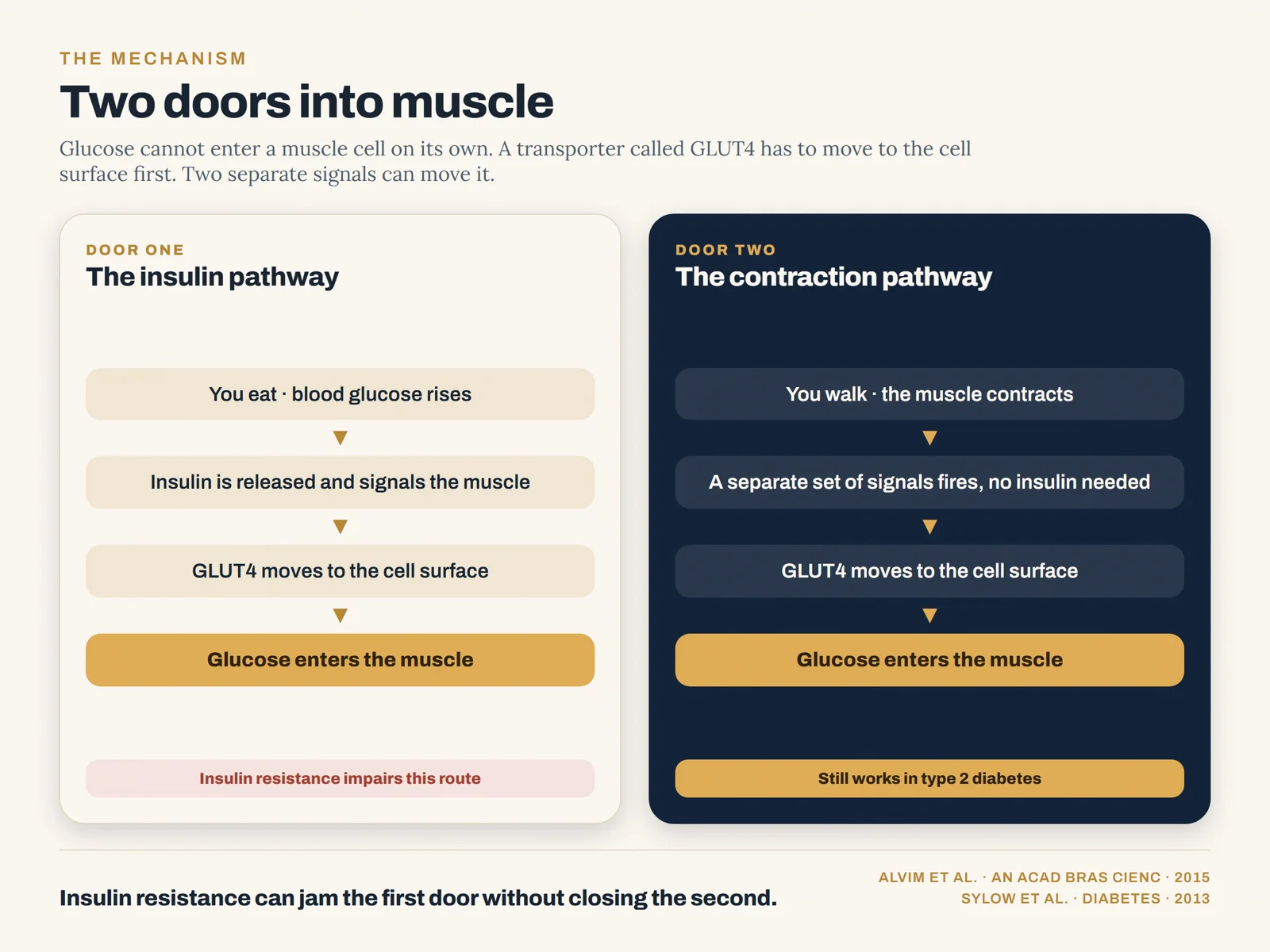
Which sets up one of those sentences you read twice. From a review of muscle glucose uptake in Anais da Academia Brasileira de Ciências: people with type 2 diabetes have reduced insulin-stimulated uptake because of insulin resistance, however, those individuals have normal glucose uptake during exercise.
The insulin door can be rusted half shut, and the contraction door still works.
Researchers are still mapping exactly how that second pathway fires. A 2013 paper identified a protein called Rac1 as one of the regulators, activated by exercise in both mice and humans. The fine detail is open. The existence of the second route is not.
It is also not very marketable, which may be part of why you have not heard it.
When should you walk after eating?
Here is where most people, including people trying hard, get it backwards.
A 2023 review pooled eight randomized trials and compared three things: moving before a meal, moving after it, and sitting still.
Moving after the meal beat sitting still. Moving after the meal also beat moving before it. And moving before the meal was not meaningfully better than doing nothing at all for the rise that followed (Engeroff et al., a meta-analysis in Sports Medicine).
The sooner after eating, the better it worked.
So the six a.m. workout is a good thing that is not doing the job you thought. If you have been getting up early, training hard, and still hitting a wall at three in the afternoon, you have not been failing. You have been doing the right thing at the wrong hour.
Standing desk versus walking: does standing count?
Partly, and the honest answer is more useful than a yes.
A 2022 review put three conditions head to head: sitting through, standing breaks, walking breaks. Standing did lower the glucose response. Walking lowered it more than twice as much, and unlike standing it moved insulin too (Buffey et al., Sports Medicine).
Which makes sense once you know about the second door. Standing is posture. Contraction is what turns the key, and a standing desk does not contract much.
Keep the desk. Just do not let it stand in for the walk.
How long should you walk after a meal?
There are two strategies here, and they are not the same one. Use either. Use both.
Strategy one: break up the sitting. Two or three minutes of light walking every twenty to thirty minutes. That is the pattern that produced the 39 percent figure. It suits a desk day better than it sounds: up, down the hallway, back.
Strategy two: walk soon after eating. Ten to twenty minutes, starting within a few minutes of putting the fork down rather than an hour later. This is the one the meta-analysis supports, and it is the easier habit to keep.
Beyond that:
Pick the meal that wrecks you. For most people that is dinner, and dinner is followed by the longest sit of the day. Worst combination on the schedule.

Pace barely matters. The trial used about two miles an hour, which is slower than you are imagining.
Give it three weeks before you judge it. Not because it is slow, the effect shows up the same day, but because you are looking for a pattern in how three in the afternoon feels, and one Tuesday is not a pattern.
What this evidence does and does not show
These were short trials measuring glucose across a single day, not heart attacks across a decade. The groups were small, two dozen people in each. The 2023 review rated its own included trials at high risk of bias, and said so plainly, which is more than most health writing will tell you.
The honest word for this evidence is promising, not proven.
What makes it worth your ten minutes anyway is that the mechanism, the trials and ordinary experience all point the same direction, and the cost of testing it on yourself is a pair of shoes. That ratio is rare. Most things you are told to try do not have it.
If you take medication that lowers blood sugar, changing your activity pattern changes what those drugs do. Worth a conversation with whoever prescribes them. Not a reason to sit still.
Why we keep writing things like this
Bodies were built to move after eating. Not to train for an hour and then sit for nine. Every culture that ever walked home from a meal was doing this long before anyone ran a trial, and the trial, when it finally arrived, agreed with them.
The design is good. Our job is to point at it and get out of the way, which is most of why we are building what we are building in a town of two thousand people.
And notice what this needs. No membership. No supplement. Nobody who has to see you again in six weeks. If you have had your fill of protocols that only work for as long as you keep paying for them, this is the opposite of that. You can run it for the rest of your life and never speak to us again.
That is the point. The goal is never to make you dependent on a facility. The goal is for you to own your health.
Read this next: The Five Pillars of Owning Your Health. Movement is one of them, and the other four decide more than most therapies do.
Sources
Every study named above, linked to the original. Retrieved from PubMed.
- Dempsey PC et al. Diabetes Care, 2016. Interrupting sitting with three-minute light walking or simple resistance breaks in 24 adults with type 2 diabetes. Glucose exposure across the day fell from 24.2 to 14.8, insulin from 3,293 to 2,104. Read the study
- Dunstan DW et al. Diabetes Care, 2012. Two-minute walking breaks every twenty minutes in 19 overweight adults aged 45 to 65. Glucose response fell from 6.9 to 5.2, insulin from 828.6 to 634. Read the study
- Engeroff T, Groneberg DA, Wilke J. Sports Medicine, 2023. Meta-analysis of eight randomized trials, 116 participants. Exercise after a meal beat both exercise before it and sitting still; pre-meal exercise was not significantly better than no exercise. Read the meta-analysis
- Buffey AJ et al. Sports Medicine, 2022. Meta-analysis of seven trials comparing standing breaks with light walking breaks. Walking beat standing on both glucose and insulin. Read the meta-analysis
- Alvim RO et al. Anais da Academia Brasileira de Ciências, 2015. Review of muscle glucose uptake describing both pathways, and the finding that glucose uptake during exercise is normal in people with type 2 diabetes. Read the review
- Sylow L et al. Diabetes, 2013. Identified Rac1 as a regulator of contraction-stimulated glucose uptake, activated by exercise in both mice and humans. Read the study
Nothing here is medical advice. It is education, and decisions about your health are yours.
Questions people ask
- How long should you walk after eating to lower blood sugar?
- Ten to twenty minutes is enough. In the trials that measured it, the walking was light, around two miles an hour, and the benefit came from starting soon after the meal rather than from walking hard or long.
- When is the best time to walk after a meal?
- As soon after eating as you reasonably can. A 2023 meta-analysis of eight randomized trials in Sports Medicine found that walking after a meal lowered the glucose response more than walking before it, and that walking before a meal was not significantly better than sitting still.
- How much does walking after meals lower blood sugar?
- In a 2016 randomized crossover trial in Diabetes Care, 24 adults with type 2 diabetes who took three-minute walking breaks every 30 minutes had a 39 percent lower glucose response across the day than on the day they sat, eating identical meals.
- Is standing after a meal as good as walking?
- No. A 2022 meta-analysis in Sports Medicine found standing breaks lowered the glucose response, but light walking lowered it more than twice as much and also reduced insulin, which standing did not.
- Why does walking lower blood sugar even with insulin resistance?
- Muscle has two separate ways to pull glucose in. Insulin is one. Muscle contraction is the other, and it does not need insulin. That is why glucose uptake during exercise is normal in people with type 2 diabetes even though insulin-stimulated uptake is impaired.
