
fundamentals · education ·
The 5 Free Habits That Shape Your Health Most, With The Research Behind Each
Before any therapy, protocol or supplement, five fundamentals decide most of your outcomes. Here is the named study behind each one.

Every therapy we will offer at the healing center works better on a body whose fundamentals are handled. None of them replaces the fundamentals.
That is not modesty. It is the order of operations. Hyperbaric oxygen on four hours of sleep is an expensive way to feel briefly better. So before we write a word about chambers and plunges and panels, here are the five things we teach first, and the research under each one.
All five are free, or close to it. That is not a coincidence. It is most of the reason they come first.
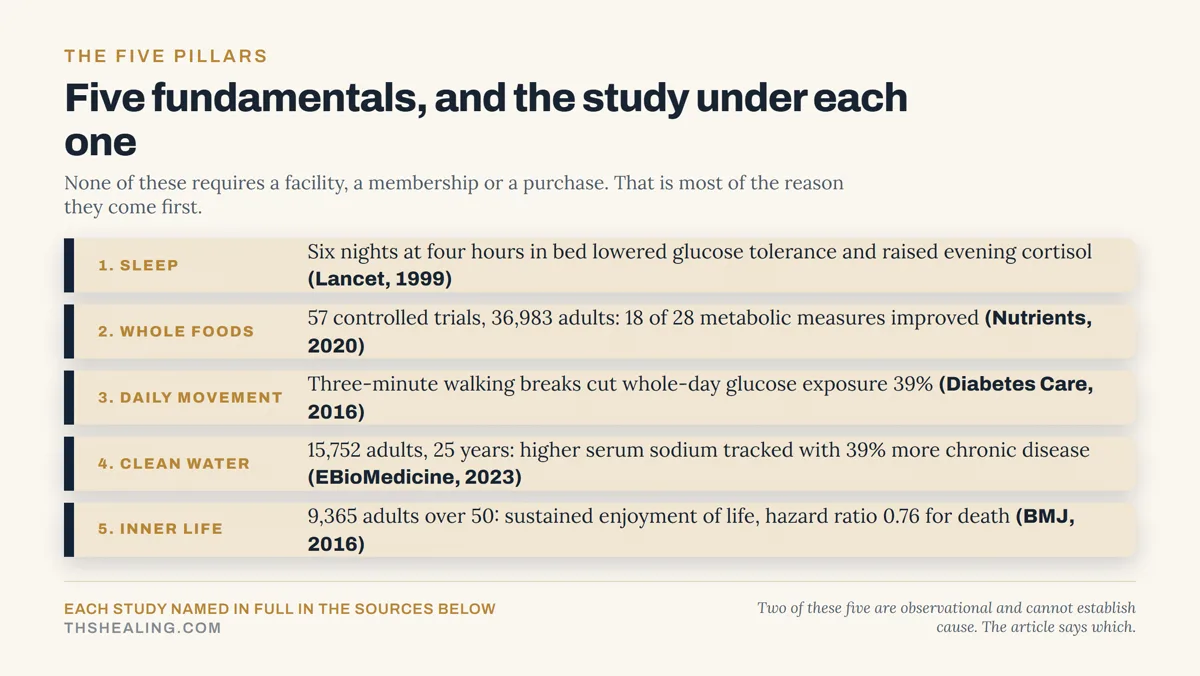
Each pillar below names one study, says what it actually measured, and ends with one thing to do this week. Where the evidence is observational and cannot prove cause, we say so in the same breath as the number, because that is the difference between teaching you something and selling you something.
Pillar one: sleep like it is your job
Nearly every repair system in your body does its heaviest work while you are unconscious. You do not get a version of health that skips this.
Here is how fast it shows up. Researchers restricted eleven healthy young men to four hours in bed for six nights, then compared them against themselves after six nights of twelve hours in bed (Spiegel, Leproult and Van Cauter, The Lancet, 1999).
Six nights. Glucose tolerance dropped. Evening cortisol rose. Sympathetic nervous system activity went up. The authors noted the changes resembled what they see in normal ageing.
It is a small study, eleven people, and we are telling you that rather than letting the number carry more than it can. But the design is a within-person comparison, which is a strong way to run a small sample, and the direction has held up in the twenty-five years since.
This week: pick a bedtime and defend it for seven nights. Dark room, same time, screens off at the end of the night. Not a perfect routine. A defended one.
Pillar two: eat food your great-grandmother would recognize
Whole foods, mostly plants, prepared at home, and drastically less of anything that arrives in a box with a cartoon on it.
The evidence for the pattern is better than the evidence for any single food in it. A systematic review pooled 57 controlled trials covering 36,983 adults eating a Mediterranean-style whole-food pattern (Papadaki, Nolen-Doerr and Mantzoros, Nutrients, 2020). Of 28 measures of metabolic health, 18 improved. Cardiovascular disease incidence was 39% lower. Stroke was 33% lower.
Notice what nobody in those trials was doing. Nobody was supplementing. They were eating.
This week: put something colorful and close to the ground on your plate every day. Fresh or frozen. That is the whole assignment.
Pillar three: move every day, hard sometimes
Daily movement keeps the machinery running. Occasional intensity, lifting something heavy or getting your heart rate genuinely up, tells your body it still needs to be strong.
The daily part matters more than most people expect, and it is smaller than most people expect. In a randomized crossover trial, three-minute walking breaks every half hour cut whole-day glucose exposure by 39% in adults with type 2 diabetes, with no change to what anyone ate (Dempsey et al., Diabetes Care, 2016).
Three minutes. Not a workout. A walk to the mailbox, repeated.
This week: walk for ten minutes after your largest meal of the day. We wrote the whole story of why that works, and the timing turns out to matter more than the effort.
Pillar four: hydrate with water worth drinking
Most people run mildly dehydrated on liquids that are working against them.
This pillar used to be the one we could only argue from common sense. That changed. NIH researchers followed 15,752 adults enrolled in middle age for 25 years, using serum sodium as a stand-in for lifelong hydration habits (Dmitrieva et al., EBioMedicine, 2023).
People whose middle-age serum sodium ran above 142 mmol/l had a 39% higher risk of developing chronic disease, and up to 50% higher odds of being biologically older than their birth certificate said. Above 144, premature mortality risk was 21% higher.
The authors are careful, and so are we: this is observational, and they explicitly call for intervention studies to confirm that hydration is what is doing it. It is the strongest evidence this pillar has ever had and it is not proof.
This week: clean, filtered water, most of the day, every day. It is the cheapest health intervention that exists. It is also why our healing center’s base membership will include free reverse osmosis water refills, because the lowest rung of the ladder should be within everyone’s reach.
Pillar five: guard your inner life
Stress, isolation and hopelessness are physiological forces, not just feelings. This is the pillar people skip, because it does not feel like health. It feels like a luxury you get to after the real work is done.
Researchers followed 9,365 English adults aged 50 and over, asking about enjoyment of life at three separate check-ins across four years, then tracking mortality for up to seven years (Zaninotto, Wardle and Steptoe, BMJ, 2016). Compared with people who never reported high enjoyment, those who reported it at all three check-ins had a hazard ratio for death from any cause of 0.76.
It is observational, and the authors say so plainly. But it survived the obvious objection: the pattern held even after excluding everyone who died within two years of the last measurement.
We built our whole company around this pillar, because health pursued alone rarely lasts.
This week: make one ten-minute appointment with joy and keep it like it is a doctor’s visit.
Why these five, in this order
Because each one makes the next one easier, and because none of them is for sale.
You do not need us for any of this. That is the point of leading with it. The therapies we will offer at 317 W. Mill St are for a well-tended body that wants to do more, and a body running on four hours of sleep and sweet drinks is not that body yet.
Master these five and you have done more for your long-term health than most of what is on the market. Then come see us.
Read this next: start with the one that has the most leverage for the least effort: researchers cut blood sugar spikes by 39% without changing a single meal. For pillar two, what most food as medicine advice never mentions is the opener to our food series. And pillar five gets its own article in researchers gave 334 people a cold virus on purpose.
Sources
- Spiegel K, Leproult R, Van Cauter E. “Impact of sleep debt on metabolic and endocrine function.” The Lancet, 1999;354(9188):1435-1439. https://pubmed.ncbi.nlm.nih.gov/10543671/
- Papadaki A, Nolen-Doerr E, Mantzoros CS. “The Effect of the Mediterranean Diet on Metabolic Health: A Systematic Review and Meta-Analysis of Controlled Trials in Adults.” Nutrients, 2020;12(11):3342. https://pubmed.ncbi.nlm.nih.gov/33143083/
- Dempsey PC, Larsen RN, Sethi P, et al. “Benefits for Type 2 Diabetes of Interrupting Prolonged Sitting With Brief Bouts of Light Walking or Simple Resistance Activities.” Diabetes Care, 2016;39(6):964-972. https://doi.org/10.2337/dc15-2336
- Dmitrieva NI, Gagarin A, Liu D, Wu CO, Boehm M. “Middle-age high normal serum sodium as a risk factor for accelerated biological aging, chronic diseases, and premature mortality.” EBioMedicine, 2023;87:104404. https://pubmed.ncbi.nlm.nih.gov/36599719/
- Zaninotto P, Wardle J, Steptoe A. “Sustained enjoyment of life and mortality at older ages: analysis of the English Longitudinal Study of Ageing.” BMJ, 2016;355:i6267. https://pubmed.ncbi.nlm.nih.gov/27965194/
Article metadata retrieved from PubMed.
Educational content from True Health Solutions. We do not diagnose or prescribe, and nothing here is a substitute for care from someone who knows your history. The body heals. We write about what supports that design.
Questions people ask
- What are the five pillars?
- Sleep, whole foods, daily movement, clean water, and your inner life. We teach them first because each one has human research behind it and none of them requires a facility, a membership or a purchase to start.
- Do I need the healing center to do any of this?
- No. All five pillars are free or close to it. The therapies we will offer work better on a body whose fundamentals are handled, and none of them replaces the fundamentals.
- Which pillar should I start with?
- Sleep, in most cases. It is upstream of the others. In a controlled study, six nights of four hours in bed measurably reduced glucose tolerance and raised evening cortisol in healthy young men.
- Is this a protocol or a plan?
- Neither. It is the order of operations. Each pillar has its own article going deeper, and each one ends with a single thing you can start this week.
- Do these pillars treat or cure disease?
- No, and we do not claim they do. The studies named here measure markers and risk across groups of people. They support a way of living, not a promise about any diagnosis.
