
fundamentals · education · food ·
Whole Foods Beat Their Own Supplements In 46 Trials. Here's Why
Researchers put whole foods head to head with the supplements made from them. Across 46 trials, only one of the two moved blood pressure.
Somebody finally ran the obvious experiment.
Take the compounds everyone credits for the health benefits of fruit, vegetables, tea and olive oil. Pull them out of the food. Concentrate them into a capsule. Then test the capsule against the food itself, in real people, and see which one actually moves a number a doctor would care about.
The answer is the thing most food-as-medicine advice never mentions.
What happened when the food went up against the pill?
Researchers pooled 46 randomized controlled trials covering 2,494 adults with an average age of 53. Half the trials fed people whole polyphenol-rich foods. The other half gave purified extracts of those same polyphenols (Kiyimba et al., Advances in Nutrition, 2023).
The whole foods lowered systolic blood pressure by 3.69 mmHg. The purified extracts did not move it at all.
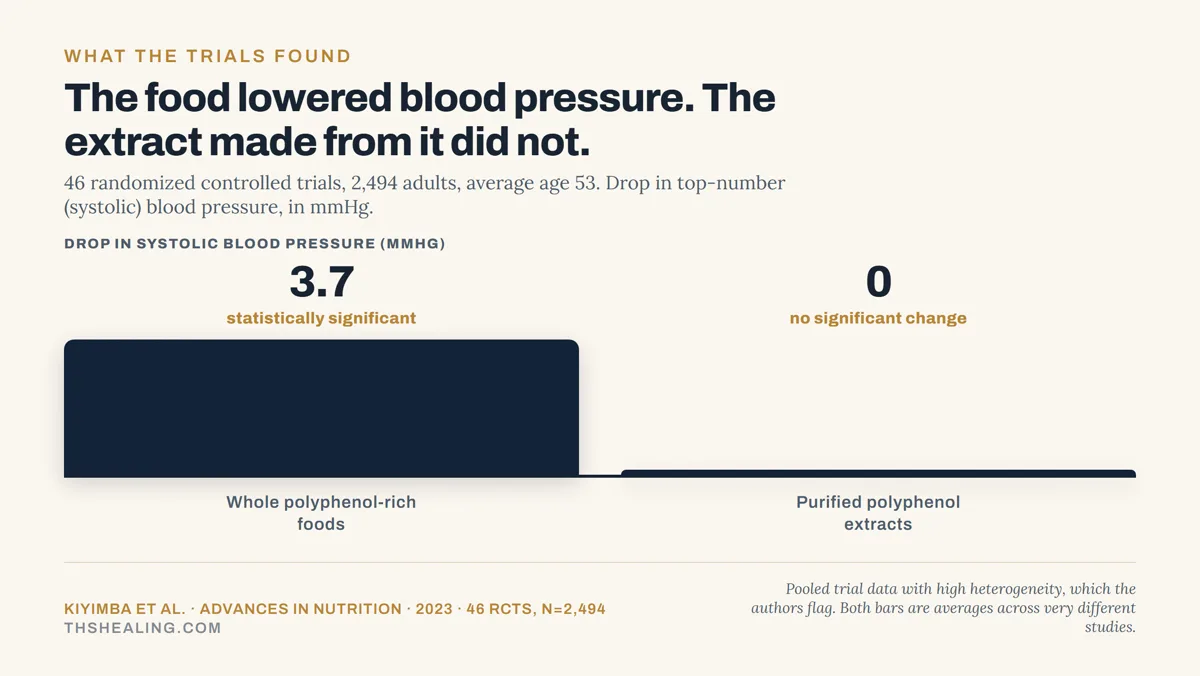
Read that again, because the supplement aisle is built on the opposite assumption. The active ingredient, isolated and concentrated and standardized, did less than the messy whole food it was extracted from.
It is not that extracts do nothing. In the same analysis they nudged waist circumference and triglycerides. But for the number most people are actually watching, the food won and the capsule did not show up.
Why would the whole food beat the concentrate?
Here is the plain version. A blueberry is not a delivery device for one compound. It is hundreds of compounds arriving together, wrapped in fiber, water and sugar, digested slowly, absorbed at a pace your gut was built to handle.
Scientists call that the food matrix. It is a fancy term for a simple idea: what the compound arrives with changes what it does. Pull one molecule out of that arrangement and you have not purified it. You have removed everything it was working with.
Fiber slows the whole delivery down so your gut bacteria get a turn at it. Fat in the same meal changes what crosses into your blood at all. Dozens of related compounds arrive together and appear to do more as a group than any of them does alone. None of that survives the extraction step, which is the one step the capsule is built around.
This is the part we find hard to get past. You can take creation apart, study the pieces, name them, bottle them, and still end up with less than what was on the plate.
Does the pattern hold past blood pressure?
It does, and the biggest test is worth knowing by name.
A systematic review pooled 57 controlled trials covering 36,983 adults on the Mediterranean pattern, which is mostly vegetables, fruit, legumes, whole grains, nuts and olive oil (Papadaki et al., Nutrients, 2020). Of 28 measures of metabolic health, 18 improved. Body weight, waist, blood pressure, fasting glucose, insulin resistance, cholesterol, triglycerides, liver fat, three separate inflammation markers, and how well the blood vessels themselves relaxed.
Cardiovascular disease was 39% lower in the diet groups. Stroke was 33% lower.
Those are big numbers, and they belong to a pattern, not a product. Nobody in those trials was taking anything. They were eating.
What is working against it?
The other half of the story is interference, and it has its own receipts.
Pooling 25 prospective cohort studies, researchers found that the people eating the most ultra-processed food had 37% higher risk of developing diabetes, 32% higher risk of high blood pressure, and 32% higher risk of obesity than the people eating the least (Vitale et al., Advances in Nutrition, 2023).
Now here is where we are going to be more careful than the headlines are, because the honest version is more useful to you.
A 2024 analysis followed 206,957 US adults across three long-running cohorts and then meta-analyzed 22 studies on top of that (Mendoza et al., Lancet Regional Health Americas, 2024). Total ultra-processed intake tracked with 17% higher cardiovascular risk. But when they broke the category apart, it stopped behaving like one thing. Sugar-sweetened and artificially sweetened drinks and processed meats carried the risk. Bread, cold cereals, yoghurt and dairy desserts went the other direction and were associated with slightly lower risk.
So “ultra-processed” is not a moral category. It is a shorthand that happens to contain both soda and sandwich bread. If you are going to change one thing, change what the data actually points at, which is the sweet drinks and the processed meat, not the loaf on the counter.
The authors also flagged that the measured risk shifted by more than 50% depending on how researchers defined ultra-processed in the first place. We would rather tell you that than hand you a clean number we cannot stand behind.
Where the design comes in
The first instruction about food in Scripture is not a restriction. It is an inventory.
“Then God said, ‘Behold, I have given you every plant yielding seed that is on the surface of all the earth, and every tree which has fruit yielding seed; it shall be food for you.’” Genesis 1:29, NASB
We are not going to tell you that verse proves the blood pressure finding. It does not, and pretending otherwise would cheapen both. The verse carries the conviction. The 46 trials carry the evidence. What is worth sitting with is that they keep pointing the same direction: the plant, whole, as it grew, is the thing.
That conviction is why this site teaches plant-forward whole foods and will keep doing it. Not because other people’s plates are our business, but because that is where twenty years of watching people get better has landed our founder, and because the published literature keeps landing there too.
What to do about it this week
One thing. Not a protocol, not a reset, not a list of forty superfoods.
Put something colorful and close to the ground on your plate every day. Fresh or frozen, both count, and frozen is often picked riper. Berries on oatmeal. A handful of greens under whatever you were already making. An apple you actually eat instead of the one going soft in the drawer.

Color is not decoration. The pigment in a purple carrot, a red cabbage, a blueberry skin, that is the polyphenol. When we say eat the rainbow we are not being cute. We are saying eat the compounds those 46 trials were testing, in the arrangement they came in.
Then, if you want the higher-leverage version: swap one sweet drink a day for water. That is the single item the cohort data points at hardest, and it costs you nothing.
You do not need a membership, a facility, or a perfect plan to start. Lunch is available today.
Read this next: The Five Pillars of Owning Your Health is the map this article sits inside, and food is pillar two. If you want to see how small the right change can be, researchers cut post-meal blood sugar spikes by 39% without changing a single meal.
This article is the opener for a series that takes one food at a time and asks what the research can actually carry. Next up: why researchers keep handing people a cup of berries, the kitchen mistake that wastes most of your turmeric, and the green tea habit that quietly changes the whole story.
Sources
- Kiyimba T, Yiga P, Bamuwamye M, Ogwok P, Van der Schueren B, Matthys C. “Efficacy of Dietary Polyphenols from Whole Foods and Purified Food Polyphenol Extracts in Optimizing Cardiometabolic Health: A Meta-Analysis of Randomized Controlled Trials.” Advances in Nutrition, 2023;14(2):270-282. https://pubmed.ncbi.nlm.nih.gov/36796437/
- Papadaki A, Nolen-Doerr E, Mantzoros CS. “The Effect of the Mediterranean Diet on Metabolic Health: A Systematic Review and Meta-Analysis of Controlled Trials in Adults.” Nutrients, 2020;12(11):3342. https://pubmed.ncbi.nlm.nih.gov/33143083/
- Vitale M, Costabile G, Testa R, et al. “Ultra-Processed Foods and Human Health: A Systematic Review and Meta-Analysis of Prospective Cohort Studies.” Advances in Nutrition, 2023;15(1):100121. https://pubmed.ncbi.nlm.nih.gov/38245358/
- Mendoza K, Smith-Warner SA, Rossato SL, et al. “Ultra-processed foods and cardiovascular disease: analysis of three large US prospective cohorts and a systematic review and meta-analysis of prospective cohort studies.” Lancet Regional Health Americas, 2024;37:100859. https://pubmed.ncbi.nlm.nih.gov/39286398/
- Bakaloudi DR, Chrysoula L, Kotzakioulafi E, Theodoridis X, Chourdakis M. “Impact of the Level of Adherence to Mediterranean Diet on the Parameters of Metabolic Syndrome: A Systematic Review and Meta-Analysis of Observational Studies.” Nutrients, 2021;13(5):1514. https://pubmed.ncbi.nlm.nih.gov/33946280/
Article metadata retrieved from PubMed.
Educational content from True Health Solutions. We do not diagnose or prescribe, and nothing here is a substitute for care from someone who knows your history. The body heals. We write about what supports that design.
Questions people ask
- Is whole food better than taking a supplement?
- For blood pressure, the trial evidence says yes. A 2023 meta-analysis of 46 randomized controlled trials found that whole polyphenol-rich foods lowered systolic blood pressure by about 3.7 mmHg, while purified extracts of the same compounds produced no significant change.
- What is a polyphenol?
- A family of compounds plants make, concentrated in colorful skins, leaves, seeds and spices. They are part of why a blueberry is blue and why green tea tastes the way it does.
- Are ultra-processed foods all equally bad?
- No, and the research is clear about it. In an analysis of three US cohorts totaling over 200,000 people, sugar-sweetened drinks and processed meats carried the higher cardiovascular risk, while bread, cold cereals and yoghurt were actually associated with lower risk.
- Does eating this way treat or cure disease?
- No. We do not claim any food treats, cures, heals or prevents any disease. The studies here measure markers and risk across groups of people. What they support is a way of eating, not a promise about your diagnosis.
