
education · food ·
Your Turmeric Isn't Absorbing. Black Pepper Raised It 2,000%
Curcumin taken on its own is almost undetectable in human blood. One kitchen pairing changed that by 2,000%, and most turmeric advice never mentions it.
In 1998 a research team in Bangalore gave healthy volunteers two full grams of curcumin, the compound that makes turmeric yellow and gets all the credit, then measured what showed up in their blood.
The answer was almost nothing. Serum levels were, in the paper’s own words, either undetectable or very low.
Two grams. Gone.
What changed it?
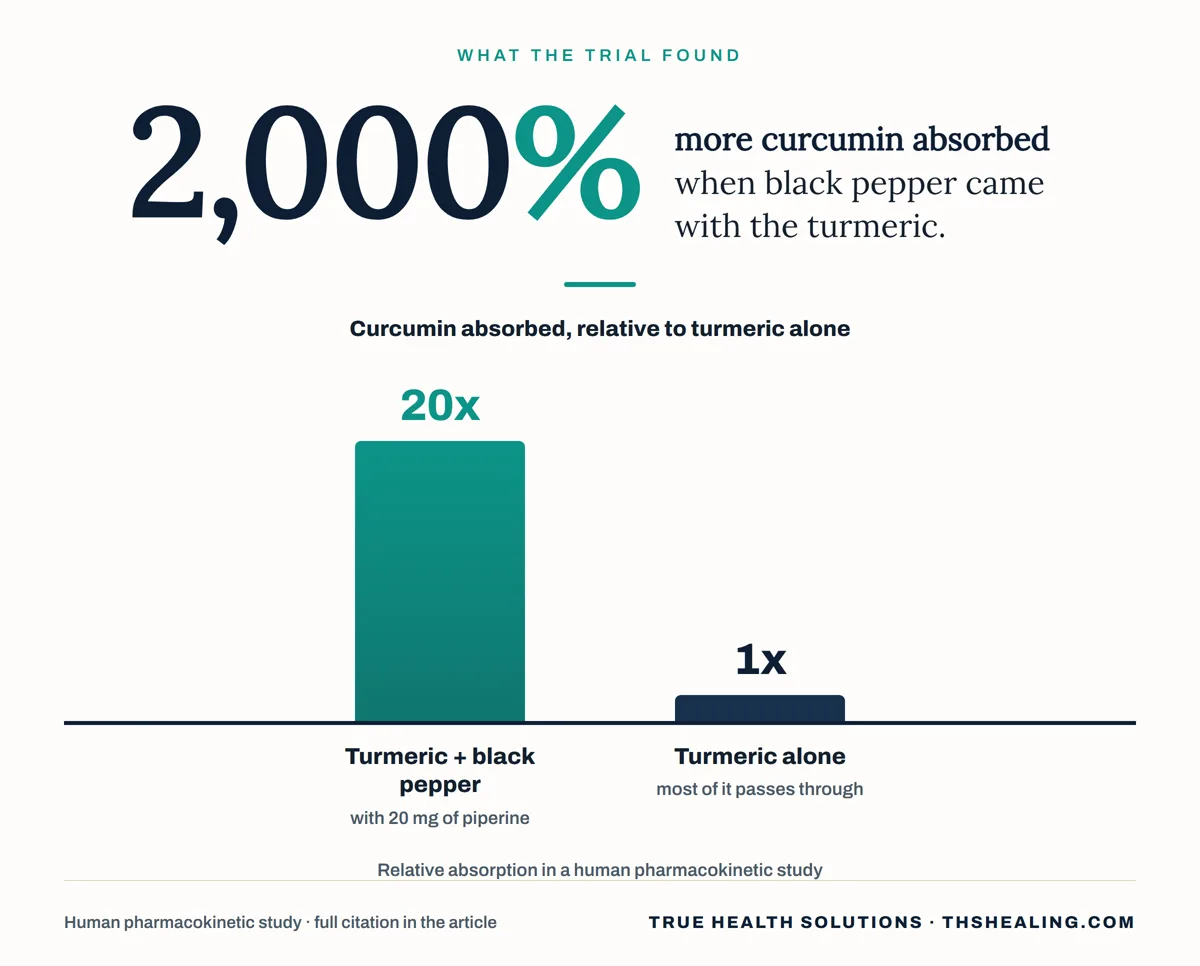
They ran the same test again and added 20 milligrams of piperine, the compound that makes black pepper hot.
Curcumin bioavailability went up by 2,000% (Shoba et al., Planta Medica, 1998).
Same spice. Same dose. One addition that costs nothing and sits in every kitchen in America. The difference between a supplement your body never sees and one it does.
Why would pepper do that?
Because the problem was never absorption in the way people assume. It was disposal.
Your liver and the wall of your intestine both run a chemical process called glucuronidation, which tags compounds for removal. It is a good system. It is how your body clears things it does not recognize. Curcumin gets tagged and escorted out almost immediately, which is why it can pass through you without ever reaching the bloodstream in a meaningful amount.
Piperine slows that tagging down. It does not add anything to the turmeric. It just buys the curcumin time to be absorbed before the cleanup crew arrives.
Now notice what that means. Traditional cooking across India and Southeast Asia has paired turmeric with black pepper, and cooked both in fat, for centuries. Nobody in those kitchens knew the word glucuronidation. The pairing was worked out by taste and by habit long before anybody could explain it.
That is the kitchen mistake, by the way. Not that people use too little turmeric. It is that they take it the one way it does not work: a scoop of powder in water, or a capsule on an empty stomach, stripped of the fat and the pepper it was always eaten with.
Is 2,000% too good to be true?
Fair question, and we would rather raise it ourselves than have you find it later.
That study is from 1998 and it is small. It was a pharmacokinetics study, which means it measured what showed up in blood, not whether anybody felt better or any disease marker moved. A 2,000% increase from a starting point of almost nothing is still a small absolute amount, and the paper says so plainly: serum levels with curcumin alone were undetectable or very low.
So the honest reading is not “black pepper makes turmeric powerful.” It is “without something like black pepper, curcumin barely gets in at all.” That is a floor, not a ceiling, and it is the same shape as the berry finding: get under the threshold and the food you believe in does nothing measurable.
It matters because it explains a pattern people keep running into. Somebody takes turmeric for three months, feels no different, and concludes the research is hype. Often what actually happened is that the compound never made it past the intestinal wall.
So what can turmeric actually do?
Here is where we are going to disappoint the supplement aisle, because the honest answer is narrower than the marketing and still worth knowing.
Researchers pooled 103 randomized controlled trials covering 7,216 participants and 42 separate health outcomes, then graded their own confidence in each result (Jafari et al., Phytotherapy Research, 2024). Twenty-three of the 42 outcomes showed a statistically significant effect. But significance is not the same as confidence, and they were careful to separate the two.
High confidence for exactly four things: fasting blood sugar, the inflammation marker CRP, HDL cholesterol, and body weight. Moderate confidence for eleven more, including waist, BMI, insulin resistance and a couple of antioxidant markers. Low or very low confidence for the remaining 28.
Read that bottom rung again, because it is where almost every claim you have seen about turmeric lives.
The authors are blunt about why. The trials in the pool have methodological limits, and they call for longer studies with more people before anybody gets confident. We are repeating that here rather than burying it, because a site that only quotes the top rung is a site you should stop trusting.
What we take from it
Turmeric is not a cure and we are not going to pretend it is one. What it looks like, on the evidence, is a genuinely useful everyday spice with a real but modest effect on a handful of markers, which is a much more ordinary claim than the internet makes and a much easier one to defend.
That is enough. Most of health is ordinary things done repeatedly. The spice cabinet is not where the miracle is. It is where a small, cheap, permanent improvement is, and those add up in a way that a thirty-day protocol never does.
“Then God said, ‘Behold, I have given you every plant yielding seed that is on the surface of all the earth, and every tree which has fruit yielding seed; it shall be food for you.’” Genesis 1:29, NASB
The conviction is ours and the verse carries it. The numbers above are what the trials carry. We keep those two jobs separate on purpose.
What to do this week
Cook with it instead of taking it.
Turmeric in the pot with lentils, chickpeas, rice, roasted vegetables or soup. Crack black pepper in with it. Let both cook in a little olive oil or another plant fat. That is the whole pairing, and it is how most of the world already eats turmeric.
Grate fresh ginger into the same dishes while you are there. It is the same family of root, and its evidence is in some ways cleaner than turmeric’s. An umbrella review of 24 systematic reviews found the strongest, highest-confidence effects for two things: relieving nausea in pregnancy, where the effect was large, and easing osteoarthritis pain, where it was small but consistently found (Crichton et al., American Journal of Clinical Nutrition, 2022). Doses of half a gram to three grams a day, for up to three months, came up again and again.
One honest warning before you go further than the kitchen. Piperine does not only raise curcumin absorption, it raises absorption of other things you might be taking, and curcumin has known interactions including with blood thinners. Food-scale turmeric and a high-dose capsule are two different questions. If you take medication, the second question belongs to whoever prescribes it, not to an article.
Read this next: this piece belongs to a series that opens with what most food as medicine advice never mentions, which is where the whole-food-versus-extract evidence lives. The dose lesson has a twin in the berry research, where half a cup did nothing and one cup did something. And the fundamentals underneath all of it are in The Five Pillars of Owning Your Health.
Sources
- Shoba G, Joy D, Joseph T, Majeed M, Rajendran R, Srinivas PS. “Influence of piperine on the pharmacokinetics of curcumin in animals and human volunteers.” Planta Medica, 1998;64(4):353-356. https://pubmed.ncbi.nlm.nih.gov/9619120/
- Jafari A, Abbastabar M, Alaghi A, Heshmati J, Crowe FL, Sepidarkish M. “Curcumin on Human Health: A Comprehensive Systematic Review and Meta-Analysis of 103 Randomized Controlled Trials.” Phytotherapy Research, 2024;38(12):6048-6061. https://pubmed.ncbi.nlm.nih.gov/39478418/
- Crichton M, Davidson AR, Innerarity C, et al. “Orally consumed ginger and human health: an umbrella review.” American Journal of Clinical Nutrition, 2022;115(6):1511-1527. https://pubmed.ncbi.nlm.nih.gov/35147170/
- Kiyimba T, Yiga P, Bamuwamye M, Ogwok P, Van der Schueren B, Matthys C. “Efficacy of Dietary Polyphenols from Whole Foods and Purified Food Polyphenol Extracts in Optimizing Cardiometabolic Health: A Meta-Analysis of Randomized Controlled Trials.” Advances in Nutrition, 2023;14(2):270-282. https://pubmed.ncbi.nlm.nih.gov/36796437/
Article metadata retrieved from PubMed.
Educational content from True Health Solutions. We do not diagnose or prescribe, and nothing here is a substitute for care from someone who knows your history. The body heals. We write about what supports that design.
Questions people ask
- Why does turmeric need black pepper?
- Curcumin, the active compound in turmeric, is broken down fast by the liver and intestinal wall. Piperine from black pepper slows that breakdown. In a human study, 20 mg of piperine raised curcumin bioavailability by 2,000%.
- How much black pepper do I need?
- The study used 20 mg of piperine, which is far more than a normal pinch. Culinary pepper is worth adding and is how most traditional cooking already uses turmeric, but no one should read a kitchen grind as matching a study dose.
- Does turmeric need fat too?
- Curcumin is fat soluble, so it is generally taken with food and fat. This is also how turmeric is used in most of the world's kitchens, cooked into a dish rather than stirred into water.
- Does turmeric treat inflammation or arthritis?
- We do not claim it treats, cures, heals or prevents any condition. A meta-analysis of 103 trials found curcumin moved some markers, with high confidence for only four of the forty-two outcomes measured.
- Are curcumin capsules safe with my medications?
- Ask the person who prescribes them. Piperine raises absorption of curcumin and of other drugs too, and curcumin has known interactions including with blood thinners. Food-scale turmeric and a high-dose supplement are different questions.
