
education · food · heart ·
Half A Cup Of Blueberries Did Nothing. 1 Cup Changed Artery Function
A six-month double-blind trial fed 115 adults blueberries at two doses. Only one of them moved the needle, and the gap between them is the whole lesson.
Most nutrition headlines skip the detail that matters most, which is how much.
A team in the United Kingdom did not skip it. They ran the longest blueberry trial on record, six months, double-blind, 115 adults with metabolic syndrome, average age 63. And instead of testing berries against nothing, they tested two amounts of berries against a matched placebo that looked and tasted the same.
One amount worked. The other might as well have been sawdust.
What did the trial actually measure?
Artery function, mostly. Specifically flow-mediated dilation, which sounds technical and is not.
Your arteries are not rigid pipes. The lining is a living layer that releases a signal telling the vessel to relax and widen when more blood needs to get through. Researchers cuff your arm, cut off flow for a few minutes, release it, and watch on ultrasound how much the artery opens in response. A vessel that opens well is healthy. A vessel that barely responds is the early, silent version of trouble, long before anything shows up on a symptom list.
That measurement is the one that moved.
What happened at each dose?
A daily cup of blueberries improved flow-mediated dilation by 1.45 percentage points, with a confidence interval of 0.83 to 2.1 (Curtis et al., American Journal of Clinical Nutrition, 2019). Arterial stiffness improved too. In participants not taking a statin, HDL cholesterol rose.
Half a cup a day did nothing measurable. Not a smaller effect. No effect on any marker they tracked.
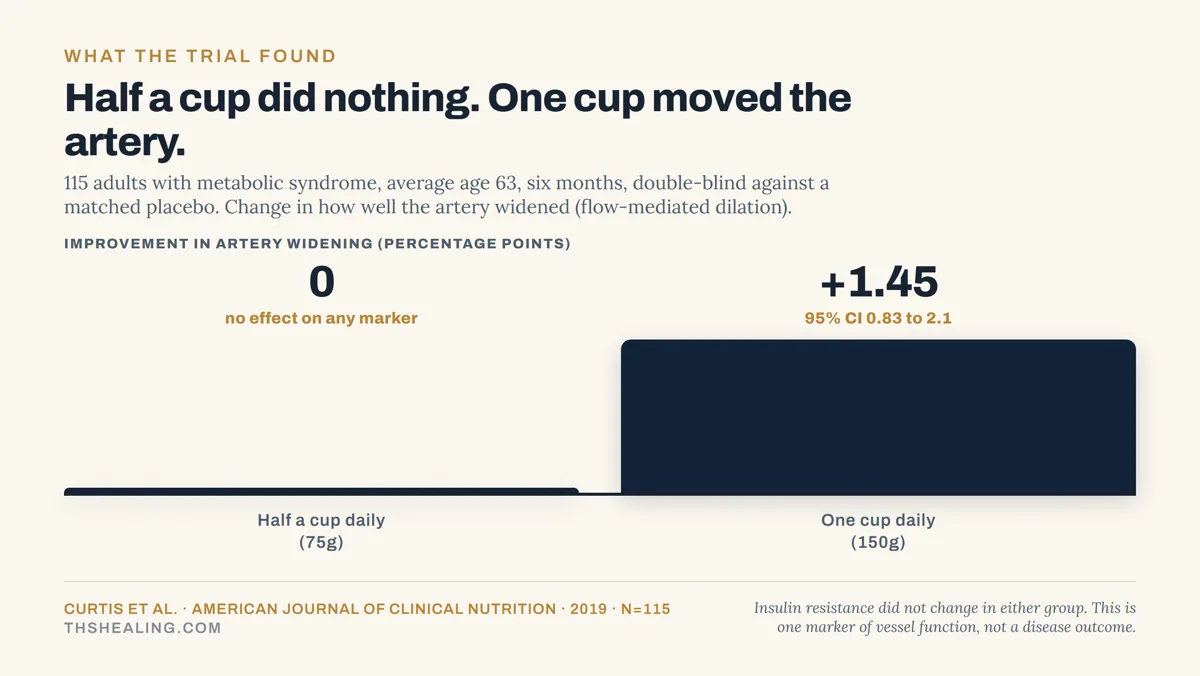
The authors note the effect size is in the range associated with a 12 to 15% lower cardiovascular risk. That is their framing of what the marker predicts, and it is worth holding loosely, because a marker moving is not the same as a life being longer.
Here is what we take from it. There is a floor. Below the floor, a food you believe in does nothing at all, and you conclude the food does not work when what actually happened is that you never reached the dose the study used. Berries on top of the yogurt once in a while is not the protocol. A cup a day was the protocol.
Is the effect on arteries a fluke?
It is the most consistent thing in this whole literature, which is why we lead with it.
A systematic review pulled together 49 randomized placebo-controlled trials of berry anthocyanins in humans, 22 of them measuring vascular function (Ahles et al., International Journal of Molecular Sciences, 2021). The authors described the evidence for beneficial effects on endothelial function as consistent. Blood pressure improved across studies. Memory improved in the cognitive trials.
And then the honest part. Effects on metabolic markers like blood sugar and blood lipids were, in their word, less consistent. Cognition beyond memory was thinner still.
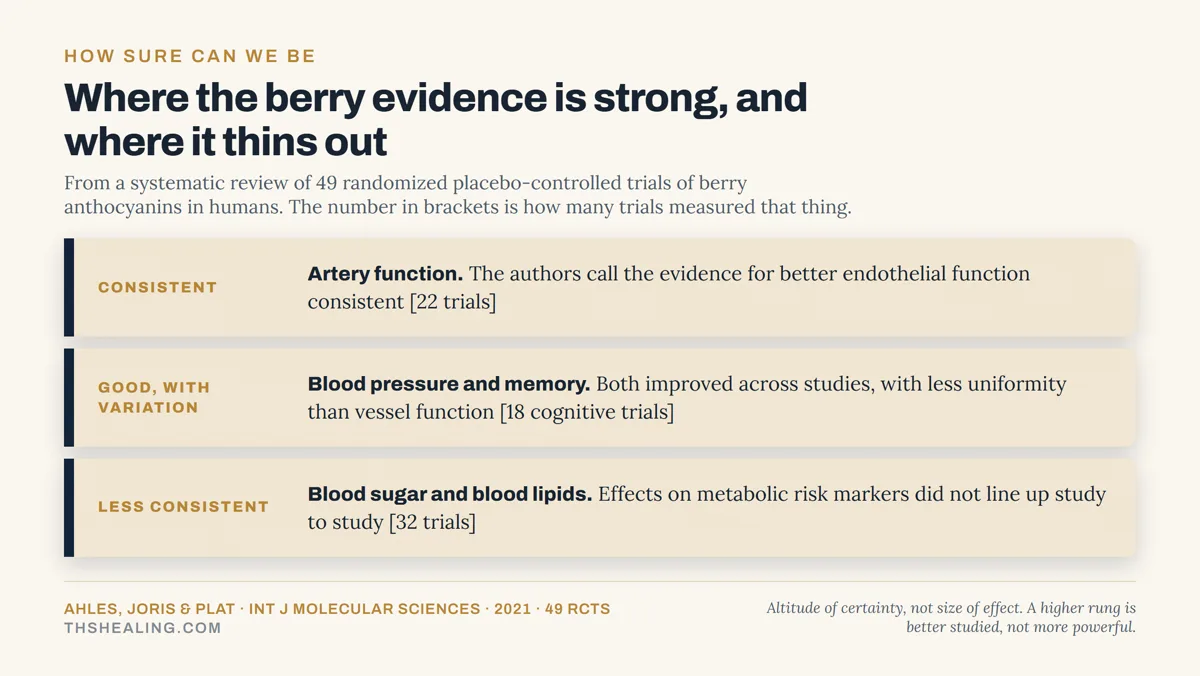
So the ladder looks like this. Artery function, solid. Blood pressure and memory, good. Everything else people claim about berries, thinner than the claim.
We put this in a graphic on purpose, because it is the shape of almost every food story you will ever read. There is a finding at the top that has been replicated until it is boring, a middle tier that is real but wobbly, and a bottom tier that is where the marketing lives. When somebody sells you a berry supplement for your memory, they are quoting the middle rung. When somebody sells it for your metabolism, they are quoting a rung the review says did not hold up.
Does cooking ruin them?
This one surprised us.
A crossover trial had ten volunteers eat blueberries two ways: baked into products, and unprocessed as a drink made from the same freeze-dried powder (Rodriguez-Mateos et al., Molecular Nutrition and Food Research, 2014). Baking cut the anthocyanins by 42%, which the purists would tell you ruins the whole thing.
Artery function improved to a similar degree either way.
The composition changed. Some compounds dropped, others rose, and the body seems to work with what arrives. We would not read that as license to bake berries into a pastry and call it medicine. We would read it as permission to stop treating berries as fragile. Put them in the oatmeal. Cook them down over the weekend. Buy the frozen bag because it is cheaper and it is what you will actually eat.
Where the design shows up
Nobody had to engineer the blue into a blueberry. The pigment is the compound. What makes the fruit look the way it does is the same thing the trials are measuring, which is a strange and good arrangement if you sit with it for a second.
“Then God said, ‘Behold, I have given you every plant yielding seed that is on the surface of all the earth, and every tree which has fruit yielding seed; it shall be food for you.’” Genesis 1:29, NASB
The verse is our conviction, not our evidence. The 115 people in Norwich are the evidence. We find it worth noticing that they keep agreeing.
What to do this week
One cup a day, and buy it frozen.
That is the whole action step. A cup is roughly a large handful and a half. Frozen berries are picked riper, cost less, do not rot in the drawer while you feel guilty about them, and are what most of these trials are effectively standardized to anyway.
Put the bag where you will see it. On oatmeal, in a smoothie with spinach, thawed into plain yogurt, or eaten straight out of the bag half frozen, which is better than it sounds.
One note on cost, because this is the part that decides whether anyone actually does it. A cup a day for a month is a meaningful grocery line for a working family. Frozen is usually a third to half the price of fresh, keeps for months, and wastes nothing. Buying the big bag is not settling for a lesser version. In trial terms it may be the closer match, since most of these studies used freeze-dried powder standardized to fresh weight rather than fruit off a shelf.
If you do it for a week and nothing dramatic happens, that is expected. The trial took six months to see a change in a vessel, and nobody in it felt the difference on a Tuesday.
Read this next: this article sits inside a series that starts with what most food as medicine advice never mentions, which is where the whole-food-beats-the-extract finding comes from. If berries are pillar two on your plate, The Five Pillars of Owning Your Health is where the other four live. Next in the food series: the kitchen mistake that wastes most of your turmeric.
Sources
- Curtis PJ, van der Velpen V, Berends L, et al. “Blueberries improve biomarkers of cardiometabolic function in participants with metabolic syndrome: results from a 6-month, double-blind, randomized controlled trial.” American Journal of Clinical Nutrition, 2019;109(6):1535-1545. https://pubmed.ncbi.nlm.nih.gov/31136659/
- Ahles S, Joris PJ, Plat J. “Effects of Berry Anthocyanins on Cognitive Performance, Vascular Function and Cardiometabolic Risk Markers: A Systematic Review of Randomized Placebo-Controlled Intervention Studies in Humans.” International Journal of Molecular Sciences, 2021;22(12):6482. https://pubmed.ncbi.nlm.nih.gov/34204250/
- Rodriguez-Mateos A, Del Pino-García R, George TW, Vidal-Diez A, Heiss C, Spencer JPE. “Impact of processing on the bioavailability and vascular effects of blueberry (poly)phenols.” Molecular Nutrition and Food Research, 2014;58(10):1952-1961. https://pubmed.ncbi.nlm.nih.gov/25044909/
- Kiyimba T, Yiga P, Bamuwamye M, Ogwok P, Van der Schueren B, Matthys C. “Efficacy of Dietary Polyphenols from Whole Foods and Purified Food Polyphenol Extracts in Optimizing Cardiometabolic Health: A Meta-Analysis of Randomized Controlled Trials.” Advances in Nutrition, 2023;14(2):270-282. https://pubmed.ncbi.nlm.nih.gov/36796437/
Article metadata retrieved from PubMed.
Educational content from True Health Solutions. We do not diagnose or prescribe, and nothing here is a substitute for care from someone who knows your history. The body heals. We write about what supports that design.
Questions people ask
- How many blueberries did the trial actually use?
- One cup a day, which is 150 grams, for six months. A half cup, 75 grams, was tested in the same trial and produced no significant effect on any marker measured.
- Do frozen blueberries work as well as fresh?
- The trials generally use freeze-dried blueberry powder standardized to a fresh-weight equivalent, so frozen fruit is a reasonable everyday stand-in. Frozen berries are also usually picked riper than fruit shipped fresh.
- Does cooking destroy the benefit?
- Not necessarily. A crossover trial baked blueberries into products and lost 42% of their anthocyanins, yet the improvement in artery function was similar to eating them unprocessed.
- Do blueberries lower blood sugar or reverse diabetes?
- No. In the six-month trial, insulin resistance did not change at either dose. We do not claim any food treats, cures, heals or prevents any disease.
- Are berry supplements as good as the fruit?
- The broader trial evidence says no. A meta-analysis of 46 trials found whole polyphenol-rich foods lowered blood pressure while purified extracts of the same compounds did not.
