
education · food ·
Green Tea Is Safe To Drink. The Capsules Are A Different Story
The same compound, from the same plant, got two different verdicts from the same panel. What separated them was not the dose alone. It was the form.
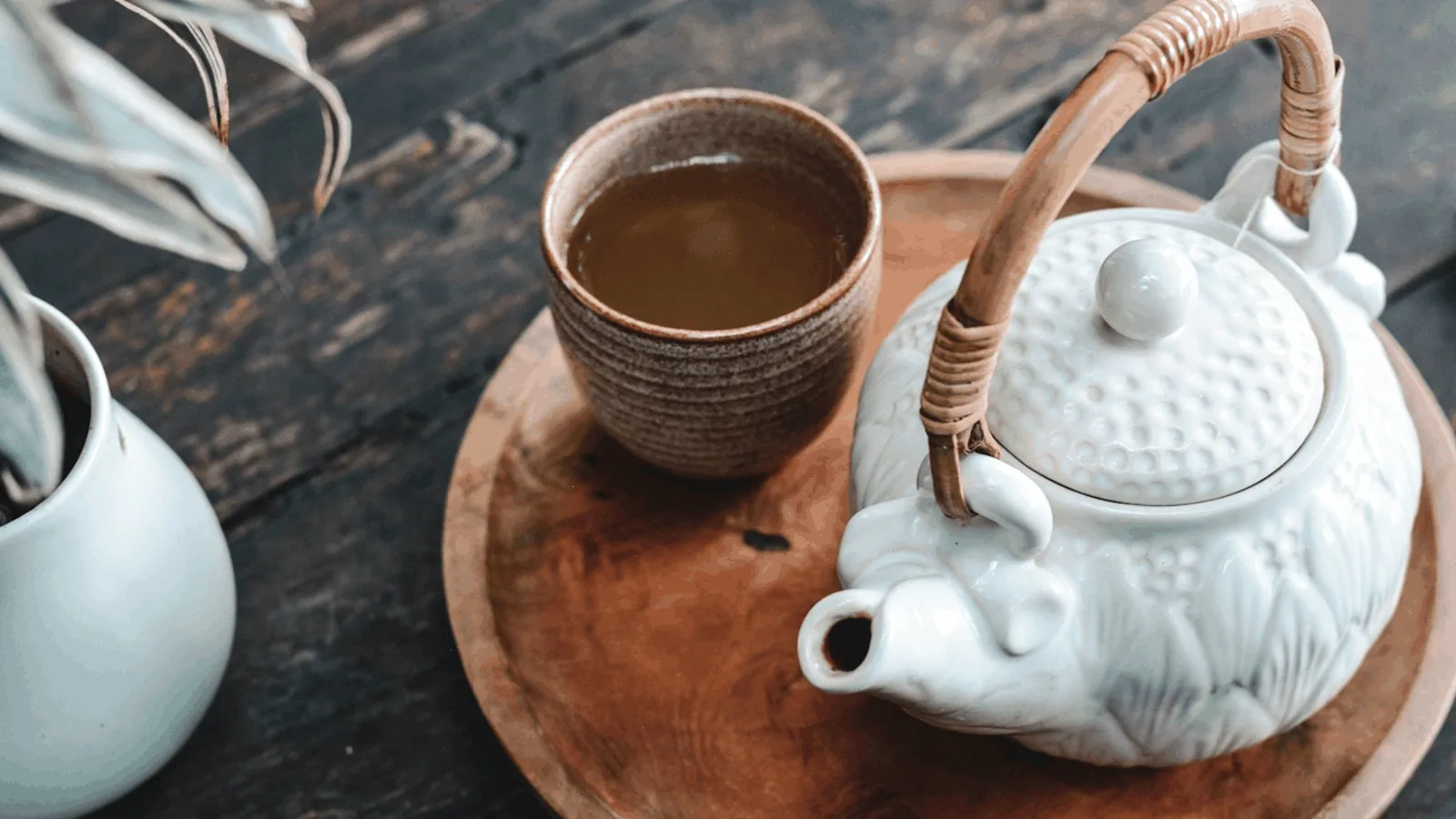
Here is a thing that almost never happens in nutrition.
A regulatory panel took one compound, looked at every way people actually get it, and came back with two different answers depending on how it arrived. Not two answers for two different compounds. The same molecule, from the same plant, cleared in one form and flagged in another.
The compound is EGCG. The plant is green tea.
What did the panel actually do?
Europe’s food safety authority convened a panel to review green tea catechins from every dietary source: brewed tea, reconstituted drinks, and supplements (EFSA ANS Panel, EFSA Journal, 2018). They worked through published trials, national monographs and submitted data, focused on one question above all: does this stuff hurt the liver?
They started by measuring what people actually consume. Across European countries, a green tea drinker takes in somewhere between 90 and 300 mg of EGCG a day. Heavy drinkers were estimated up to 866 mg a day. Supplements, meanwhile, deliver anywhere from 5 mg to 1,000 mg in a single daily dose depending on the product.
Then they gave their verdicts.
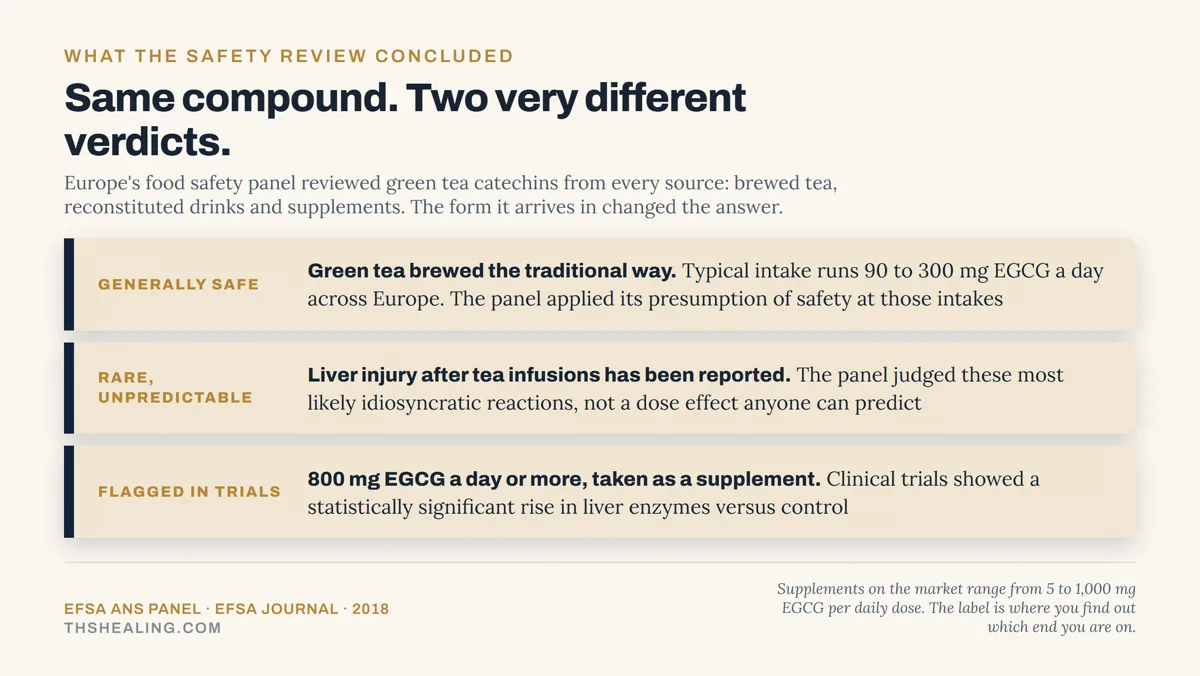
Catechins from green tea infusion prepared the traditional way are, in their language, generally considered to be safe.
And from clinical trials, doses of 800 mg of EGCG a day or more taken as a food supplement produced a statistically significant increase in serum transaminases, which are the enzymes a doctor checks when they want to know whether your liver is under strain.
Wait. Heavy tea drinkers hit 866 mg. Why is that fine?
Good catch, and it is the most interesting part of the whole document.
The panel’s concern is attached to the supplement form, not to the raw milligram count. That distinction is worth sitting with, because it runs against how most people think about dose.
A person drinking green tea through the day is taking small amounts, repeatedly, diluted in a lot of water, alongside food, over twelve or fourteen hours. A person taking a concentrated extract is delivering the same or more in one hit, on an empty stomach, in minutes. Your liver meets a very different situation in each case, even when the total on paper is the same.
This is the same lesson as the turmeric one, running in the opposite direction. There, the food matrix was what made the compound work. Here, the food matrix is what makes it safe. Take the compound out of its arrangement and you change both.
We want to be careful not to overclaim in tea’s favor either. The panel also noted rare cases of liver injury after green tea infusions, which they judged most likely to be idiosyncratic reactions. Idiosyncratic means unpredictable and not dose-dependent, which is an honest way of saying nobody can tell you in advance whether you are the rare person. That is rare enough that it does not change our advice, and it is real enough that we are not going to leave it out.
What does this change about how you drink it?
Almost nothing, and that is the point.
Brew the tea. Drink it through the day. That is the form with the multi-century track record and the regulatory green light, and it is the cheapest version too.
What it changes is what you do at the supplement shelf. If you pick up a green tea extract, the number that matters is EGCG per daily dose, and it is on the label precisely because this review made it matter. A product delivering 1,000 mg in a capsule is not a stronger version of your morning cup. It is a different exposure in a different form, at the dose where trials found liver enzymes moving.
So is green tea good for anything, or just not bad for you?
Fair, since we have spent this whole article on safety.
The most interesting active question is fatty liver, which is a strange place for the story to land given everything above. A systematic review gathered the work on green tea catechins and non-alcoholic fatty liver disease across rodent models and human subjects (Abunofal and Mohan, Medicines, 2022). Supplementation reduced body weight, fat tissue and food intake, and appeared to act on the genes involved in building and clearing fat.
Then the authors say the quiet part out loud: more research is needed to settle dose, duration and delivery method, and large randomized clinical trials are still required before anybody draws a firm conclusion. Much of the mechanistic work is in rodents, not people.
So the honest summary is a promising direction, not a finding you should act on. We are telling you it exists because you will see it quoted somewhere with far more confidence than the authors used.
Where the design shows up
There is an arrangement here worth noticing. The leaf grows with the compound already diluted, already paired with water, already suited to being sipped rather than swallowed whole. Nobody had to design a safe delivery system for green tea. It came as one.
“Then God said, ‘Behold, I have given you every plant yielding seed that is on the surface of all the earth, and every tree which has fruit yielding seed; it shall be food for you.’” Genesis 1:29, NASB
The verse is our conviction. The panel’s review is the evidence. We keep saying that because the moment a site starts using Scripture as a data point, you should stop believing its data.
What to do this week
Brew it. Do not bolus it.
Two or three cups of actual green tea across the day, hot or iced, loose leaf or bags, whatever you will keep doing. Steep it for two or three minutes rather than thirty seconds, because the catechins need time to come out of the leaf.
If you are already taking a green tea extract, go look at the label right now and find the EGCG number. If it is at or above 800 mg a day, that is the conversation to have with whoever manages your medications, and it is worth having this week rather than next year.
And if you take anything that is processed by the liver, or you have any history of liver trouble, the supplement question is not one an article should answer for you.
Read this next: this piece opens our green tea cluster. Next, the messier question of why oral cancer studies keep circling back to green tea, and the lab-bench story in what breast cancer researchers keep testing in a dish. The whole food series starts at what most food as medicine advice never mentions, and the same form-changes-everything lesson shows up in the kitchen mistake that wastes most of your turmeric.
Sources
- EFSA Panel on Food Additives and Nutrient Sources added to Food (ANS). “Scientific opinion on the safety of green tea catechins.” EFSA Journal, 2018;16(4):e05239. https://pubmed.ncbi.nlm.nih.gov/32625874/
- Abunofal O, Mohan C. “Salubrious Effects of Green Tea Catechins on Fatty Liver Disease: A Systematic Review.” Medicines (Basel), 2022;9(3):20. https://pubmed.ncbi.nlm.nih.gov/35323719/
- Shoba G, Joy D, Joseph T, Majeed M, Rajendran R, Srinivas PS. “Influence of piperine on the pharmacokinetics of curcumin in animals and human volunteers.” Planta Medica, 1998;64(4):353-356. https://pubmed.ncbi.nlm.nih.gov/9619120/
- Kiyimba T, Yiga P, Bamuwamye M, Ogwok P, Van der Schueren B, Matthys C. “Efficacy of Dietary Polyphenols from Whole Foods and Purified Food Polyphenol Extracts in Optimizing Cardiometabolic Health: A Meta-Analysis of Randomized Controlled Trials.” Advances in Nutrition, 2023;14(2):270-282. https://pubmed.ncbi.nlm.nih.gov/36796437/
Article metadata retrieved from PubMed.
Educational content from True Health Solutions. We do not diagnose or prescribe, and nothing here is a substitute for care from someone who knows your history. The body heals. We write about what supports that design.
Questions people ask
- Is green tea safe to drink every day?
- Europe's food safety panel concluded that catechins from green tea infusion prepared in the traditional way are generally considered safe at the intakes reported across European countries, which run about 90 to 300 mg of EGCG a day.
- How much EGCG is in a cup of green tea?
- It varies with leaf, water temperature and steeping time, but typical daily intake for a European green tea drinker falls between 90 and 300 mg of EGCG. Heavy drinkers were estimated as high as 866 mg a day.
- At what dose did green tea extract become a concern?
- The panel found evidence from clinical trials that 800 mg of EGCG a day or more, taken as a food supplement, produced a statistically significant rise in liver enzymes compared with control groups.
- Can brewed green tea hurt your liver?
- Rare cases of liver injury have been reported after drinking green tea infusions. The panel judged these most likely to be idiosyncratic reactions, meaning unpredictable and not tied to a particular dose.
- Should I take a green tea extract supplement?
- We do not recommend supplements here and we are not qualified to manage your medications. If you are considering one, the EGCG content per daily dose is the number to look for, and that conversation belongs with whoever prescribes for you.
