
education · food ·
What Green Tea Does To Cancer Cells In A Lab, & Why That's Not A Health Claim
Researchers measured cancer cells getting physically harder to move after EGCG exposure. Here is what that means, and why it is not a promise about anyone.
A cancer cell’s most dangerous ability is not growing fast. It is moving.
A tumor that stays put is a local problem with a local solution. A tumor whose cells detach, travel and settle somewhere else is a different disease entirely. That migration is what makes cancer lethal, and it depends on cells being soft and deformable enough to squeeze where they are not supposed to go.
So a Japanese research group did something clever. They measured how stiff cancer cells were, before and after exposing them to the main compound in green tea.
What did they actually measure?
Young’s modulus, which is an engineering term for how much a material resists being deformed. Steel has a high one. A marshmallow has a low one. Cancer cells, notoriously, have a low one, which is part of how they get around.
After EGCG exposure, the average stiffness of human lung cancer cell lines went up, and the cells’ motility went down (Fujiki et al., Molecules and Cells, 2018).
The compound did not poison the cells. It appeared to make them physically harder to move.
The same review covers four decades of this group’s work: EGCG inhibiting melanoma cells from spreading to the lungs of mice, EGCG working synergistically with existing anticancer drugs against human cell lines, and EGCG reducing the self-renewal of cancer stem cells, which are the small population thought to drive recurrence.
Read as a body of laboratory work, it is genuinely impressive.
Now here is the part that matters
Every sentence above happened in a dish or in a mouse.
We are going to be blunt, because this is the exact point where health content usually stops being honest. A cell in a dish sits in a bath of EGCG at a concentration the researchers chose, for as long as they choose. Nothing has to be absorbed. Nothing gets tagged by your liver and thrown out. Nothing has to find its way through your bloodstream to a specific tissue at a useful dose.
When you drink tea, all of those things have to happen, and most of the compound does not survive the trip.
That is why the phrase in the lab is not a hedge we add to be careful. It is a description of a completely different situation from the one you are in when you pour a cup.
How big is the gap, really?
Big enough that it has a name in the field. Researchers call it the translation problem, and green tea is one of its clearest examples.
Think about what a dish experiment can do that your morning cup cannot. It can hold a compound against a cell at a steady concentration for seventy-two hours straight. It can skip your stomach acid entirely. It can skip your intestinal wall, your liver, and the disposal system we wrote about in the turmeric article, which exists specifically to remove compounds like this one. It can deliver a dose to the cell that no human being could drink their way to without landing in the range the safety panel flagged.
None of that makes the lab work useless. It is how you find out whether a compound does anything at all, and where to look next. It is the first question, not the last one.
The mistake is treating the first question as though it were the last one. A headline that says green tea stops cancer cells is technically describing something real and is functionally a lie, because the reader hears a sentence about themselves and the study was a sentence about a dish.
So what does the human evidence say about breast cancer?
This is where we have to disappoint anybody who came here hoping.
A review of the epidemiological evidence across cancer sites sorted the meta-analyses by what they actually found (Abe and Inoue, European Journal of Clinical Nutrition, 2020).
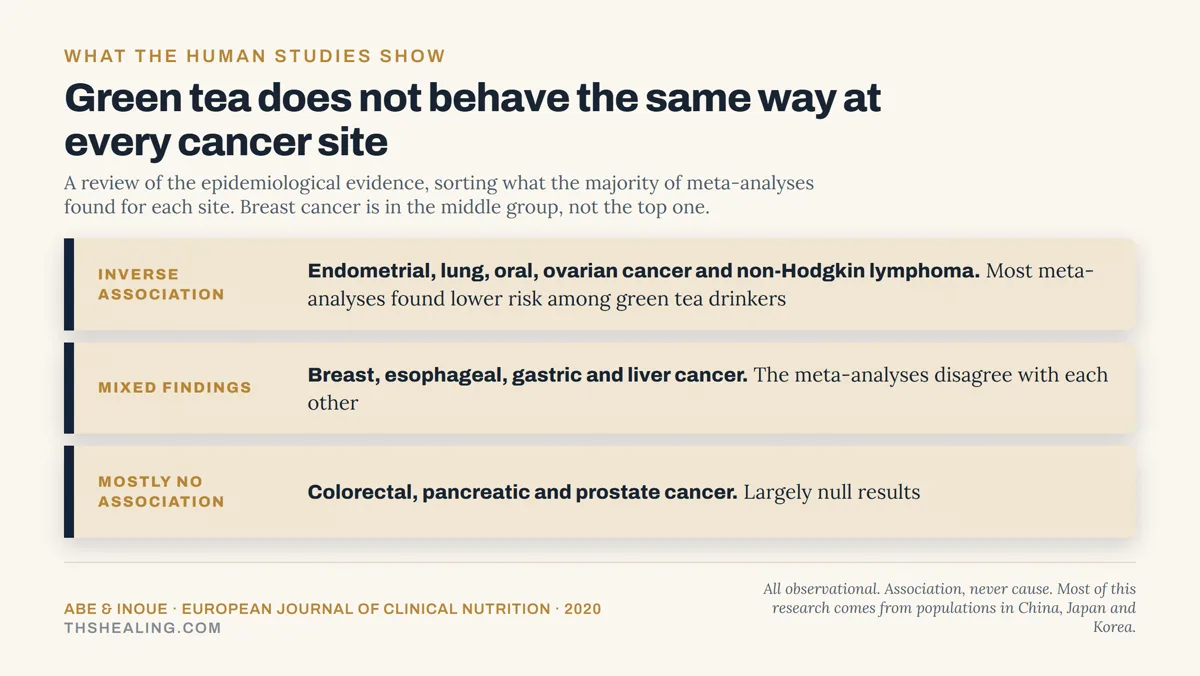
For endometrial, lung, oral and ovarian cancer and non-Hodgkin lymphoma, the majority of meta-analyses observed an inverse association with green tea.
Breast cancer is not in that group. It sits in the mixed-findings group, alongside esophageal, gastric and liver cancer, which means the meta-analyses disagree with each other.
And Cochrane, reviewing 142 studies across more than a million people, concluded that the evidence for green tea reducing cancer risk overall is limited and inconsistent (Filippini et al., Cochrane Database of Systematic Reviews, 2020).
There is one bright spot worth naming honestly. A double-blind randomized phase II trial found green tea extract reduced recurrence of colorectal adenomas, which are pre-cancerous growths, not cancer. That is a real randomized human finding. It is also about the colon, not the breast, and one phase II trial is a starting point rather than a conclusion.
Why we wrote this one at all
Because the lab findings are real and interesting, and because you deserve to meet them from somebody who will tell you what they are not.
Somewhere on the internet right now, that cell-stiffness result is being sold to a woman with a new diagnosis as a reason to buy a bottle. She will not be told that the cells were lung cancer lines in a dish, that the human breast evidence is explicitly mixed, or that the highest-quality review calls the whole picture inconsistent.
We would rather be the site that tells her, and loses the sale we were never making.
If you or someone you love is facing a breast cancer diagnosis, the things with the strongest evidence behind them are screening, treatment, and the care team who knows your case. A cup of tea is not in competition with any of that, and anyone who suggests otherwise is selling something.
What to do this week
Drink the tea for ordinary reasons.
It is pleasant, inexpensive, and Europe’s food safety panel reviewed the brewed form and considers it generally safe at normal intakes. That is a fine reason to make it a habit, and it is the only reason we will give you.
Do not take a green tea extract on the strength of laboratory results. Do not delay a screening or a scan because you added something to your routine. And if you are in treatment, tell your oncology team about anything you are taking, because catechins interact with more than people assume.
Read this next: the practical safety picture is in Europe’s safety panel cleared green tea, then it looked at the capsules, which is the one to read if you take a supplement. The observational side of the cancer question, and how to read any food-and-cancer headline, is in one cup of tea a day tracked one way and more than one tracked the other. The wider food series opens at what most food as medicine advice never mentions.
Sources
- Fujiki H, Watanabe T, Sueoka E, Rawangkan A, Suganuma M. “Cancer Prevention with Green Tea and Its Principal Constituent, EGCG: from Early Investigations to Current Focus on Human Cancer Stem Cells.” Molecules and Cells, 2018;41(2):73-82. https://pubmed.ncbi.nlm.nih.gov/29429153/
- Abe SK, Inoue M. “Green tea and cancer and cardiometabolic diseases: a review of the current epidemiological evidence.” European Journal of Clinical Nutrition, 2020;75(6):865-876. https://pubmed.ncbi.nlm.nih.gov/32820240/
- Filippini T, Malavolti M, Borrelli F, Izzo AA, Fairweather-Tait SJ, Horneber M, Vinceti M. “Green tea (Camellia sinensis) for the prevention of cancer.” Cochrane Database of Systematic Reviews, 2020;3(3):CD005004. https://pubmed.ncbi.nlm.nih.gov/32118296/
- EFSA Panel on Food Additives and Nutrient Sources added to Food (ANS). “Scientific opinion on the safety of green tea catechins.” EFSA Journal, 2018;16(4):e05239. https://pubmed.ncbi.nlm.nih.gov/32625874/
Article metadata retrieved from PubMed.
Educational content from True Health Solutions. We do not diagnose or prescribe, and nothing here is a substitute for care from someone who knows your history. The body heals. We write about what supports that design.
Questions people ask
- Does green tea kill cancer cells?
- In laboratory dishes, EGCG has been shown to slow the movement of human cancer cell lines and make them physically stiffer. Cells in a dish are not a person, and we do not claim green tea treats, cures, heals or prevents any cancer.
- What does the human evidence say about green tea and breast cancer?
- A review of the epidemiological evidence places breast cancer in the mixed-findings group, meaning the meta-analyses disagree with each other. It is not in the group where most analyses found lower risk.
- Why do lab results so often not carry over to people?
- A dish delivers a precise concentration directly to cells for as long as researchers choose. A person has to absorb the compound, survive the liver's clearing of it, and get a useful amount to the right tissue. Most of it never arrives.
- Is there any human trial evidence for green tea and cancer?
- Some. A double-blind randomized phase II trial found reduced recurrence of colorectal adenomas, which are pre-cancerous growths, not cancer. The Cochrane review of 142 studies concluded the overall evidence remains limited and inconsistent.
- Should I drink green tea for cancer protection?
- We would not tell you to. Drink it because it is a pleasant, inexpensive, safety-reviewed daily habit. Do not substitute it for screening, for treatment, or for the risk factors that are actually established.
