
education · food ·
Tea & Throat Cancer: What The Research Actually Says (It Points 3 Ways)
A pooled analysis of 9,548 head and neck cancer cases found tea linked to lower odds at one site and higher odds at another. Most articles quote half of it.

If you search green tea and oral cancer, you will find a long line of confident articles. We went and read what they are drawing from, and the honest summary is not confident at all.
It is more interesting than that. The research points in different directions depending on which part of the throat you are asking about and how much tea is in the question.
What did the biggest pooled analysis find?
An international consortium pooled 14 case-control studies covering 9,548 head and neck cancer cases and 15,783 controls, and adjusted for the obvious confounders (Nguyen et al., Cancer, 2024).
Three findings came out, and they do not agree with each other.
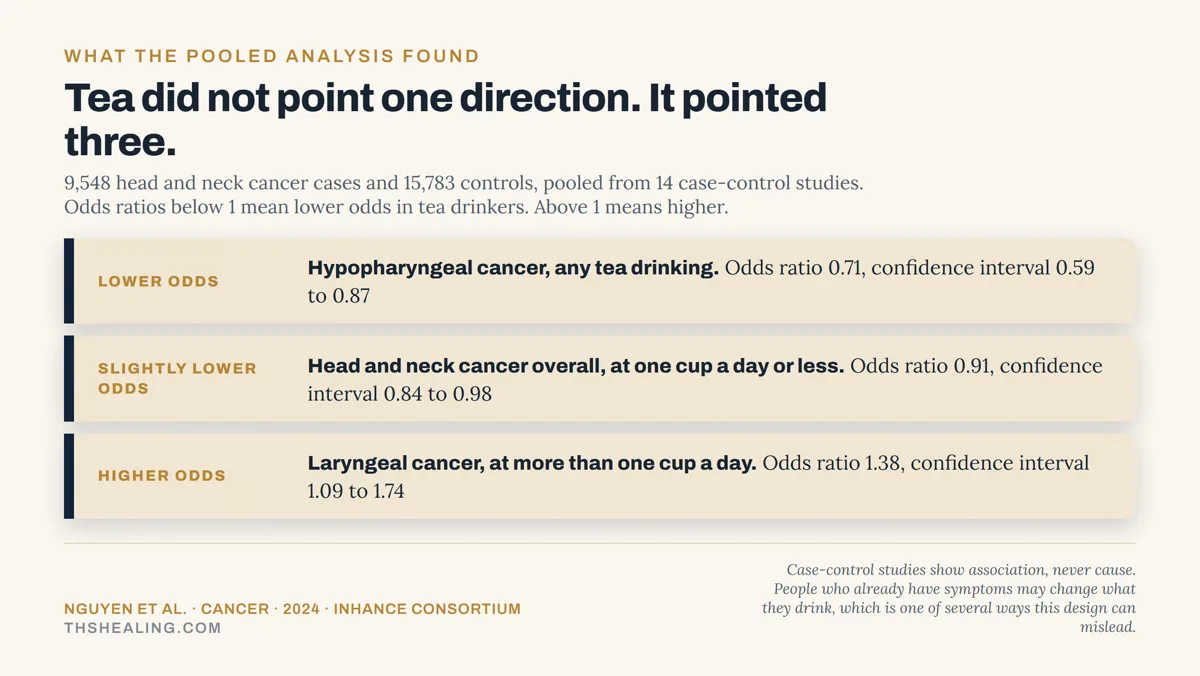
Tea drinking was associated with lower odds of hypopharyngeal cancer, odds ratio 0.71. At a cup a day or less, lower odds of head and neck cancer overall, odds ratio 0.91.
And above one cup a day, higher odds of laryngeal cancer, odds ratio 1.38, with a confidence interval that does not cross 1.
The larynx sits directly above the hypopharynx. Two structures inches apart, same cup of tea, opposite directions.
Does that mean tea causes laryngeal cancer?
No, and this is the part worth learning even if you never drink tea again.
These are case-control studies. Researchers find people who already have the cancer, find similar people who do not, and ask both groups what they used to consume. That design is fast and cheap and it is vulnerable in ways a forward-looking study is not.
People with a developing throat problem may have changed what they drink long before diagnosis. People remember habits imperfectly, and they remember them differently after a diagnosis. Hot beverage temperature, which nobody in these datasets measured well, is itself a known risk factor for oesophageal cancer.
Any one of those could produce a number like 1.38 without tea doing anything at all. That is not us waving away an inconvenient result. It is the same skepticism we would apply if the number had gone the friendly direction, which is exactly the test of whether skepticism is real.
What about the studies that look better for tea?
There are plenty, and they are worth seeing.
A dose-response meta-analysis of 14 case-control studies found tea drinkers had odds of oral cancer of 0.700, and calculated that each additional cup per day tracked with 6.2% lower odds (Zhou et al., Medicine, 2018). That is a clean-looking result, and it is the one most articles quote.
Same design limits apply. Same caution.

So what does the highest-quality review say?
This is the one that should settle the tone of every article on this subject, and almost none of them mention it.
Cochrane, which sets the standard for this kind of synthesis, updated its review of green tea for cancer prevention in 2020. They included 142 studies: 11 randomized trials covering 1,795 participants, and 131 observational studies covering more than 1,100,000 people (Filippini et al., Cochrane Database of Systematic Reviews, 2020).
Overall cancer incidence, highest tea intake versus lowest: risk ratio 0.83, confidence interval 0.65 to 1.07. That interval crosses 1, which means the result is compatible with no effect.
Cancer mortality: risk ratio 0.99. Effectively nothing.
Their own summary is that the findings were inconsistent and provide limited evidence for a beneficial effect of green tea on overall cancer risk or on specific sites.
Then they name the pattern we have been circling. For several cancer sites, including oesophageal, prostate, urinary tract and leukaemia, cohort studies showed increased risk while case-control studies showed decreased risk or no difference. The answer changed with the study design.
They also noted that most of the research comes from Asian populations who drink green tea very differently from Americans, which limits how far any of it travels.
How to read any food-and-cancer headline
You will meet this same shape again, so here is the short version we use.
Ask what kind of study it was. A randomized trial assigns people to the thing. A cohort study follows people forward from before anyone is sick. A case-control study starts with sick people and looks backward. Confidence should drop in that order, and headlines almost never tell you which one they are quoting.
Ask whether the confidence interval crosses 1. Cochrane’s overall cancer number was 0.83, which sounds like 17% lower risk until you see the interval running from 0.65 to 1.07. An interval that crosses 1 means no effect is still on the table.
Ask who was studied. Most of this literature is Asian populations drinking tea in amounts and styles that do not match a mug of bagged green tea in Kansas.
Ask what the same paper found that nobody quoted. That is usually where the honest answer lives, and it is the reason we spend as long as we do reading the papers instead of the articles about the papers.
Why we published this anyway
Because the honest version of a health question is worth more than a confident one, and because you are going to run into the confident version everywhere else.
If somebody tells you green tea prevents oral cancer, they are quoting case-control data while ignoring a Cochrane review that says the evidence is inconsistent. If somebody tells you tea causes throat cancer, they are doing the same thing with a different row of the same table.
Neither one is lying about the number. Both are hiding the rest of the table.
What to do this week
Nothing, on the cancer question. Drink tea because you like it, and because the safety review cleared the brewed form, not because an article promised you protection from a disease.
What we would actually act on, if this topic is on your mind, is the part of the risk picture that is not in dispute. Tobacco and heavy alcohol are the dominant, repeatedly confirmed risk factors for head and neck cancer, by margins that make a tea-shaped odds ratio look like rounding error. Any hour spent optimizing a beverage is better spent on those two.
And if you have a sore that will not heal, a lump, a persistent hoarseness, or trouble swallowing that lasts more than a couple of weeks, that belongs to a dentist or a doctor this week, not to a search engine.
Read this next: the safety side of this cluster is in Europe’s safety panel cleared green tea, then it looked at the capsules, which is the practical one. The lab-bench version of the cancer question is what breast cancer researchers keep testing in a dish. And the series this all belongs to starts at what most food as medicine advice never mentions.
Sources
- Filippini T, Malavolti M, Borrelli F, Izzo AA, Fairweather-Tait SJ, Horneber M, Vinceti M. “Green tea (Camellia sinensis) for the prevention of cancer.” Cochrane Database of Systematic Reviews, 2020;3(3):CD005004. https://pubmed.ncbi.nlm.nih.gov/32118296/
- Nguyen T, Koric A, Chang CE, et al. “Coffee and tea consumption and the risk of head and neck cancer: An updated pooled analysis in the International Head and Neck Cancer Epidemiology Consortium.” Cancer, 2024;131(2):e35620. https://pubmed.ncbi.nlm.nih.gov/39711146/
- Zhou H, Wu W, Wang F, Qi H, Cheng Z. “Tea consumption is associated with decreased risk of oral cancer: A comprehensive and dose-response meta-analysis based on 14 case-control studies.” Medicine (Baltimore), 2018;97(51):e13611. https://pubmed.ncbi.nlm.nih.gov/30572470/
- EFSA Panel on Food Additives and Nutrient Sources added to Food (ANS). “Scientific opinion on the safety of green tea catechins.” EFSA Journal, 2018;16(4):e05239. https://pubmed.ncbi.nlm.nih.gov/32625874/
Article metadata retrieved from PubMed.
Educational content from True Health Solutions. We do not diagnose or prescribe, and nothing here is a substitute for care from someone who knows your history. The body heals. We write about what supports that design.
Questions people ask
- Does green tea prevent oral cancer?
- No study here shows that, and we do not claim it. The Cochrane review of 142 studies concluded the evidence for green tea reducing overall cancer risk is limited and inconsistent. What exists are associations in observational research, which cannot establish cause.
- What did the head and neck cancer analysis find?
- Pooling 9,548 cases and 15,783 controls, tea drinking was associated with lower odds of hypopharyngeal cancer, odds ratio 0.71. Drinking one cup a day or less was associated with slightly lower odds of head and neck cancer overall. Drinking more than one cup a day was associated with higher odds of laryngeal cancer, odds ratio 1.38.
- Why do the studies disagree with each other?
- Study design. Cochrane found that for several cancer sites, cohort studies showed increased risk while case-control studies showed decreased risk or none. When the design changes the answer, the honest conclusion is that nobody knows yet.
- Should I stop drinking tea because of the larynx finding?
- We would not read one association from case-control data that way. It is a reason to be skeptical of confident claims in either direction, not a reason to change a habit with centuries behind it.
- What is the difference between association and cause?
- An association means two things occur together in a population. A cause means one produces the other. Observational studies can only show the first. That gap is where most health headlines go wrong.
