
education · fundamentals ·
Feeling Cheerful May Help You Fight Off Colds, According To This Study
Volunteers were infected under quarantine and watched for objective signs of illness. The trait that separated them was not optimism, and not the lack of gloom.

“A joyful heart is good medicine, but a broken spirit dries up the bones.” Proverbs 17:22, NASB
That verse is three thousand years old and it reads like a metaphor. For most of history that is all anybody could say about it.
Then some researchers at Carnegie Mellon did something you cannot do with a metaphor. They took 334 healthy volunteers, measured how they tended to feel, put cold virus into their noses, and locked them in quarantine to watch what happened.
What did the quarantine studies actually do?
The design is unusually clean, which is why the results are worth your time.
Volunteers aged 18 to 54 were assessed for two separate things: a positive emotional style, meaning a tendency to feel happy, pleased and relaxed, and a negative emotional style, meaning a tendency toward anxious, hostile and depressed. Then they received nasal drops containing a rhinovirus and were monitored under quarantine, not for how sick they said they felt, but for verified infection and objective signs of illness (Cohen et al., Psychosomatic Medicine, 2003).
People with a positive emotional style were less likely to develop a cold. The relationship was dose-responsive, meaning more of the trait went with less illness in steps, and it survived adjustment for pre-existing antibodies to the virus, virus type, age, sex, education, race, body mass and season. The adjusted relative risk comparing the lowest third to the highest third was 2.9.
Three years later the same group did it again with 193 different volunteers, this time using both a rhinovirus and an influenza virus (Cohen et al., Psychosomatic Medicine, 2006). Same result, same magnitude.
But is it just optimism by another name?
That was our first objection, and it was the researchers’ too, which is why the 2006 study was built to answer it.
They controlled for optimism. For extraversion. For mastery, self-esteem, sense of purpose, and how healthy people said they were. The association between positive emotional style and resistance to illness held independently of every one of those.
Here is the finding that changed how we think about this. Negative emotional style was not associated with catching a cold. It was associated with reporting more symptoms than the objective markers justified.
So gloom did not make people sick. It made them feel sicker than they measurably were. And joy was not the absence of gloom. It was its own thing, doing its own work.
That distinction matters if you are the sort of person who has been told to cheer up. The research is not saying your hard feelings are making you ill. It is saying there is something separate and buildable, and its absence is the gap, not your sadness.

Does it hold up over a lifetime?
Here the evidence gets bigger and, honestly, weaker in kind, because nobody can randomize a life.
Researchers at University College London used the English Longitudinal Study of Ageing to follow 9,365 men and women aged 50 and over (Zaninotto, Wardle and Steptoe, BMJ, 2016). They asked about enjoyment of life three separate times across four years, in 2002, 2004 and 2006, then tracked mortality for up to seven years afterward. 1,310 people died during follow-up.
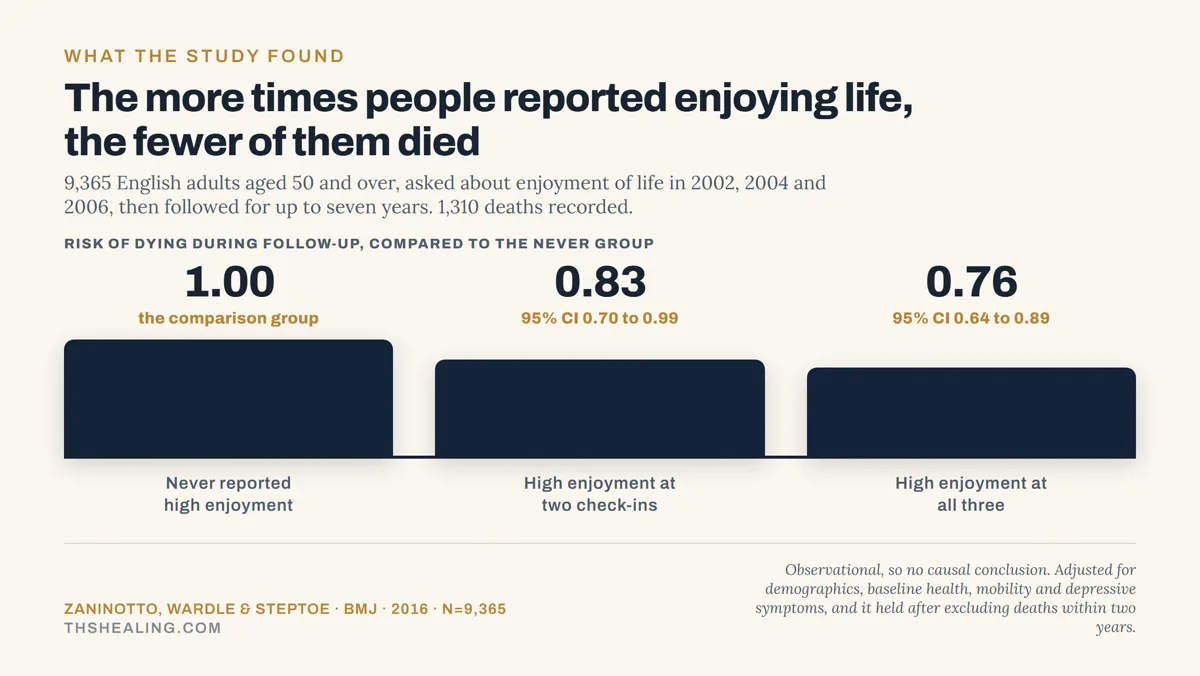
Compared with the group who never reported high enjoyment, those who reported it at two of the three check-ins had a hazard ratio of 0.83. Those who reported it at all three had 0.76. The pattern held after adjusting for demographics, baseline health, mobility problems and depressive symptoms.
Now the honest caveats, which the authors put in their own paper.
This is observational, and they say plainly that causal conclusions cannot be drawn. The obvious worry is reverse causation: sick people enjoy life less, and sick people die sooner, which would produce this pattern with joy doing nothing at all. The authors tested that by excluding everyone who died within two years of the final measurement. The association held.
That is a real check, and it does not settle the question. It does mean the easy dismissal does not work either.
What might be happening underneath?
We will hold this part loosely, because the mechanism work is thinner than the outcome work.
Chronic stress raises cortisol, and sustained cortisol dampens parts of the immune response. That is well established. The Cohen studies found positive emotional style was associated with lower endocrine hormone levels and better health practices, though neither of those accounted for the difference in illness, which is a nice example of researchers reporting a finding that undercut their own neatest explanation.
So we can say the direction is plausible. We cannot tell you the pathway. Anyone who does is going past the data.
What we take from it
Not that joy is a treatment. It is not, and we will not put that on a page.
What we take is that the interior life is physiological. Not symbolically, not as encouragement. The thing Proverbs calls a joyful heart shows up in a quarantine unit as fewer verified infections, and in a seven-year mortality follow-up as a hazard ratio.
The verse carries the conviction. The studies carry the evidence. They are doing two different jobs and we are not going to blur them, because the moment we use Scripture as a data point you should stop trusting our data.
But we notice they keep pointing the same direction. And we notice that of the five things we teach as fundamentals, this is the one people skip, because it does not feel like health. It feels like a luxury you get to once the real work is done.
The 9,365 people in that study would suggest otherwise.
What to do this week
Make one appointment with joy and keep it like it is a doctor’s visit.
Ten minutes. Put the phone face down. Call the person who makes you laugh in the way that is not at anyone’s expense. Sit outside. Play the song. Read the thing that is not useful.
If you want the version with the most support behind it, make it recurring rather than large. The mortality finding was not about one very good year. It was about reporting high enjoyment at three separate check-ins across four years. Sustained, not spectacular.
And if joy has been genuinely out of reach for a while, that is not a willpower problem and this article is not the right tool. Depression is a real and treatable thing, and it deserves a person, not a paragraph.
Read this next: joy is the fifth of The Five Pillars of Owning Your Health, and the one most people treat as optional. For the same pattern of small things compounding, see how researchers cut blood sugar spikes by 39% without changing a single meal, and where the food side of the fundamentals starts in what most food as medicine advice never mentions.
Sources
- Cohen S, Doyle WJ, Turner RB, Alper CM, Skoner DP. “Emotional style and susceptibility to the common cold.” Psychosomatic Medicine, 2003;65(4):652-657. https://pubmed.ncbi.nlm.nih.gov/12883117/
- Cohen S, Alper CM, Doyle WJ, Treanor JJ, Turner RB. “Positive emotional style predicts resistance to illness after experimental exposure to rhinovirus or influenza A virus.” Psychosomatic Medicine, 2006;68(6):809-815. https://pubmed.ncbi.nlm.nih.gov/17101814/
- Zaninotto P, Wardle J, Steptoe A. “Sustained enjoyment of life and mortality at older ages: analysis of the English Longitudinal Study of Ageing.” BMJ, 2016;355:i6267. https://pubmed.ncbi.nlm.nih.gov/27965194/
- Chida Y, Steptoe A. “Positive psychological well-being and mortality: a quantitative review of prospective observational studies.” Psychosomatic Medicine, 2008;70(7):741-756. https://pubmed.ncbi.nlm.nih.gov/18725425/
Scripture quoted from the New American Standard Bible. Article metadata retrieved from PubMed.
Educational content from True Health Solutions. We do not diagnose or prescribe, and nothing here is a substitute for care from someone who knows your history. The body heals. We write about what supports that design.
Questions people ask
- Does being happy stop you getting sick?
- It does not stop anything. In two quarantine studies where volunteers were deliberately infected, people with a positive emotional style were less likely to develop objectively verified illness, with an adjusted risk ratio of about 2.9 comparing the lowest third to the highest third.
- Is this just about optimism or positive thinking?
- No, and that is the striking part. The 2006 study controlled for optimism, extraversion, mastery, self-esteem, sense of purpose and self-reported health, and the association held independently of all of them.
- Does being negative make you sick?
- In the 2003 study, negative emotional style was not associated with catching a cold at all. It was associated with reporting more symptoms than the objective markers supported. Positive style and negative style behaved as separate things, not opposite ends of one thing.
- What does the mortality research show?
- In 9,365 English adults over 50 followed for up to seven years, those reporting high enjoyment of life at all three check-ins had a hazard ratio of 0.76 for death from any cause, compared with those who never did. It is observational, so it cannot establish cause.
- Does joy treat or cure disease?
- No. We do not claim joy treats, cures, heals or prevents any disease. Proverbs is wisdom, and the studies here measure risk across groups. Neither is a promise about any individual.
