
education · food ·
1 Brazil Nut A Day Closed A Real Nutrient Gap In 8 Weeks (But Not Cholesterol)
Small trials said Brazil nuts improve cholesterol. Then eight of them were pooled, and only one of the two findings survived.
Here is a small study that reads like good news.
Thirty-seven severely obese women ate one Brazil nut a day for eight weeks. Their HDL cholesterol rose, with a p-value of less than 0.00001, and two standard measures of cardiovascular risk improved with it (Cominetti et al., Nutrition Research, 2012).
Another trial found LDL down and HDL up nine hours after a single serving (Colpo et al., Journal of Nutrition and Metabolism, 2013). A third, in 130 healthy adults, found total cholesterol and fasting glucose both fell over eight weeks (Donadio et al., European Journal of Nutrition, 2017).
Three trials, same direction. This is the point where most articles stop.
What happened when someone pooled them
Researchers gathered eight randomized trials of Brazil nut intake and ran the numbers together (Godos et al., Antioxidants, 2022).
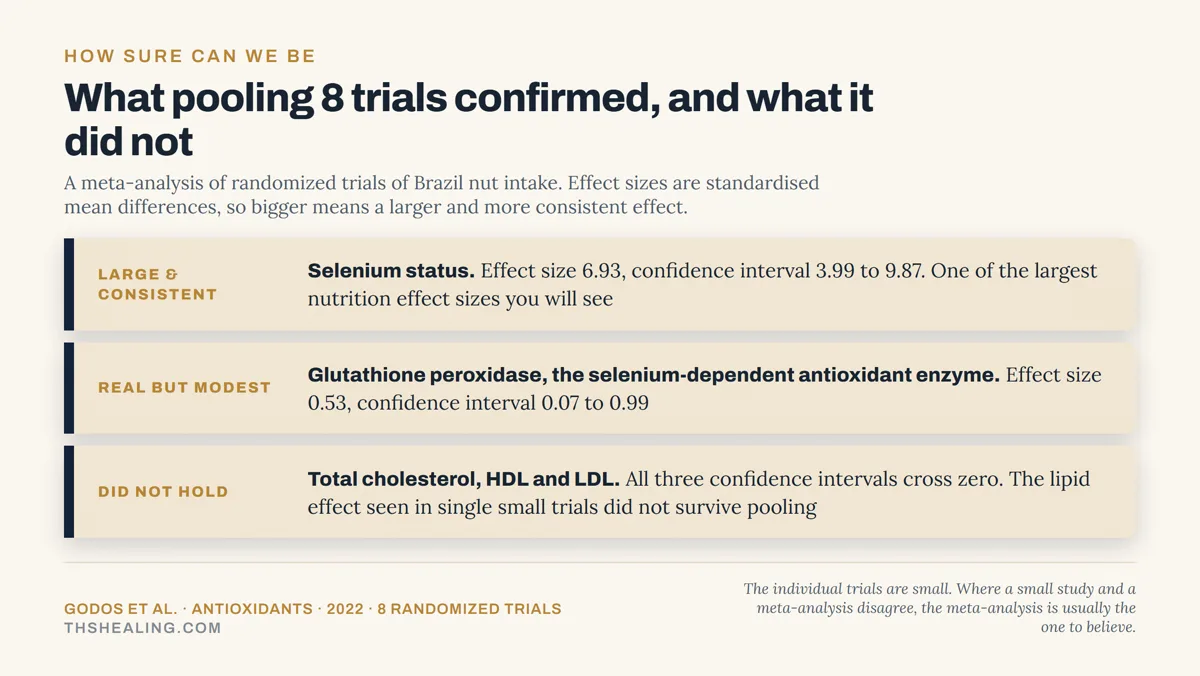
Total cholesterol: effect size -0.22, confidence interval -0.57 to 0.14. Crosses zero.
HDL: -0.04, interval -0.28 to 0.19. Crosses zero.
LDL: -0.15, interval -0.43 to 0.13. Crosses zero.
The lipid effect did not survive pooling. Not one of the three reached significance once the trials were looked at together.
We are telling you this on a page that could just as easily have run the three cheerful studies and stopped. When a small trial and a meta-analysis of eight trials disagree, the meta-analysis is the one to believe, and that rule does not get suspended because the smaller result was nicer.
What did survive, and it is not small
Selenium status. Effect size 6.93, confidence interval 3.99 to 9.87.
That is an enormous number by the standards of nutrition research. Most dietary interventions move a marker a little. This one moves it like a drug.
Glutathione peroxidase, the antioxidant enzyme your body can only build with selenium, also rose: effect size 0.53, interval 0.07 to 0.99. Smaller, real, and exactly what you would expect if the selenium is genuinely arriving and being used.
So the honest headline is not that Brazil nuts fix your cholesterol. It is that Brazil nuts fix a selenium deficiency faster and more reliably than almost anything else you can eat.
Why that is worth more than it sounds
Look again at the trial we opened with. Every one of those 37 women was selenium deficient at baseline, and eight weeks of one nut a day corrected it.
That is the useful frame. A Brazil nut is not a general-purpose health food. It is an unusually direct answer to one specific gap, and whether it does anything for you depends on whether you have that gap.
Selenium content in soil varies enormously by region, and the nuts themselves vary with it, which is why the numbers in these trials swing so widely. Two nuts from different sacks are not the same dose.
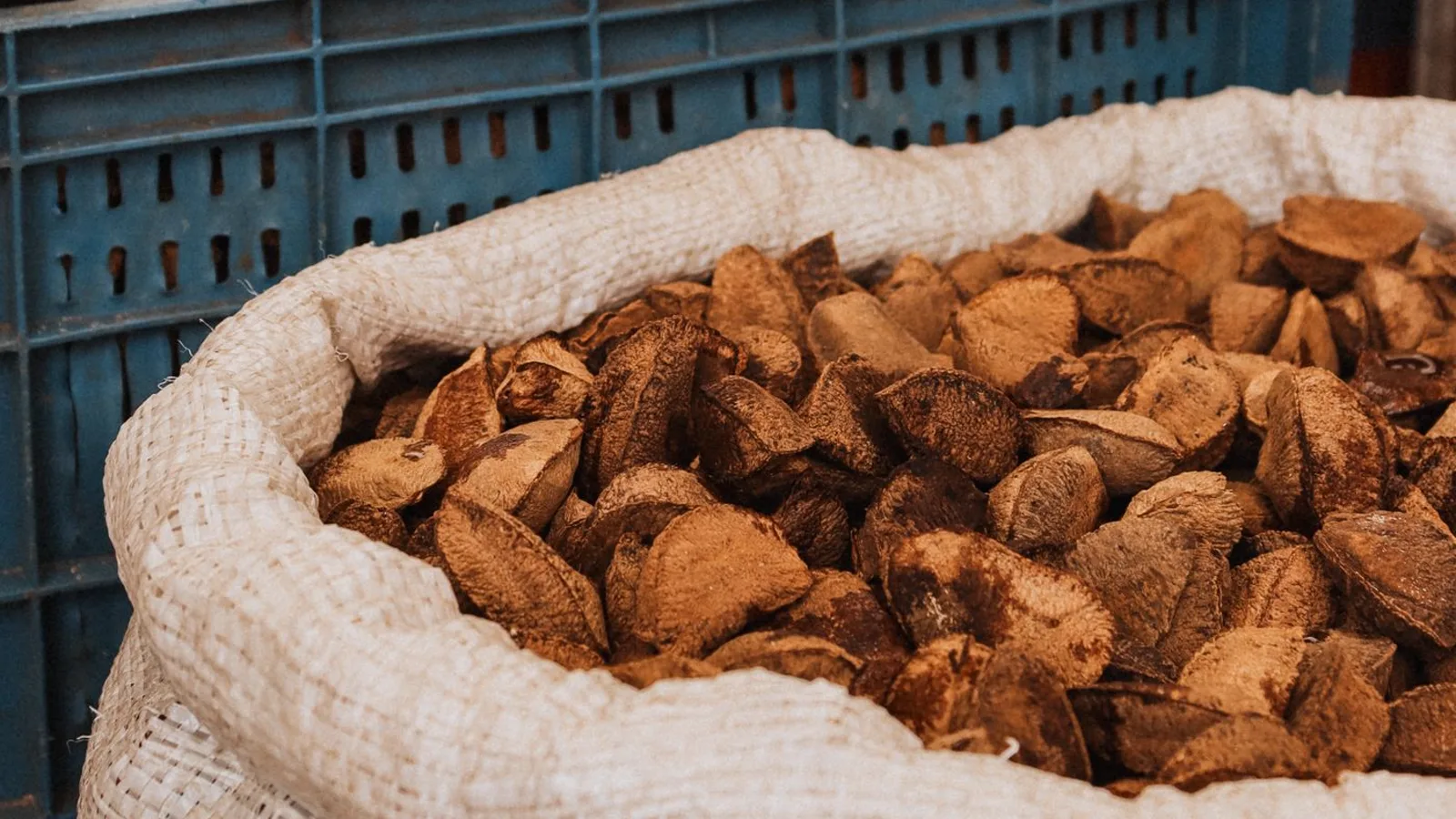
That is not a figure of speech. Brazil nuts are still largely wild-harvested from the Amazon rather than farmed, gathered from trees that cannot be cultivated in plantations at any useful scale, and what each tree pulls out of its patch of ground is what ends up in the sack.
The part that makes this different from every other nut
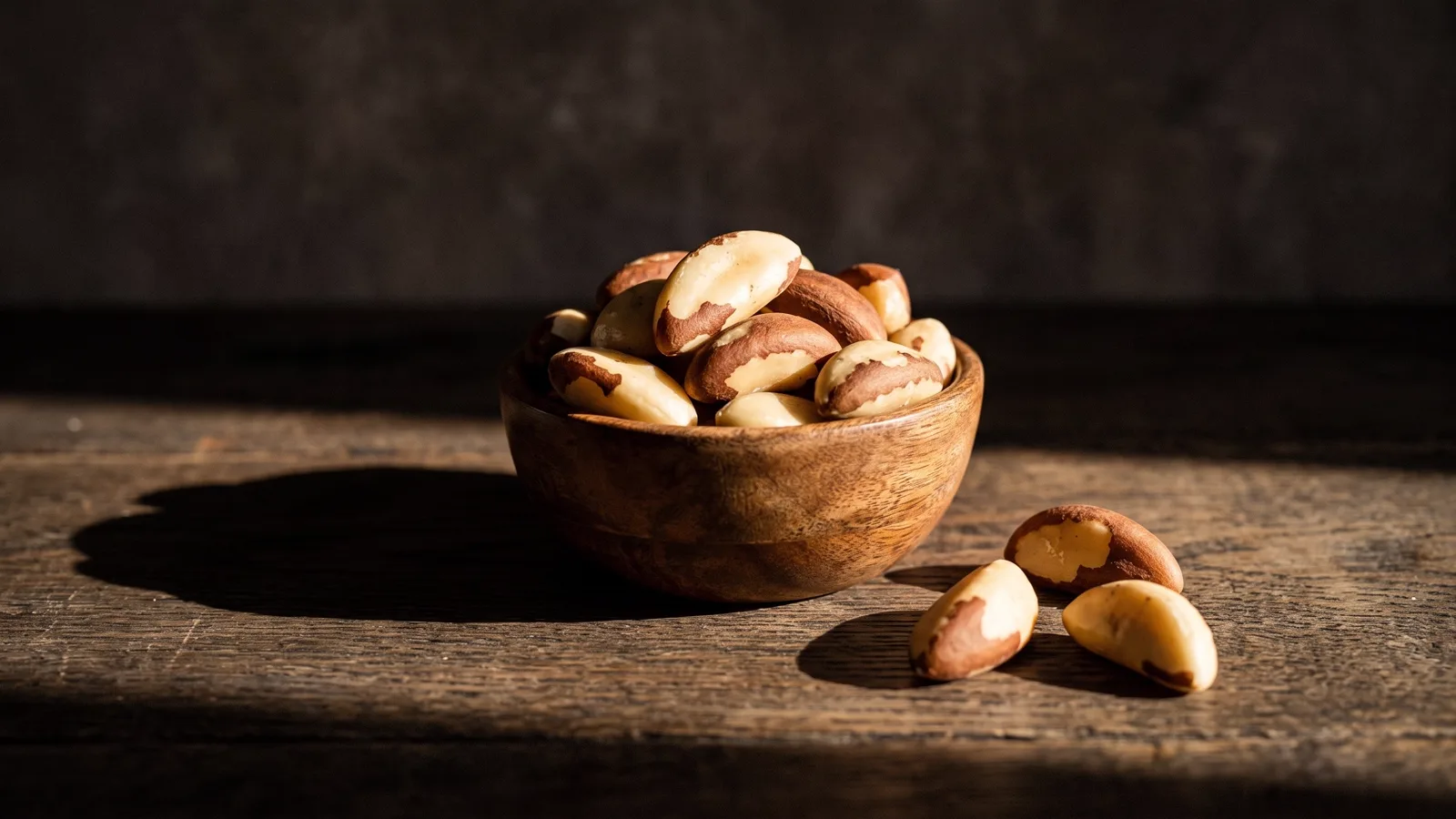
One nut in the Cominetti trial carried about 290 micrograms of selenium.
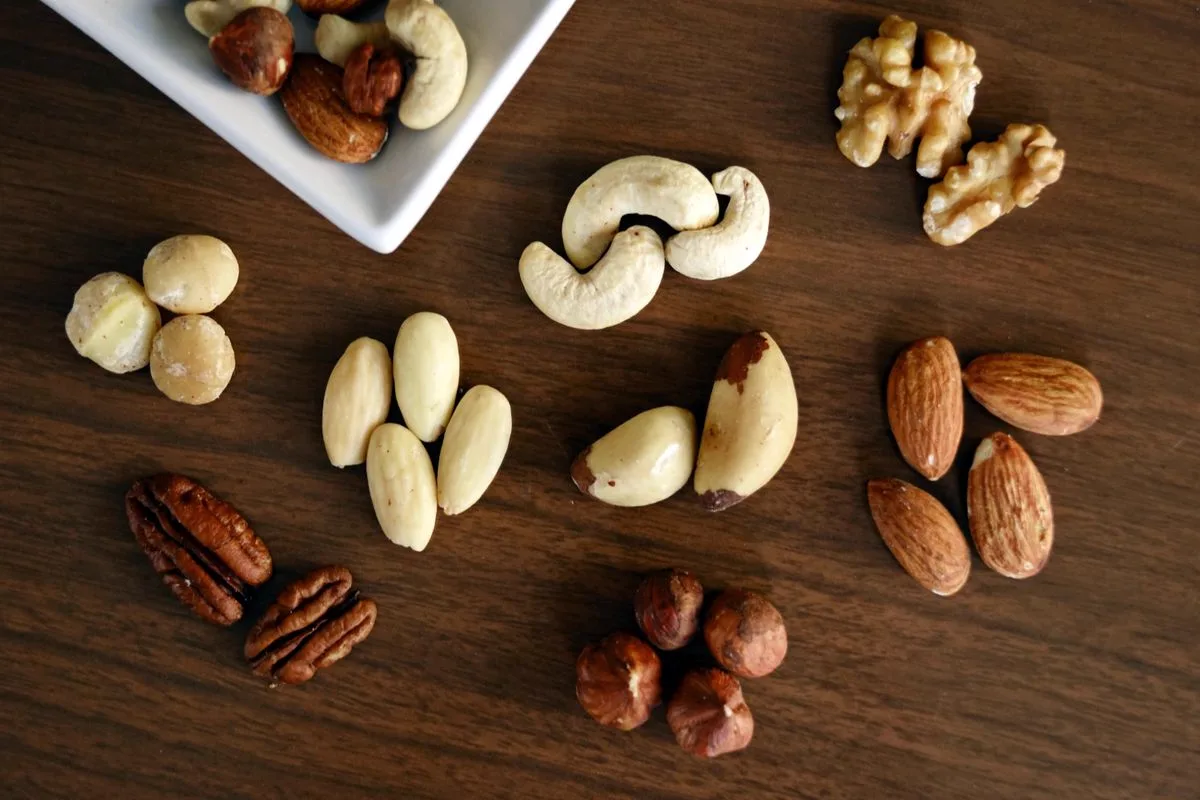
Hold that number against the adult daily requirement of 55 micrograms and the adult upper limit of 400, and something unusual becomes obvious. A single Brazil nut is not a serving of a food. It is closer to a dose of a supplement that happens to grow on a tree.
This is the only food we have written about where the sensible instruction is a maximum rather than a minimum, and it is why the companion piece exists.
Where the design shows up
Most of what we write about here is forgiving. Eat more vegetables, eat more fibre, walk more. The failure mode is not doing enough.
The Brazil nut is the exception, and it is a useful exception to have met. Provision is not the same as unlimited. A tree in the Amazon concentrates a trace element so efficiently that one seed covers a person’s needs several times over, and the correct response to that is respect rather than enthusiasm.
“Then God said, ‘Behold, I have given you every plant yielding seed that is on the surface of all the earth, and every tree which has fruit yielding seed; it shall be food for you.’” Genesis 1:29, NASB
The verse carries the conviction. The eight pooled trials carry the evidence, including the parts that did not work out.
What to do this week
One nut. Not a handful.
If you want the selenium, one Brazil nut a day is the protocol that was actually tested, and it is enough. If you are eating them by the handful because they are nice, that is a different activity and the companion piece explains why it matters.
And do not buy a Brazil nut supplement on the strength of a cholesterol claim. The cholesterol claim is the part that did not hold.
Read this next: the number that should govern how you eat these, and what happens above it: how many Brazil nuts a day, and the limit most people miss. For the same pattern of a small finding failing to survive pooling, see what the best-controlled beetroot trials found.
Sources
- Godos J, Giampieri F, Micek A, et al. “Effect of Brazil Nuts on Selenium Status, Blood Lipids, and Biomarkers of Oxidative Stress and Inflammation: A Systematic Review and Meta-Analysis of Randomized Clinical Trials.” Antioxidants, 2022;11(2):403. https://pubmed.ncbi.nlm.nih.gov/35204285/
- Cominetti C, de Bortoli MC, Garrido AB, Cozzolino SMF. “Brazilian nut consumption improves selenium status and glutathione peroxidase activity and reduces atherogenic risk in obese women.” Nutrition Research, 2012;32(6):403-407. https://pubmed.ncbi.nlm.nih.gov/22749175/
- Colpo E, Vilanova CDA, Brenner Reetz LG, et al. “A single consumption of high amounts of the Brazil nuts improves lipid profile of healthy volunteers.” Journal of Nutrition and Metabolism, 2013;2013:653185. https://pubmed.ncbi.nlm.nih.gov/23840948/
- Donadio JLS, Rogero MM, Guerra-Shinohara EM, Desmarchelier C, Borel P, Cozzolino SMF. “SEPP1 polymorphisms modulate serum glucose and lipid response to Brazil nut supplementation.” European Journal of Nutrition, 2017;57(5):1873-1882. https://pubmed.ncbi.nlm.nih.gov/28501922/
Article metadata retrieved from PubMed.
Educational content from True Health Solutions. We do not diagnose or prescribe, and nothing here is a substitute for care from someone who knows your history. The body heals. We write about what supports that design.
Questions people ask
- Do Brazil nuts lower cholesterol?
- The individual trials suggested so, but a meta-analysis of eight randomized trials found no significant effect on total cholesterol, HDL or LDL. All three confidence intervals crossed zero. Where a small study and a pooled analysis disagree, the pooled analysis is usually the one to believe.
- What do Brazil nuts reliably do?
- Raise selenium status, and dramatically. The same meta-analysis found an effect size of 6.93 on blood selenium, which is one of the largest you will encounter in nutrition research, plus a smaller real effect on the selenium-dependent antioxidant enzyme glutathione peroxidase.
- How much selenium is in one Brazil nut?
- In the trial that measured it, a single nut delivered about 290 micrograms. That is several times the adult daily requirement and most of the way to the adult upper limit, which is why the companion article is about how many not to eat.
- Were the people in these trials already deficient?
- In one of them, yes. All 37 women in the Cominetti trial were selenium deficient at baseline, and eight weeks of one nut a day corrected it. That matters: fixing a deficiency is not the same as improving someone who was already fine.
- Does this mean Brazil nuts treat anything?
- No, and we do not claim that. These trials measured markers in blood. Correcting a nutrient deficiency is a real and useful thing, and it is not a treatment for any disease.
