
food · heart · education ·
Higher Potassium Intake Tracked With 24% Lower Stroke Risk Across 127,038 People
Everyone talks about cutting sodium. The other half of that equation has 22 trials and eleven cohorts behind it, and almost nobody mentions it.
Everybody has been told to cut salt. Almost nobody has been told the other half of the same sentence.
Sodium and potassium work against each other in the body, and the modern plate has managed to get both wrong at once: too much of one, too little of the other.
What the pooled evidence says
The World Health Organization commissioned a systematic review that gathered 22 randomized controlled trials covering 1,606 people and 11 cohort studies covering 127,038 adults (Aburto et al., BMJ, 2013).
On blood pressure, increased potassium intake lowered:
- Systolic pressure by 3.49 mmHg (95% CI 1.82 to 5.15)
- Diastolic pressure by 1.96 mmHg (95% CI 0.86 to 3.06)
With an important qualifier. That effect was seen in people with hypertension and not in those without it. If your blood pressure is already normal, this literature does not promise you a lower number.
At higher intakes, in the range of 90 to 120 mmol a day, systolic pressure fell 7.16 mmHg. The reviewers found no dose response beyond that, which is the same flattening curve we keep meeting.
The number that made this review famous
Across the cohort studies, higher potassium intake was associated with a 24% lower risk of stroke (risk ratio 0.76, 95% CI 0.66 to 0.89).
Higher potassium intake was associated with a 24% lower risk of stroke. These results suggest that increased potassium intake is potentially beneficial to most people without impaired renal handling of potassium.
Aburto et al., BMJ, 2013
Grade that properly before you repeat it. Cohort studies are observational. People who eat more potassium eat more vegetables, fruit, beans and potatoes, and tend to do other things differently too. The reviewers rated this as moderate quality evidence, which is respectable and is not the same as proof.
The associations with cardiovascular disease overall and with coronary heart disease were not statistically significant. The stroke signal is the one that stands up, and we will not inflate it into the others.
Then somebody ran the trial
Observational evidence can only take you so far, and in 2021 a trial closed the gap.
Researchers cluster-randomised 600 villages in rural China, 20,995 people, all either with a history of stroke or aged over 60 with high blood pressure. One group kept using regular salt. The other switched to a salt substitute: 75% sodium chloride, 25% potassium chloride. Mean follow-up was 4.74 years (Neal et al., New England Journal of Medicine, 2021).
That one swap produced:
- Stroke down 14% (rate ratio 0.86, 95% CI 0.77 to 0.96, P = 0.006)
- Major cardiovascular events down 13% (0.87, P < 0.001)
- Death from any cause down 12% (0.88, P < 0.001)
This is a different tier of evidence from the cohort studies above. Randomised, hard outcomes, nearly five years, twenty thousand people.
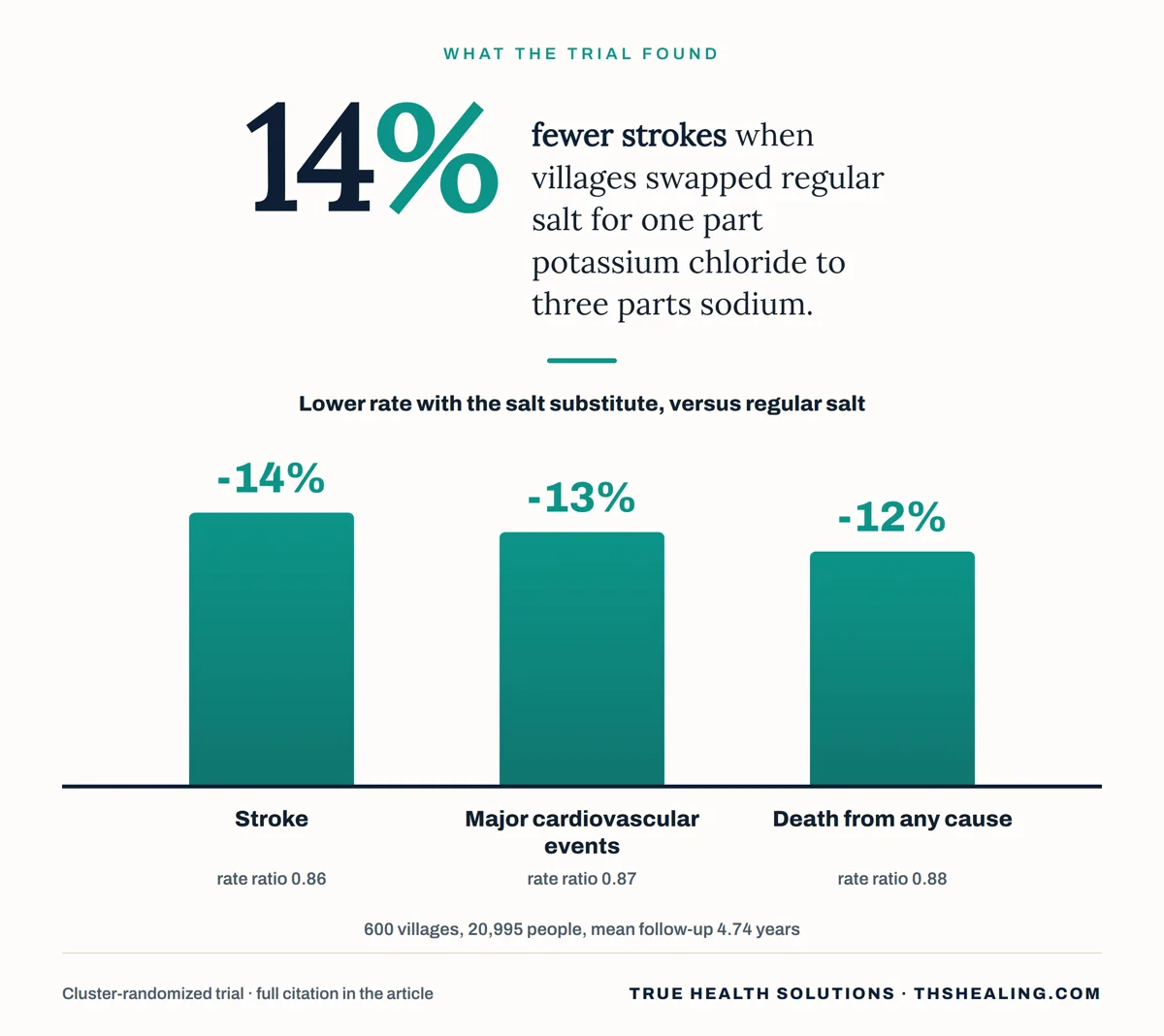
The rates of stroke, major cardiovascular events, and death from any cause were lower with the salt substitute than with regular salt.
Neal et al., New England Journal of Medicine, 2021
Be precise about who was studied: older adults, most with previous stroke or hypertension, in a population eating a lot of salt to begin with. It does not promise a healthy forty-year-old the same 12%.
The safety question, answered
This is the section that matters, because potassium is one of the few nutrients where more is not automatically fine.
In these adults, increased potassium intake had no significant adverse effect on kidney function, blood lipids, or catecholamine concentrations.
The salt substitute trial checked the specific fear directly. Serious adverse events attributed to hyperkalemia, dangerously high blood potassium, were not significantly higher in the substitute group: 3.35 against 3.30 events per 1000 person-years, rate ratio 1.04.
But read the reviewers’ own qualifier: beneficial to most people without impaired renal handling of potassium. If your kidneys are not clearing it properly, or you take a drug that raises potassium, this is genuinely dangerous territory and the answer is a conversation, not a plate change decided from an article.
The kidney question is less settled than the dogma
Anyone with kidney disease has been told to restrict potassium. That advice is not wrong, and it is being examined.
In 1,860 patients with pre-dialysis chronic kidney disease, those with the lowest urinary potassium excretion, which is a proxy for how much they were eating, had higher blood pressure variability and an adjusted 2.5 times the risk of cardiovascular events compared with those excreting the most (Suh et al., Nutrients, 2021).
Their conclusion was that restriction of dietary potassium should be individualised in pre-dialysis CKD rather than applied as a blanket rule.
Read that carefully, because it is not permission. This is an observational cohort, it is specific to pre-dialysis CKD, and potassium in advanced kidney failure genuinely can stop a heart. Nothing here is a reason to change what you eat if you have kidney disease.
What it is, is a reason to ask. A blanket restriction handed down without a recent measurement is worth a conversation with the person managing your kidneys.
Where it actually is
The foods carrying serious potassium are unglamorous and cheap.
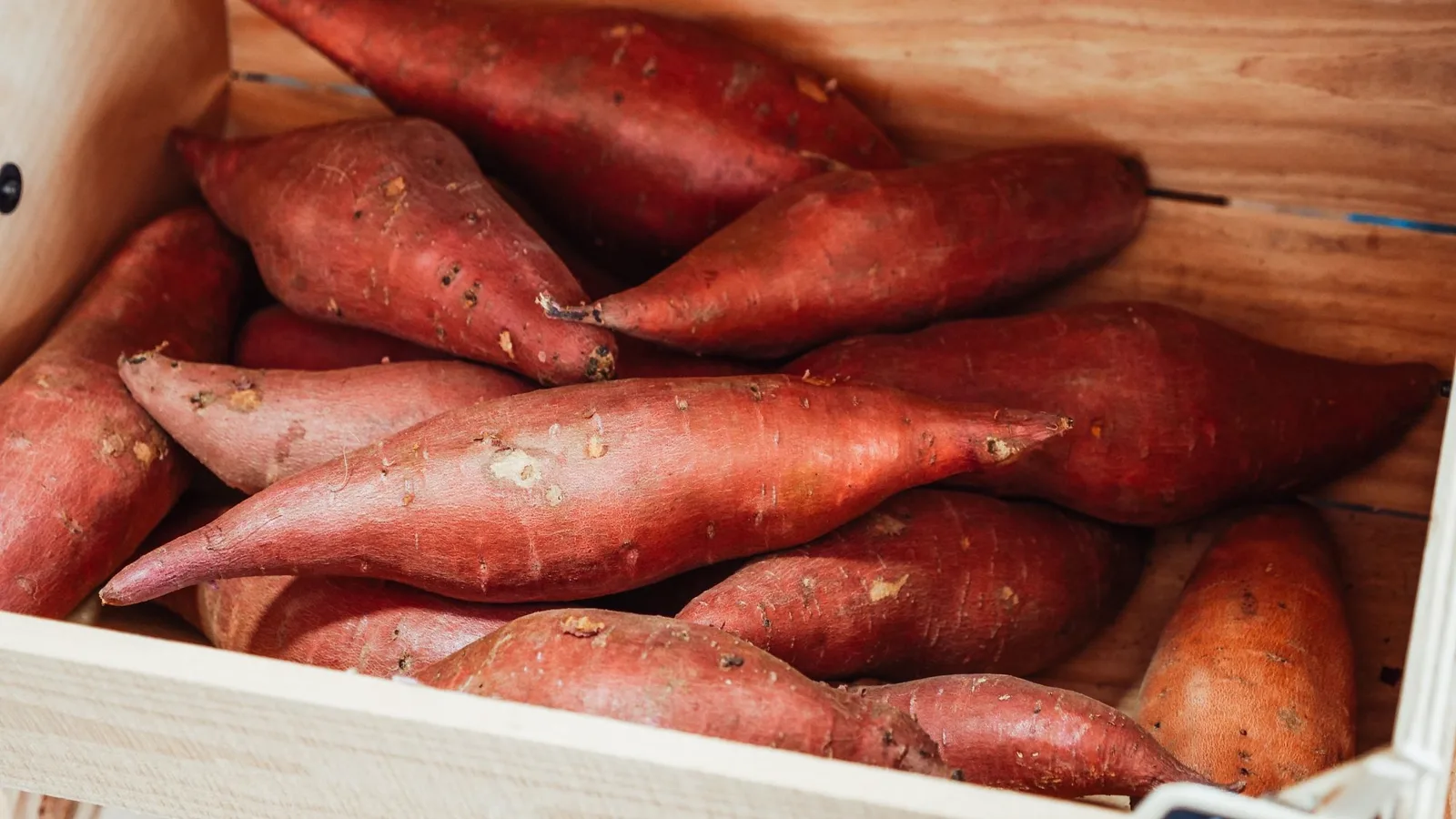
Potatoes and sweet potatoes, with the skin. Beans and lentils. Leafy greens. Bananas, which get all the publicity while carrying less than a potato. Tomato paste. Squash. Avocado. Dried apricots.
Notice what that list has in common. These are not supplement-aisle items. They are the ordinary contents of a plant-forward plate, which is why this nutrient almost never gets its own marketing campaign. Nobody can patent a potato.
Why this beats a supplement
Potassium chloride tablets exist and we are not recommending them.
The reason is partly safety, since concentrated potassium can affect heart rhythm in a way that a baked potato cannot. And it is partly that the foods carrying potassium arrive with fibre, magnesium, nitrate and the rest of the package, and the trials that produced the stroke association were measuring what people ate, not what they swallowed in a capsule.
Where the design shows up
Two minerals, pulling in opposite directions, balanced by whatever you put on the plate.
The modern food supply gets that balance backwards almost by accident: sodium is added to preserve and to sell, potassium is stripped out in processing. Nobody designed that. It fell out of an industry optimising for shelf life.
Eating close to the ground puts the ratio back without anybody having to think about milligrams.
“He causes the grass to grow for the cattle, and vegetation for the labor of mankind, so that he may produce food from the earth.” Psalm 104:14, NASB
The verse carries the conviction. Twenty-two trials and 127,038 people carry the number.
What to do this week
Add one potassium-heavy food to a meal you already eat, and keep the skin on.
A baked potato instead of bread. Beans in the soup. A handful of greens into whatever is in the pan. Tomato paste rather than a jar of sauce with sugar in it.
If you have kidney disease, or take a medication that raises potassium, ask first. For most people this is simply what eating vegetables looks like when you name the mineral.
Read this next: the other half of this equation, and the tea with pooled trials behind it: hibiscus tea lowered blood pressure across 13 trials. For the kitchen bulb with the strongest blood pressure number on this site, garlic dropped blood pressure 8.7 points.
Sources
-
Aburto NJ, Hanson S, Gutierrez H, Hooper L, Elliott P, Cappuccio FP. “Effect of increased potassium intake on cardiovascular risk factors and disease: systematic review and meta-analyses.” BMJ, 2013;346:f1378. https://pubmed.ncbi.nlm.nih.gov/23558164/
-
Neal B, Wu Y, Feng X, et al. “Effect of Salt Substitution on Cardiovascular Events and Death.” The New England Journal of Medicine, 2021;385(12):1067-1077. https://pubmed.ncbi.nlm.nih.gov/34459569/
-
Suh SH, Song SH, Oh TR, et al. “Association of Urinary Potassium Excretion with Blood Pressure Variability and Cardiovascular Outcomes in Patients with Pre-Dialysis Chronic Kidney Disease.” Nutrients, 2021;13(12):4443. https://pubmed.ncbi.nlm.nih.gov/34959995/
Article metadata retrieved from PubMed. Photograph from Pexels. Scripture quoted from the New American Standard Bible.
Educational content from True Health Solutions. We do not diagnose or prescribe, and nothing here is a substitute for care from someone who knows your history. The body heals. We write about what supports that design.
Questions people ask
- Does potassium lower blood pressure?
- In people who have hypertension, yes. Pooled across 22 randomized trials, increased potassium intake lowered systolic pressure by 3.49 mmHg and diastolic by 1.96 mmHg. The effect was seen in people with hypertension and not in those without it.
- How much potassium?
- When the higher intake was in the range of 90 to 120 mmol a day, systolic pressure fell by 7.16 mmHg. The reviewers found no dose response beyond that, so more was not better.
- What about stroke?
- Across 11 cohort studies covering 127,038 adults, higher potassium intake was associated with a 24% lower risk of stroke. That is observational evidence, so it shows association rather than proof of cause.
- Is more potassium safe?
- In these adults, increased intake had no significant adverse effect on kidney function, blood lipids, or catecholamine concentrations. That said, anyone with impaired kidney handling of potassium, or taking drugs that raise it, needs to ask first, because for them it is genuinely dangerous.
- Should I take a potassium supplement?
- Food first. Potassium supplements are one of the few where over-doing it can affect heart rhythm, and the foods that carry it also carry fibre, magnesium and the rest. This is a plate question, not a pill question.
