
education · food · heart ·
Garlic Lowered Blood Pressure 8.7 Points In Trials, With One Catch
In people who already had high blood pressure, the drop was 8.7 mmHg. Then you read the methods section and find out what they were actually taking.
Researchers pooled 20 randomized controlled trials covering 970 people, all of them comparing garlic against a placebo, and measured what happened to blood pressure.
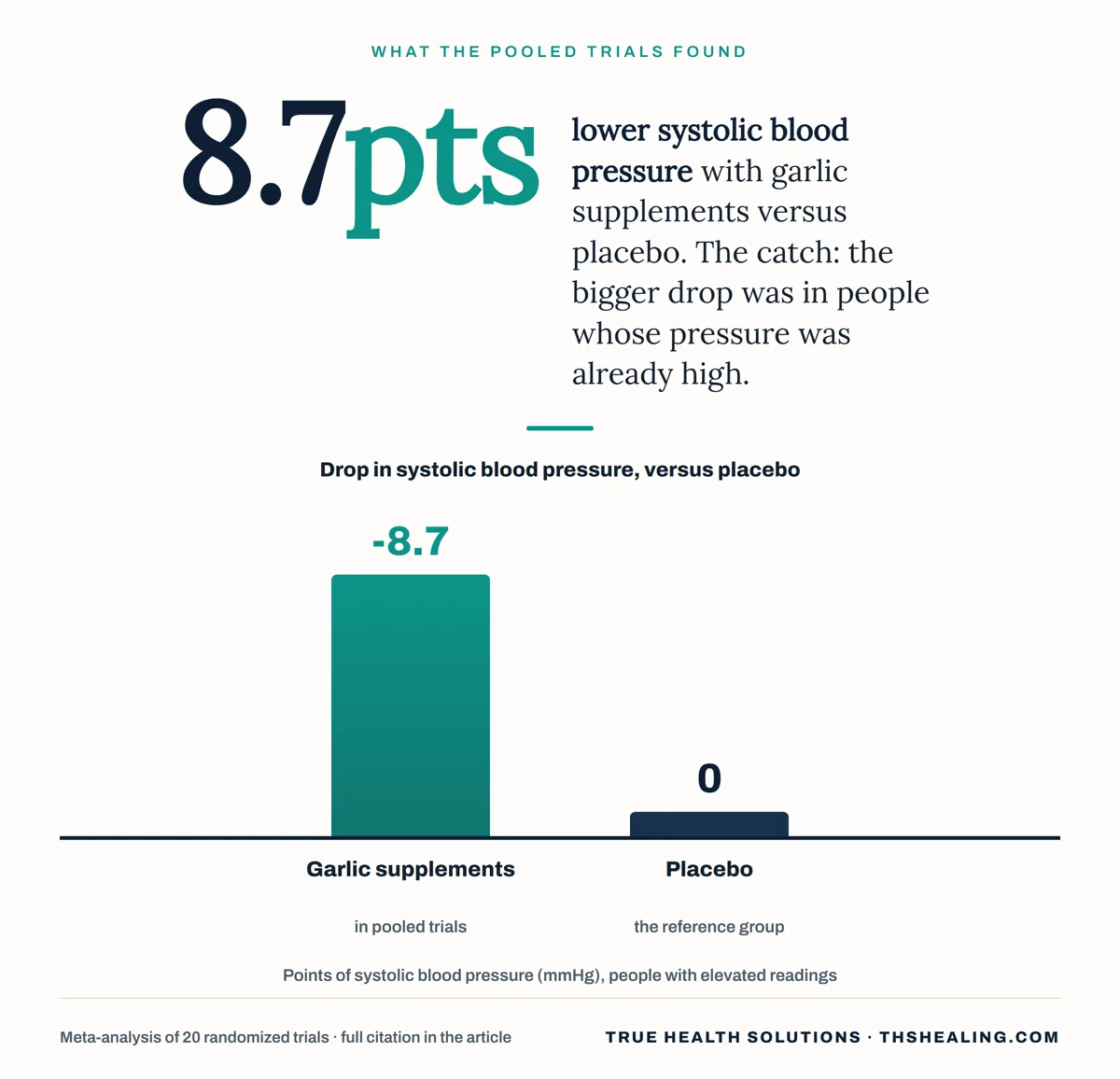
Across everyone, systolic pressure dropped 5.1 mmHg.
Among the people who already had hypertension when they started, it dropped 8.7 mmHg.
That second number is in the range clinicians care about. Then you read the methods, and the story gets more complicated than the headline.
What the trials actually measured
The pooled analysis found a mean decrease in systolic blood pressure of 5.1 mmHg and diastolic of 2.5 mmHg against placebo (Ried, The Journal of Nutrition, 2016). The subgroup already hypertensive at baseline, meaning 140/90 or above, saw 8.7 mmHg systolic across 10 trials and 6.1 mmHg diastolic across 6.
A later analysis focused only on hypertensive participants, 12 trials and 553 people, and landed in the same place: 8.3 mmHg systolic and 5.5 mmHg diastolic (Ried, Experimental and Therapeutic Medicine, 2020).
The same body of work reports a separate meta-analysis of 39 trials and 2,300 adults finding about a 10% reduction in total and LDL cholesterol, with two conditions attached: only in people whose cholesterol was already slightly elevated, and only when taken for longer than two months.
Now the part that changes how you should read all of it
Every one of those trials used a garlic supplement.
Standardized powders. Aged garlic extract. Capsules with a measured dose of a specific preparation, often a commercial one, taken daily for weeks or months.
Not a clove. Not a head of garlic in a pan on a Tuesday.
We want to sit on this, because it runs directly against the pattern in most of what we have published. In the polyphenol trials, whole food beat the purified extract outright. In the green tea review, the brewed leaf was cleared and the concentrated capsule was flagged. We have been telling you, correctly, that taking a compound out of its food usually costs you something.
Garlic is the case where the good human evidence sits on the supplement side, because that is what got tested. It is not evidence that the supplement is better. It is evidence that nobody has run the kitchen version of the trial.
That is a real gap and we would rather name it than paper over it.
So is cooking with garlic pointless?
No, and there is laboratory work showing exactly what survives a pan and what does not, which is the subject of the companion to this piece.
The short version: how you prepare a clove changes the chemistry substantially, and one small step protects a great deal of it. Crushing before heating is the step. We put it in its own article because it is practical and specific enough to deserve one.
What we cannot tell you is that a well-prepared clove delivers what a standardized capsule delivered in those trials. Nobody has measured that.
What is garlic actually doing?
The active chemistry starts with damage.
An intact clove contains a compound called alliin and, held separately, an enzyme called alliinase. They only meet when you cut, crush or chew the tissue. That collision produces allicin, and allicin is what most of the interest is about.
The reaction is startlingly fast. Using a technique that samples compounds in real time, researchers detected the fleeting intermediate in that reaction and measured its half-life at under one second at room temperature (Block et al., Journal of Agricultural and Food Chemistry, 2010).
So the smell that hits you when a knife goes through a clove is not a passive aroma being released. It is a chemical reaction happening in front of you.
What we will not claim
That garlic treats or prevents high blood pressure. The authors of the meta-analysis are careful here and so are we: they call garlic supplements a possible complementary option, and they state that long-term trials are still needed to find out what any of this does to actual cardiovascular events rather than to a number on a cuff.
A blood pressure reading is a marker. Markers are how we find things worth studying. They are not outcomes.
Where the design shows up
There is something worth noticing in a plant that keeps its active chemistry locked in two halves, and only makes it when something bites.
Garlic did not evolve allicin for your arteries. It made a defense. The compound that shows up in cardiovascular trials is the same one the plant uses to discourage being eaten, which is a strange and recurring pattern across the plants we write about.
“Then God said, ‘Behold, I have given you every plant yielding seed that is on the surface of all the earth, and every tree which has fruit yielding seed; it shall be food for you.’” Genesis 1:29, NASB
The verse carries the conviction. The 970 people in those trials carry the evidence. Separate jobs.
What to do this week
Cook with it, and know what that is and is not.
Fresh garlic, most days, in food you were making anyway. It is one of the cheapest flavors in the store and there is no reason not to. Just do not tell yourself you are dosing.
If your blood pressure is genuinely high, the honest advice is that these trials tested supplements, and a supplement decision belongs with whoever manages your medication. Garlic affects platelets and can stack with blood pressure drugs, which is exactly why it should not be a thing you quietly add.
And the step that costs you nothing: crush or chop before it goes near heat. The companion explains why that matters more than almost anything else you do with a clove.
Read this next: the practical half of this pair is the 10-minute garlic step most kitchens skip, including what the lab found happens to garlic in a microwave. For the broader principle this article complicates, start at what most food as medicine advice never mentions. Blood pressure also responds to the things in The Five Pillars of Owning Your Health.
Sources
- Ried K. “Garlic Lowers Blood Pressure in Hypertensive Individuals, Regulates Serum Cholesterol, and Stimulates Immunity: An Updated Meta-analysis and Review.” The Journal of Nutrition, 2016;146(2):389S-396S. https://pubmed.ncbi.nlm.nih.gov/26764326/
- Ried K. “Garlic lowers blood pressure in hypertensive subjects, improves arterial stiffness and gut microbiota: A review and meta-analysis.” Experimental and Therapeutic Medicine, 2020;19(2):1472-1478. https://pubmed.ncbi.nlm.nih.gov/32010325/
- Block E, Dane AJ, Thomas S, Cody RB. “Applications of direct analysis in real time mass spectrometry (DART-MS) in Allium chemistry.” Journal of Agricultural and Food Chemistry, 2010;58(8):4617-4625. https://pubmed.ncbi.nlm.nih.gov/20225897/
- Cavagnaro PF, Camargo A, Galmarini CR, Simon PW. “Effect of cooking on garlic (Allium sativum L.) antiplatelet activity and thiosulfinates content.” Journal of Agricultural and Food Chemistry, 2007;55(4):1280-1288. https://pubmed.ncbi.nlm.nih.gov/17256959/
Article metadata retrieved from PubMed.
Educational content from True Health Solutions. We do not diagnose or prescribe, and nothing here is a substitute for care from someone who knows your history, especially if you take blood pressure medication or a blood thinner. The body heals. We write about what supports that design.
Questions people ask
- How much does garlic lower blood pressure?
- In a meta-analysis of 20 randomized trials with 970 participants, garlic lowered systolic blood pressure by 5.1 mmHg on average against placebo. Among participants who already had hypertension at baseline, the drop was 8.7 mmHg systolic and 6.1 mmHg diastolic.
- Do those results apply to garlic I cook with?
- Not directly, and this is the part most articles skip. Those trials used garlic supplements and standardized extracts, including aged garlic extract, not cloves from a kitchen. Nobody has run the equivalent trial on cooking garlic.
- Does garlic affect cholesterol?
- A separate meta-analysis of 39 randomized trials with 2,300 adults found roughly a 10% reduction in total and LDL cholesterol, but only in people with slightly elevated levels to begin with and only when taken for more than two months.
- Is garlic safe to take with medication?
- Garlic affects platelet function, so it interacts with blood thinners, and it can add to the effect of blood pressure medication. If you take either, this belongs in a conversation with whoever prescribes for you, not with an article.
- Does garlic treat or cure high blood pressure?
- No, and we do not claim it does. These are trials measuring a marker in groups of people. The authors themselves called for long-term trials before anyone knows what it does to actual cardiovascular outcomes.
