
education · food ·
Crush Your Garlic & Wait 10 Minutes. Here's What It Protects
Six minutes of heat wiped out whole cloves entirely. Cloves crushed first kept a measurable amount. One knife stroke is the difference.
A group of researchers in Argentina did something the rest of us have never thought to do: they cooked garlic several different ways, then tested each version to see whether it still did anything.
The test was whether extracts from the garlic could still inhibit human blood platelets from clumping together, measured in a dish. Platelet clumping is part of how clots form, and garlic’s effect on it is one of the better-documented things about the plant.
One result stands out. Microwaved garlic had no effect on platelet aggregation at all.
What survived, and what did not
The details are more useful than that headline, because most of them are good news (Cavagnaro et al., Journal of Agricultural and Food Chemistry, 2007).
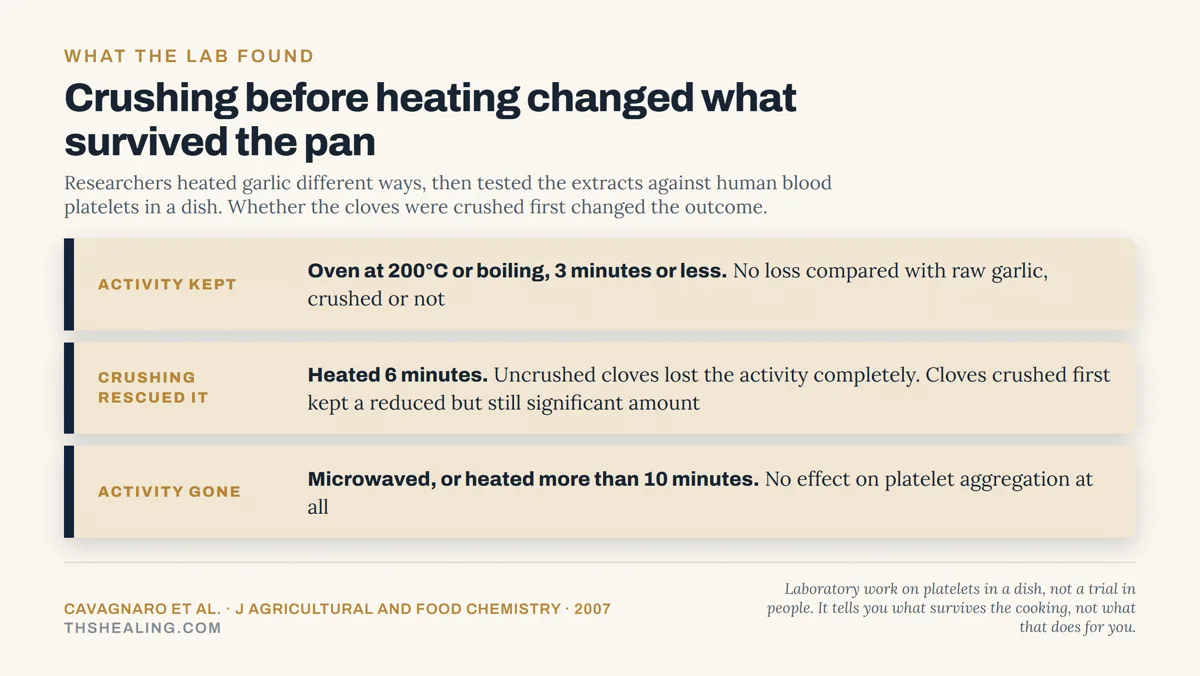
Oven heating at 200°C, or immersion in boiling water, for three minutes or less did not reduce the activity at all compared with raw garlic. Short cooking is fine.
At six minutes, the two versions came apart. Uncrushed cloves lost the activity completely. Cloves that had been crushed beforehand kept a reduced but still significant amount.
Past ten minutes at those temperatures, everything was gone regardless.
And the microwave result came with a detail worth knowing. When the researchers added raw garlic juice back to microwaved uncrushed garlic, the full antiplatelet activity was restored. So the microwave had not destroyed the raw material. It had knocked out the machinery that turns the raw material into the active compound.
Why one knife stroke does that
An intact garlic clove is carrying two things that are kept apart on purpose.
One is alliin, a fairly inert sulfur compound. The other is an enzyme called alliinase. They sit in different compartments of the cell, and they only meet when something breaks the tissue: a knife, a press, a tooth.
When they meet, the enzyme converts alliin into allicin, which is the compound doing most of the work in the research. This is the reaction you can smell, and it is fast. Researchers watching it in real time measured a key intermediate with a half-life of under one second at room temperature (Block et al., Journal of Agricultural and Food Chemistry, 2010).
Now the important bit. Alliinase is an enzyme, and enzymes are proteins, and heat destroys proteins.
Drop a whole clove into a hot pan and you inactivate the enzyme before it ever gets the chance to do its job. The alliin is still in there. The machine for converting it is dead. That is exactly what the microwave result shows, and why adding raw garlic back fixed it: the raw garlic brought working enzyme with it.
Crush the clove first and the reaction has already started. Heat arriving afterward destroys some of the product, but it cannot undo what has already been made.
About the ten-minute rest
You have probably read that you should chop garlic and let it sit before cooking. The advice is usually given as ten to fifteen minutes, and usually with an explanation that is wrong.
The wrong explanation is that allicin needs that long to develop. It does not. Allicin formation is fast, and the intermediate step in that reaction has a half-life under one second at room temperature. If you are waiting for allicin to appear, you finished waiting before you put the knife down.
The rest is still worth doing, and there is a real experiment behind it.
Researchers fed rats crushed garlic and measured DNA damage from a chemical carcinogen. Crushed garlic reduced the damaging DNA adducts in mammary tissue by 64% (Song and Milner, The Journal of Nutrition, 1999). Microwaving the garlic for 60 seconds took that protection away.
Then they ran the study that matters here. They let crushed garlic stand for 10 minutes before microwaving it for 60 seconds, and the protective effect came back.
The same paper explains why. Thirty seconds of microwaving destroyed 90% of the alliinase activity. And when they tested the individual compounds, alliin on its own did nothing, while the products of the enzyme reaction worked. The enzyme is not incidental. It is the whole mechanism.
The same researchers summarised this work two years later and added a number worth knowing for anyone who roasts things: 45 minutes of oven heating blocked the effect too, not just the microwave (Song and Milner, The Journal of Nutrition, 2001). The ten-minute stand prevented the total loss in both cases.
So the honest version of the rule is: crush, then wait about ten minutes before it meets heat. Not because allicin is slowly forming, but because you are giving the enzyme a working window before heat destroys it, and ten minutes is the interval that was actually tested.
We are dropping the fifteen. Nobody measured fifteen. Ten is the number in the experiment.
The usual caveat applies, and it is a real one: these were rats, and the outcome was DNA adduct formation, not anything happening in a person. What it establishes well is the kitchen chemistry. What it cannot establish is what that chemistry does for you.
Practical version: chop the garlic first, at the start of your prep, then do the onions and everything else. It will have rested by the time it goes in the pan without you managing a timer.
The protocol
- Fresh cloves. The mechanism depends on a working enzyme and an intact substrate, and both fade with time and processing. We have no trial comparing fresh with jarred, so this is reasoning, not a result.
- Crush, mince or finely chop. More damaged surface means more of the reaction. A press does more than a rough chop.
- Chop it first in your prep order. Aim for about ten minutes of rest before it meets heat, which is what the rat study tested. Doing the garlic first and the rest of your prep after gets you there without a timer.
- Add it late, and keep the heat short. Three minutes was harmless in the study. Six started costing. Ten took everything.
- Skip the microwave for garlic, or if you must, add some raw chopped garlic at the end.
- Some raw, sometimes. In dressings, hummus, salsa, a finishing drizzle. Raw is the version that lost nothing.
One honest limit on all of the above: this was laboratory work on platelets in a dish. It tells you what survives the pan. It does not tell you what that does for you, which is a different question and one we address in the companion piece.
Where the design shows up
We keep running into this pattern and it has not stopped being interesting.
Turmeric needed a partner to be absorbed. Green tea needed to stay in its diluted form to stay safe. Beans needed bacteria to finish the job. Garlic needs to be broken to become what the studies are about.
None of these foods hand over their chemistry on demand. Each one has a condition attached, and the conditions are mostly things ordinary kitchens have been doing for centuries without knowing why.
“Then God said, ‘Behold, I have given you every plant yielding seed that is on the surface of all the earth, and every tree which has fruit yielding seed; it shall be food for you.’” Genesis 1:29, NASB
The verse carries the conviction. The chemistry carries itself.
Read this next: the human evidence, and the uncomfortable fact that the good blood pressure trials all used supplements rather than cloves: why this kitchen bulb keeps showing up in blood pressure trials. The same crush-and-wait logic shows up in the kitchen mistake that wastes most of your turmeric.
Sources
- Cavagnaro PF, Camargo A, Galmarini CR, Simon PW. “Effect of cooking on garlic (Allium sativum L.) antiplatelet activity and thiosulfinates content.” Journal of Agricultural and Food Chemistry, 2007;55(4):1280-1288. https://pubmed.ncbi.nlm.nih.gov/17256959/
- Block E, Dane AJ, Thomas S, Cody RB. “Applications of direct analysis in real time mass spectrometry (DART-MS) in Allium chemistry. 2-propenesulfenic and 2-propenesulfinic acids, diallyl trisulfane S-oxide, and other reactive sulfur compounds from crushed garlic and other Alliums.” Journal of Agricultural and Food Chemistry, 2010;58(8):4617-4625. https://pubmed.ncbi.nlm.nih.gov/20225897/
- Song K, Milner JA. “The influence of heating on the anticancer properties of garlic.” The Journal of Nutrition, 2001;131(3s):1054S-1057S. https://pubmed.ncbi.nlm.nih.gov/11238815/
- Song K, Milner JA. “Heating garlic inhibits its ability to suppress 7,12-dimethylbenz(a)anthracene-induced DNA adduct formation in rat mammary tissue.” The Journal of Nutrition, 1999;129(3):657-661. https://pubmed.ncbi.nlm.nih.gov/10082770/
- Ried K. “Garlic Lowers Blood Pressure in Hypertensive Individuals, Regulates Serum Cholesterol, and Stimulates Immunity: An Updated Meta-analysis and Review.” The Journal of Nutrition, 2016;146(2):389S-396S. https://pubmed.ncbi.nlm.nih.gov/26764326/
Article metadata retrieved from PubMed.
Educational content from True Health Solutions. We do not diagnose or prescribe, and nothing here is a substitute for care from someone who knows your history. The body heals. We write about what supports that design.
Questions people ask
- Should I crush garlic before cooking it?
- The lab evidence says yes. When researchers heated garlic for six minutes, uncrushed cloves lost their antiplatelet activity completely, while cloves crushed beforehand kept a reduced but still significant amount.
- Do I really need to wait 10 minutes after chopping?
- Ten minutes has a real experiment behind it. Researchers let crushed garlic stand for 10 minutes before microwaving it, and that restored a protective effect the microwaving otherwise destroyed, in rats. But the common explanation is wrong: allicin forms in seconds, not over ten minutes. The rest gives the enzyme a working window before heat destroys it.
- Does microwaving garlic ruin it?
- In this study, microwaved garlic had no effect on platelet aggregation at all. Interestingly, adding raw garlic juice back to microwaved uncrushed garlic restored the full activity.
- Is there any cooking that does not damage garlic?
- Oven heating at 200 degrees Celsius or boiling for three minutes or less did not reduce the activity compared with raw garlic. The damage showed up at six minutes and was total beyond ten.
- Is jarred or pre-minced garlic as good?
- We have no trial comparing them, so we cannot tell you. The mechanism depends on an enzyme reacting with a compound when tissue is damaged, and both degrade over time, which is a reason to prefer fresh without being a study result.
