
education · food ·
The 1 Step Before Cooking Broccoli That Keeps 3x More Of The Good Stuff
Twelve men ate the same weight of broccoli two ways. Researchers measured what came out the other end, and the gap was three to one.
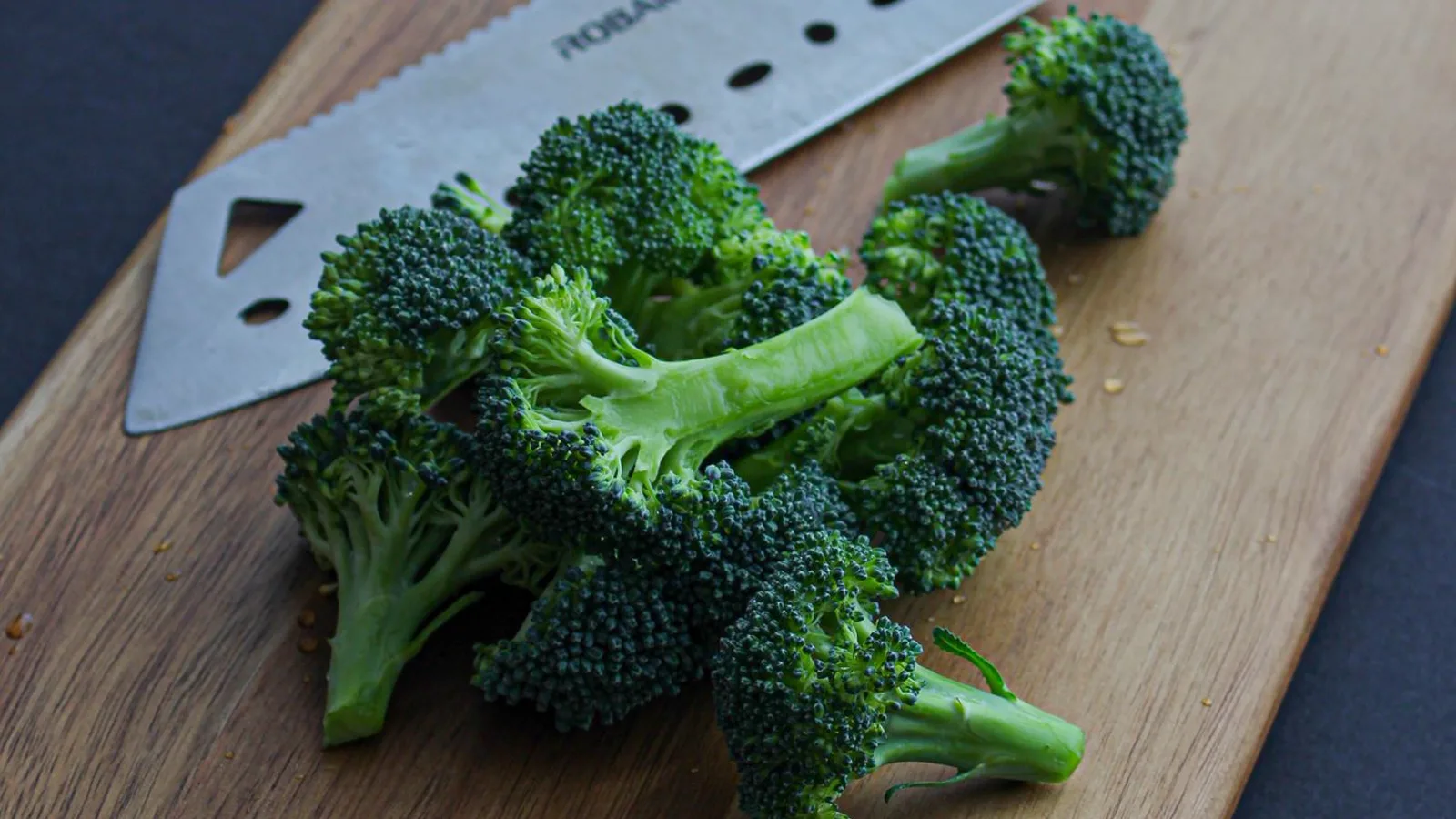
Twelve men ate 200 grams of broccoli. Later, on a different day, they ate 200 grams of the same broccoli steamed.
Researchers collected their urine for 24 hours afterward and measured how much of broccoli’s signature compound family had actually made it through them.
Fresh: 32.3%. Steamed: 10.2%.
Same vegetable, same amount, third of the delivery
The detail that makes this worth your attention is what did not differ.
When the researchers treated both the fresh and the steamed broccoli with the converting enzyme in the lab, the compound content was virtually identical: 1.1 versus 1.0 micromoles per gram (Conaway et al., Nutrition and Cancer, 2000).
The steamed broccoli was not missing the raw material. It still had it. What it had lost was the ability to convert it.
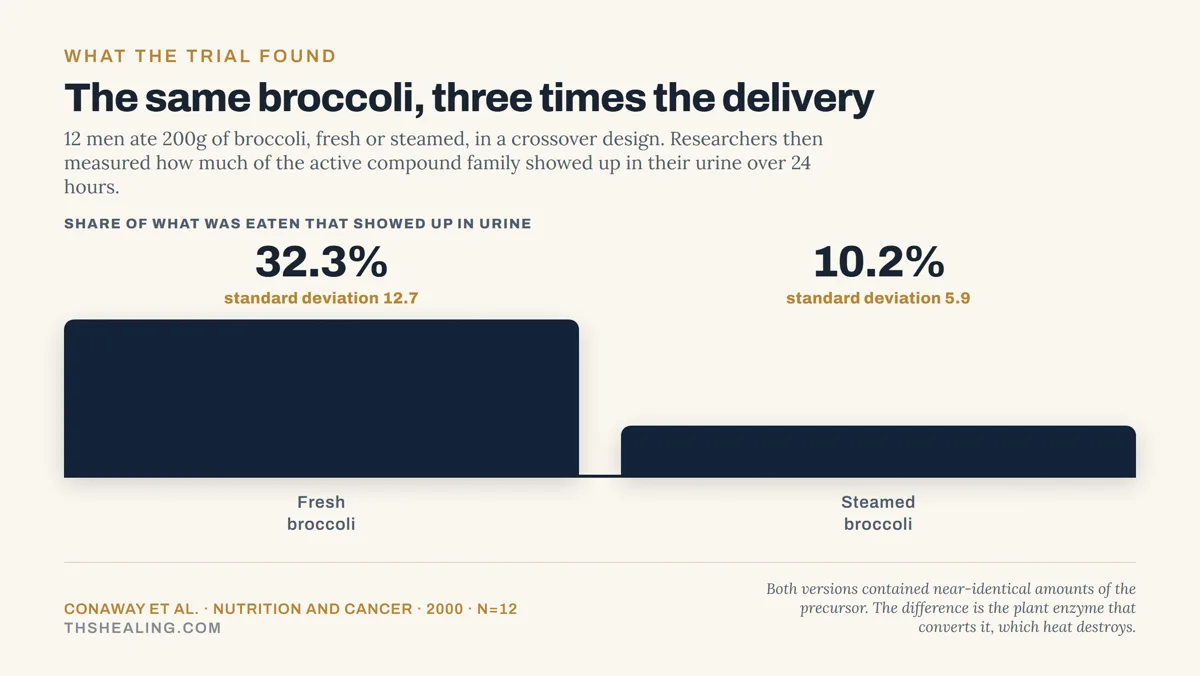
Bioavailability from fresh broccoli was roughly three times greater than from cooked, and the authors name the reason directly: myrosinase, the enzyme that does the conversion, is inactivated by heat.
If this feels familiar, it should
We wrote almost this exact article about garlic, and the mechanism is the same shape.
A broccoli plant stores glucoraphanin in one place and the enzyme myrosinase in another. They stay apart until something breaks the tissue. When you chop or chew it, they meet, and the enzyme converts the inert precursor into sulforaphane, which is the compound everybody is actually interested in.
Enzymes are proteins. Heat destroys proteins.
So a whole floret dropped into boiling water has its converting machinery switched off before it ever gets to work, and most of the precursor travels through you unchanged. Your gut bacteria convert a little of it, which is where that remaining 10.2% comes from, but they are far less efficient than the plant’s own enzyme.
The lesson is the same one the garlic research taught: give the plant’s enzyme its working window before heat arrives.
What to actually do about it
Three options, in order of how little they ask of you.
Chop and wait. Cut the broccoli, let it sit while you do the rest of your prep, then cook. Same logic as garlic: the enzyme starts converting immediately, and what it has already made survives the pan.
Add raw myrosinase back at the end. This is the trick worth knowing. The enzyme exists in other mustard-family plants, and those plants do not have to be broccoli. A quarter teaspoon of mustard powder, a handful of rocket, some grated radish, or a few raw florets stirred through at the end all bring working enzyme to cooked broccoli. This is the same move as adding raw garlic juice back to microwaved garlic, which restored the activity entirely in that study.
Eat some of it raw. Raw broccoli in a salad, or florets with something to dip them in, loses nothing.
None of this means steamed broccoli is worthless. Ten percent of something is not zero, steamed broccoli is still a vegetable, and a broccoli you will actually eat beats a raw one you will not.
What this study does and does not show
It measured absorption. That is all.
It tells you how much of a compound reached your bloodstream and left in your urine. It does not tell you what that compound did while it was in there, and it is not a cancer study, despite the journal’s name.
The claims that get attached to sulforaphane run well ahead of the human evidence, which is the subject of the companion piece on sprouts. What this trial establishes is narrow and genuinely useful: your cooking method changes the dose by a factor of three.
Where the design shows up
Four articles into writing about plants, the pattern has stopped being a coincidence.
Turmeric needs a partner compound to be absorbed at all. Green tea needs to stay dilute to stay safe. Beans need bacteria to finish the work. Garlic and broccoli both keep their chemistry in two locked halves until something breaks them open.
Not one of these foods simply hands over what it has. Every one has a condition attached, and the conditions turn out to be the things kitchens have done for centuries without knowing why.
“Then God said, ‘Behold, I have given you every plant yielding seed that is on the surface of all the earth, and every tree which has fruit yielding seed; it shall be food for you.’” Genesis 1:29, NASB
The verse carries the conviction. The twelve men carry the evidence.
What to do this week
Chop it first, cook it briefly, and keep mustard powder in the cupboard.
Cut the broccoli at the start of your prep. Steam or roast it for as short a time as gets it edible, not until it is soft. Stir a pinch of mustard powder through it at the end, off the heat.
That is the whole protocol and it costs nothing.
Read this next: the companion asks whether the famous sprout claim holds up, and the honest answer is more complicated than the headline: broccoli sprouts carry up to a hundred times the compound, and here is what that does and does not mean. The same enzyme lesson in another kitchen staple is the garlic step most kitchens skip.
Sources
- Conaway CC, Getahun SM, Liebes LL, Pusateri DJ, Topham DK, Botero-Omary M, Chung FL. “Disposition of glucosinolates and sulforaphane in humans after ingestion of steamed and fresh broccoli.” Nutrition and Cancer, 2000;38(2):168-178. https://pubmed.ncbi.nlm.nih.gov/11525594/
- Fahey JW, Zhang Y, Talalay P. “Broccoli sprouts: an exceptionally rich source of inducers of enzymes that protect against chemical carcinogens.” Proceedings of the National Academy of Sciences, 1997;94(19):10367-10372. https://pubmed.ncbi.nlm.nih.gov/9294217/
- Cavagnaro PF, Camargo A, Galmarini CR, Simon PW. “Effect of cooking on garlic (Allium sativum L.) antiplatelet activity and thiosulfinates content.” Journal of Agricultural and Food Chemistry, 2007;55(4):1280-1288. https://pubmed.ncbi.nlm.nih.gov/17256959/
Article metadata retrieved from PubMed.
Educational content from True Health Solutions. We do not diagnose or prescribe, and nothing here is a substitute for care from someone who knows your history. The body heals. We write about what supports that design.
Questions people ask
- Does cooking broccoli destroy the good compounds?
- It destroys the enzyme that makes them. In a crossover study of 12 men eating 200g of broccoli, 32.3% of the active compound family showed up in urine after fresh broccoli versus 10.2% after steamed. Both versions contained nearly identical amounts of the precursor.
- What is actually being destroyed?
- Myrosinase, a plant enzyme that converts glucoraphanin into sulforaphane when the tissue is damaged. Heat inactivates it. Without it, most of the precursor passes through unconverted.
- So do I have to eat broccoli raw?
- No. Chop it and let it stand before cooking so the enzyme works first, or add a raw source of myrosinase at the end, such as mustard powder, radish, rocket or a few raw florets. Both restore much of the conversion.
- Why does this sound like the garlic advice?
- Because it is the same mechanism. Garlic keeps alliin and alliinase apart until you cut it, and heat kills the enzyme. Broccoli keeps glucoraphanin and myrosinase apart the same way.
- Does this mean broccoli prevents cancer?
- No, and we do not claim that. This study measured how much of a compound reaches your bloodstream, not what it does once there.
