
education · food ·
Broccoli Sprouts Have Up To 100x More Sulforaphane. Here's What That Does & Doesn't Mean
The number is real and it comes from Johns Hopkins. What it means for a person is a different question with a much thinner answer.
In 1997, three researchers at Johns Hopkins published a finding that launched an entire industry.
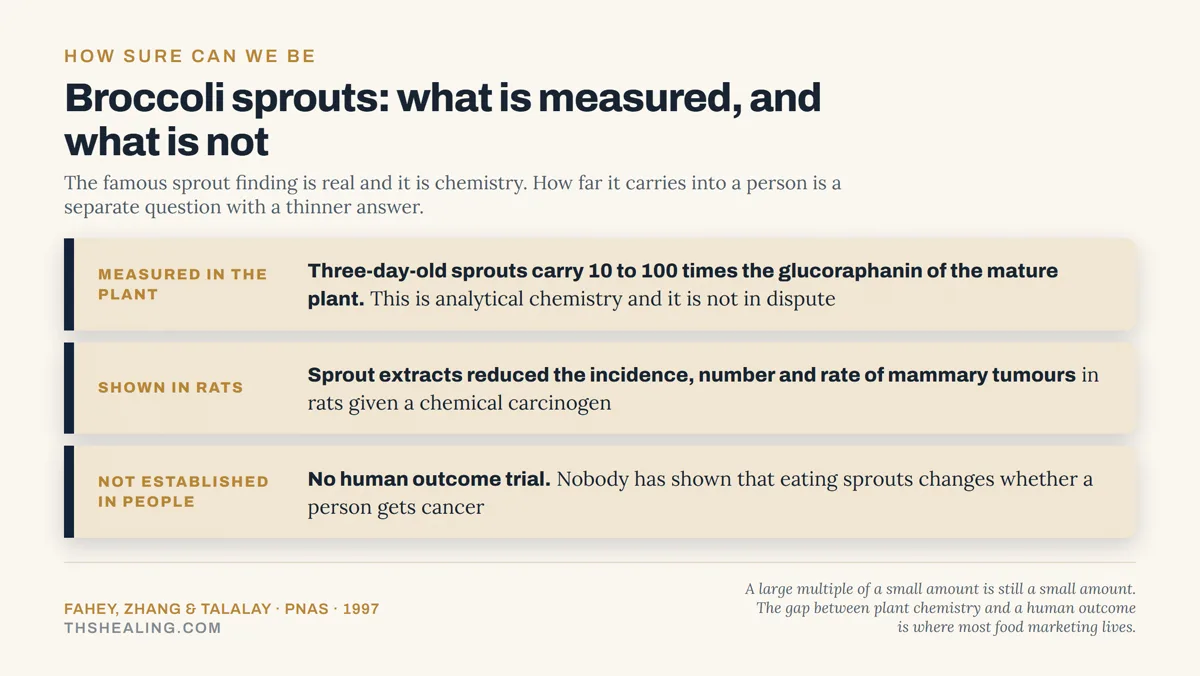
Three-day-old broccoli sprouts, they reported, contain 10 to 100 times more glucoraphanin than the mature plant. Glucoraphanin is the precursor to sulforaphane, the compound the previous article was about.
The number is real. Almost everything built on top of it deserves more scrutiny than it gets.
What the paper actually found
The finding was, in the authors’ own word, unexpected (Fahey, Zhang and Talalay, PNAS, 1997). Sprouts of certain broccoli and cauliflower cultivars, three days old, carried 10 to 100 times the glucoraphanin of the corresponding grown plants.
Note the range. It is 10 to 100, depending on cultivar. The figure usually repeated online is 20 to 50, which is narrower and more confident than the paper is.
They then fed extracts of those sprouts to rats that had been given a chemical carcinogen, and the extracts reduced the incidence, the number, and the rate of development of mammary tumours.
The three tiers, and where the marketing lives
Tier one is chemistry, and it is solid. The sprouts really do contain that much more. Nobody disputes it. It is a measurement of a plant, made with standard analytical methods.
Tier two is rats. Sprout extracts really did reduce tumours in rats exposed to a carcinogen. That is a meaningful experimental result and it is why anyone kept investigating.
Tier three does not exist yet. There is no trial showing that people who eat broccoli sprouts get less cancer. Not a weak one. Not a mixed one. The outcome study has not been done.
Every sprout powder sold on the strength of “100 times more sulforaphane” is quoting tier one and letting you assume tier three.
Two things worth holding onto
First, a large multiple of a small amount is still a small amount. You eat a handful of sprouts and you eat a whole head of broccoli. The per-gram ratio is enormous; the per-meal ratio is much less dramatic. The authors themselves frame it carefully: small quantities of crucifer sprouts may protect as effectively as much larger quantities of the mature vegetable. That is a claim about equivalence, not about superiority.
Second, and this one genuinely surprised us, there is a detail in the paper that cuts in the sprouts’ favour and almost nobody quotes it. Mature broccoli is dominated by a different family of compounds called indole glucosinolates. Sprouts of many cultivars contain negligible amounts of them. The authors note that indole glucosinolates can produce breakdown products, including indole-3-carbinol, that may enhance tumour development.
So the sprout advantage may not only be more of the good thing. It may also be less of an ambiguous thing. That is a more interesting argument than the one on the packaging, and it is sitting in the original paper where anybody could have read it.
The part the sprout industry does not put on the label
Raw sprouts carry a real food safety risk, and this is not a fringe concern.
The conditions that make a seed sprout, warmth and moisture and time, are also excellent conditions for growing bacteria. Sprouts have been behind a long line of outbreaks. People who are pregnant, elderly, very young, or immunocompromised are routinely advised to avoid raw sprouts entirely.
If you are reading about sprouts because someone in your house is unwell, that advice applies to exactly the person you are trying to help. We would rather tell you that than sell the cheerful version.
Where the design shows up
There is something worth noticing about a seed three days out of the ground.
That is the most vulnerable moment in a plant’s life. No bark, no thorns, no size, nothing to hide behind. What it has instead is chemistry, concentrated far beyond what the grown plant bothers to carry, because the grown plant has other defences.
The compound we are all chasing is a seedling’s entire arsenal.
“Then God said, ‘Behold, I have given you every plant yielding seed that is on the surface of all the earth, and every tree which has fruit yielding seed; it shall be food for you.’” Genesis 1:29, NASB
The verse carries the conviction. The chemistry carries itself, and stops exactly where the evidence stops.
What to do this week
Eat broccoli. Add sprouts if you enjoy them.
That is the honest order. The mature vegetable has the human data behind it as part of a whole-food pattern. Sprouts have spectacular chemistry and a rat study.
If you want sprouts, growing them in a jar costs a few dollars and takes three days, which is far cheaper than any powder and lets you control the conditions. Rinse them properly, twice a day, and throw away anything that smells wrong.
And remember the enzyme lesson from the companion piece: a few raw sprouts stirred into cooked broccoli at the end is a genuinely clever move, because the sprouts bring both extra precursor and working enzyme to a dish where heat destroyed the enzyme.
What we would not do is buy a supplement on the strength of a number measured in a plant.
Read this next: the cooking half of this pair, where steaming threw away two thirds of the compound: steaming broccoli threw away two thirds of it. For the same gap between plant chemistry and human outcomes, see what green tea does to cancer cells in a dish.
Sources
- Fahey JW, Zhang Y, Talalay P. “Broccoli sprouts: an exceptionally rich source of inducers of enzymes that protect against chemical carcinogens.” Proceedings of the National Academy of Sciences, 1997;94(19):10367-10372. https://pubmed.ncbi.nlm.nih.gov/9294217/
- Conaway CC, Getahun SM, Liebes LL, Pusateri DJ, Topham DK, Botero-Omary M, Chung FL. “Disposition of glucosinolates and sulforaphane in humans after ingestion of steamed and fresh broccoli.” Nutrition and Cancer, 2000;38(2):168-178. https://pubmed.ncbi.nlm.nih.gov/11525594/
- Filippini T, Malavolti M, Borrelli F, Izzo AA, Fairweather-Tait SJ, Horneber M, Vinceti M. “Green tea (Camellia sinensis) for the prevention of cancer.” Cochrane Database of Systematic Reviews, 2020;3(3):CD005004. https://pubmed.ncbi.nlm.nih.gov/32118296/
Article metadata retrieved from PubMed.
Educational content from True Health Solutions. We do not diagnose or prescribe, and nothing here is a substitute for care from someone who knows your history. The body heals. We write about what supports that design.
Questions people ask
- How much more sulforaphane is in broccoli sprouts?
- Three-day-old sprouts of certain broccoli and cauliflower cultivars contain 10 to 100 times higher levels of glucoraphanin, the precursor to sulforaphane, than the corresponding mature plants. That range is from the original 1997 paper, not the 20 to 50 times often quoted.
- Does eating sprouts prevent cancer?
- No human outcome trial has shown that, and we do not claim it. Sprout extracts reduced mammary tumours in rats given a chemical carcinogen. Rats are not people and an extract is not a salad.
- Are sprouts better than regular broccoli?
- Per gram, dramatically. In practice you eat a handful of sprouts and a whole head of broccoli, so the totals are closer than the multiple suggests. Sprouts are a supplement to the vegetable, not a replacement.
- Is there a downside to sprouts?
- Raw sprouts of any kind carry a real food-safety risk, because the warm damp conditions that sprout a seed also grow bacteria. People who are pregnant, elderly, very young or immunocompromised are usually advised to avoid raw sprouts.
- What is the interesting detail nobody mentions?
- The same paper found sprouts contain negligible amounts of indole glucosinolates, which dominate in mature broccoli and can produce breakdown products that the authors note may enhance tumour development. That cuts in the sprouts' favour and almost never gets quoted.
