
food · heart · education ·
3 Grams Of Oat Fiber A Day Lowered LDL Across 28 Trials. More Did Not Help
The dose behind the oat cholesterol claim is smaller than most people assume, and eating four times more of it did not move the number any further.
The oats-and-cholesterol claim is one of the oldest in food marketing, which usually means one of two things. Either it has been repeated so long that nobody checked, or it has been checked so thoroughly that it became boring.
This one is the second kind, and the interesting part is the dose.
The number
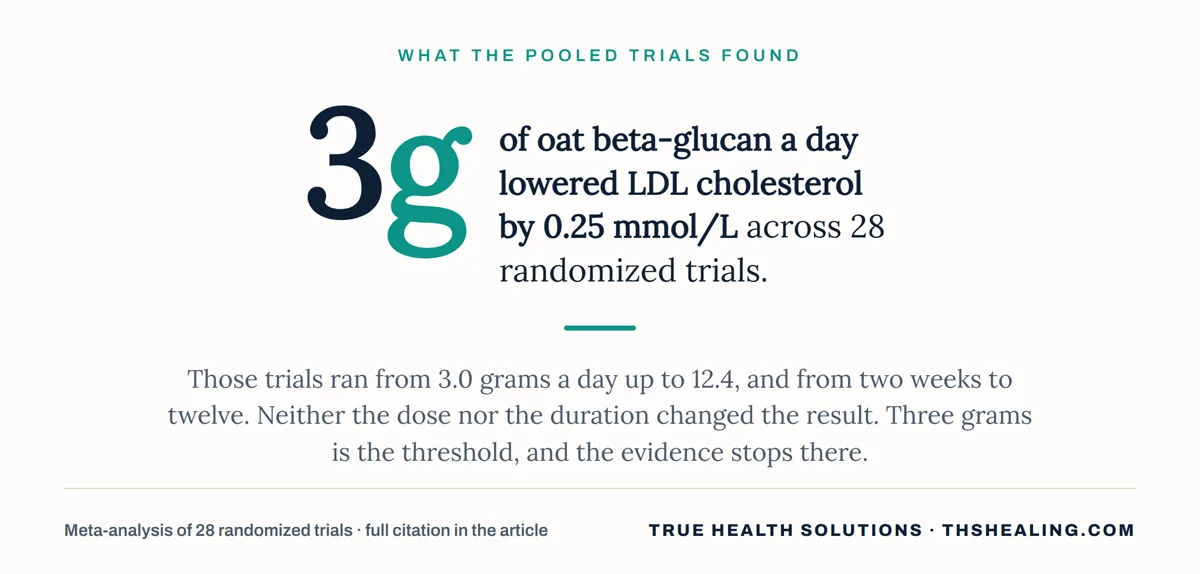
Researchers pooled 28 randomized controlled trials of oat beta-glucan at three grams a day or more (Whitehead et al., American Journal of Clinical Nutrition, 2014).
Against control, that dose lowered:
- LDL cholesterol by 0.25 mmol/L
- Total cholesterol by 0.30 mmol/L
Both highly significant. Neither dramatic.
That is the honest shape of it. This is not a statin and nobody in the literature claims it is. It is a reliable nudge from a breakfast you were going to eat anyway.
The part that should change what you buy
Trials in the analysis used doses ranging from 3 grams a day up to 12.4 grams. That is a fourfold spread.
There was no evidence that the higher doses worked better.
Nor did duration. Treatment periods ran from two to twelve weeks and longer did not mean more.
So the threshold is roughly the whole story. Three grams gets you the effect. Eating a mountain of oats does not get you four times the effect, and the products marketed on extra fiber content are selling past the point where the evidence stops.
Three grams of beta-glucan is about one cup of cooked oatmeal, or roughly 40 to 50 grams of dry oats. That is an ordinary bowl.
What it does not touch
No significant effect on HDL cholesterol. No significant effect on triglycerides.
We mention this because the way this gets marketed tends to blur into general heart health, and the measured effect is narrower than that. Oats move the LDL number. They do not appear to move the others.
Who it helps most
Two subgroups did better.
People starting with higher LDL saw significantly greater reductions. The further from where you want to be, the more room there is to move, which is a pattern that shows up across a lot of nutrition research.
People with diabetes also showed a greater effect for both LDL and total cholesterol, though the authors flag that this rested on few studies, so we will flag it too.
Why the form probably matters
The active fraction is beta-glucan, a soluble fiber that forms a gel in the gut. The working explanation is that the gel traps bile acids and carries them out, and the body pulls cholesterol from the blood to make more.
That mechanism depends on the fiber actually gelling, which is worth knowing when you look at the oat aisle. Instant oats with the fiber structure processed down, and oat products where the oats are a minor ingredient behind sugar, are not obviously the thing that was tested. The trials fed oat beta-glucan at a known dose.
There is a real number behind that worry. When food scientists extruded oat bran cereal under increasingly severe conditions, the beta-glucan’s molecular weight fell from 1,930,000 to 251,000 g/mol, and the apparent viscosity in a simulated gut extract collapsed from 2,900 to 131 mPa.s, a drop of more than twentyfold (Tosh et al., Journal of Agricultural and Food Chemistry, 2010).
Grade that carefully: it is food chemistry measuring viscosity in a lab, not a trial measuring anybody’s cholesterol. It shows processing can destroy the property the mechanism depends on. It does not prove a given cereal on a given shelf fails to work.
What we can say is that the dose is what was measured, and that gentler processing preserves the thing doing the work.
Does the wider whole-grain picture agree
Separately, a review of 25 randomized trials replacing refined grains with whole grains found that whole-grain oats specifically improved total cholesterol and LDL, with standardised effects of -0.54 and -0.57 (Marshall et al., Journal of the Academy of Nutrition and Dietetics, 2020).
Those authors add the sentence we are obliged to pass on: there is insufficient evidence to recommend whole grains over refined grains for the prevention and treatment of cardiovascular disease. Markers moved. Whether moving them prevents heart attacks is a different and unanswered question.
That is the gap between a number changing and a life changing, and it is the gap most food marketing walks straight across.
Where the design shows up
Three grams. A bowl. Every day.
There is something in this literature that keeps turning up on this site: the effective dose of a real food is usually an ordinary serving of it, and the curve flattens after that. A Brazil nut is one nut. A blueberry effect shows up at one cup, not half. Oats stop improving at three grams.
Provision tends to arrive sized correctly, and most of what gets sold past that point is being sold, not needed.
“Give us this day our daily bread.” Matthew 6:11, NASB
The verse carries the conviction. Twenty-eight trials carry the number.
What to do this week
One ordinary bowl of oatmeal, most mornings.
Not a special oat product, not a supplement, not double portions. About a cup cooked, which puts you at the dose the trials used.
If your LDL is high, this literature says you are the person who gets the most from it. If your LDL is already where you want it, the effect will be smaller, and that is fine.
Read this next: for the other half of a breakfast that holds, three plant breakfasts built from the satiety trials. And for the wider rule this fits, whole foods beat their own supplements in 46 trials.
Sources
-
Whitehead A, Beck EJ, Tosh S, Wolever TMS. “Cholesterol-lowering effects of oat beta-glucan: a meta-analysis of randomized controlled trials.” The American Journal of Clinical Nutrition, 2014;100(6):1413-1421. https://pubmed.ncbi.nlm.nih.gov/25411276/
-
Marshall S, Petocz P, Duve E, et al. “The Effect of Replacing Refined Grains with Whole Grains on Cardiovascular Risk Factors: A Systematic Review and Meta-Analysis of Randomized Controlled Trials with GRADE Clinical Recommendation.” Journal of the Academy of Nutrition and Dietetics, 2020;120(11):1859-1883. https://pubmed.ncbi.nlm.nih.gov/32933853/
-
Tosh SM, Brummer Y, Miller SS, et al. “Processing affects the physicochemical properties of beta-glucan in oat bran cereal.” Journal of Agricultural and Food Chemistry, 2010;58(13):7723-7730. https://pubmed.ncbi.nlm.nih.gov/20527967/
Article metadata retrieved from PubMed. Scripture quoted from the New American Standard Bible.
Educational content from True Health Solutions. We do not diagnose or prescribe, and nothing here is a substitute for care from someone who knows your history. The body heals. We write about what supports that design.
Questions people ask
- How much oat fiber lowers cholesterol?
- Three grams a day of oat beta-glucan. That is the threshold behind the health claims approved by food agencies worldwide, and a meta-analysis of 28 randomized trials confirmed it lowers LDL and total cholesterol at that dose.
- How much does it actually lower LDL?
- By about 0.25 mmol/L for LDL and 0.30 mmol/L for total cholesterol, compared with control. It is a modest, reliable shift rather than a dramatic one.
- Does eating more oats work better?
- Across trials using between 3 and 12.4 grams a day, there was no evidence that a higher dose produced a bigger effect. Neither did longer treatment, over the 2 to 12 week range studied.
- Who gets the most benefit?
- People starting with higher LDL saw significantly greater reductions. The trials also found a greater effect in people with diabetes, though that came from a small number of studies.
- Does it change HDL or triglycerides?
- No. The pooled analysis found no significant effect on HDL cholesterol or triglycerides. The effect is specific to LDL and total cholesterol.
