
food · education ·
Half A Cup Of Soybeans A Day Cut Hot Flashes 79% In A 12-Week Trial
Isoflavone supplements reduced hot flash frequency by about 20% across 19 trials. Whole soybeans on a plant-based plate did considerably better than that.
Menopause research is a field where women have been told for decades to either take hormones or put up with it. Soy sits in the middle of that argument, usually discussed as a supplement.
The most interesting result in this literature did not come from a capsule.
What the supplement trials found
Researchers pooled 19 randomized trials of extracted or synthesized soybean isoflavones against placebo (Taku et al., Menopause, 2012).
At a median dose of about 54mg of isoflavones a day, taken for six weeks to twelve months:
- Hot flash frequency fell 20.6% compared with placebo (95% CI -28.38 to -12.86)
- Hot flash severity fell 26.2% (95% CI -42.23 to -10.15)
One detail worth keeping. Supplements providing more than 18.8mg of genistein were more than twice as effective at reducing frequency as those providing less. Not all isoflavone products are carrying the same thing.
The heterogeneity across these trials was high, which the authors flag and so do we. Twenty percent is a real average sitting on top of a lot of variation.
Then somebody tried the bean
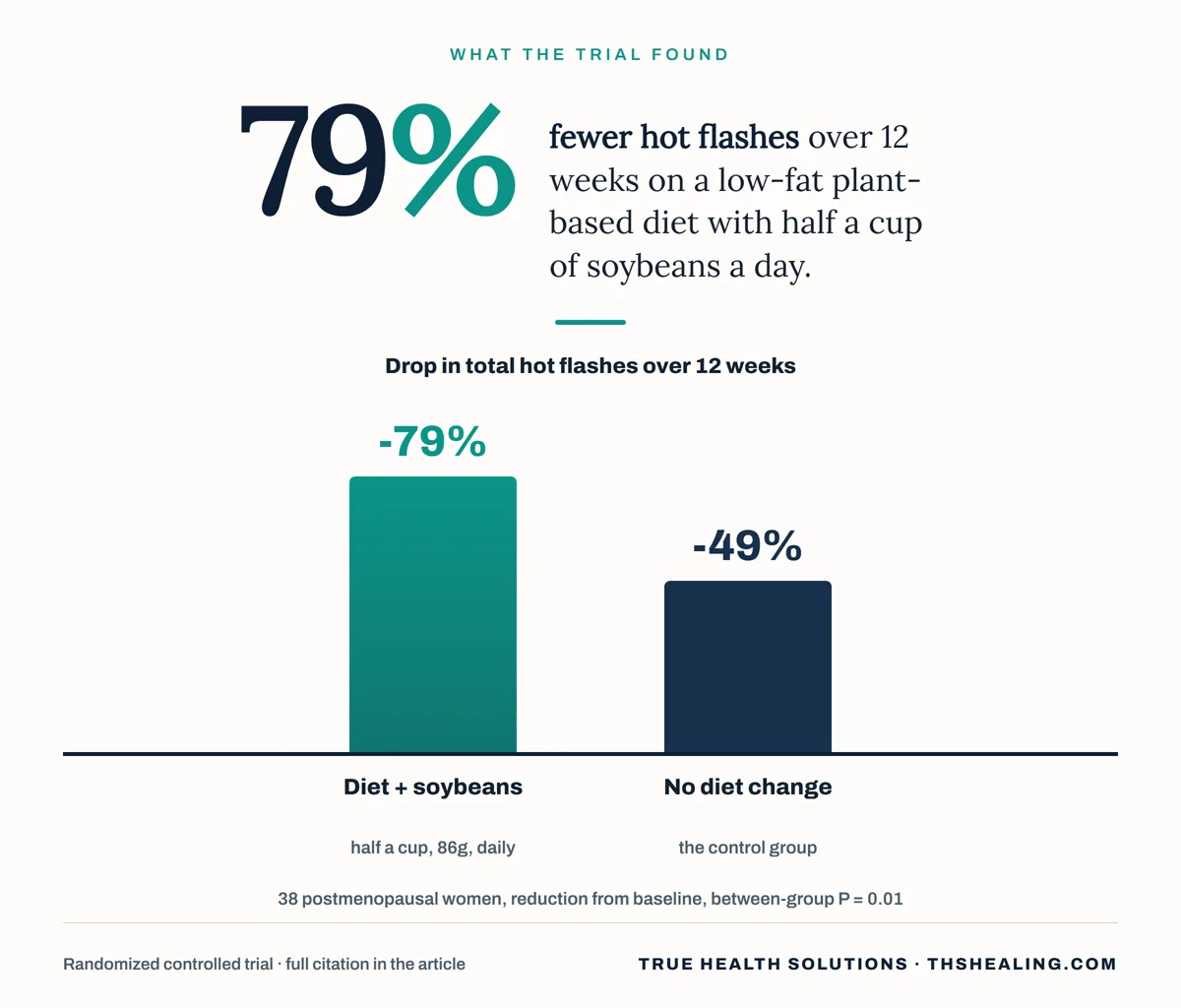
A randomized controlled trial took 38 postmenopausal women reporting two or more hot flashes a day and assigned them either to no dietary change, or to a low-fat plant-based diet including half a cup, 86g, of cooked soybeans daily for 12 weeks (Barnard et al., Menopause, 2021).
The results were not in the same range as the supplement literature.
- Total hot flashes fell 79% in the intervention group, against 49% in the control group
- Moderate-to-severe hot flashes fell 84%, against 42%
- 59% of the intervention group became free of moderate and severe hot flashes entirely
Quality of life improved significantly across vasomotor, psychosocial, physical and sexual domains.
During the 12-week study period, the majority of intervention-group participants became free of moderate-to-severe hot flashes.
Barnard et al., Menopause, 2021
Read that honestly before you get excited
Thirty-eight women. Twelve weeks. Not blinded, because you cannot blind somebody to what is on their plate.
And look at the control group: 49% fewer hot flashes with no intervention at all. That is an enormous placebo and attention effect, and it tells you how much of this symptom moves simply from paying attention to it. The comparison that matters is between the groups, and that held up at P = 0.01.
So this is not proof that soybeans are four times better than a supplement. The trials were never run against each other, the populations differ, and one was a whole diet change while the other was a capsule.
What it does show is that a whole-food approach, in a small trial, produced results well beyond what the pooled supplement evidence reports. That pattern is familiar around here.
The pattern this belongs to
This is now the fifth time on this site that the whole food has outperformed the isolated compound taken from it, or at least held its own while being cheaper and less exotic.
Whole polyphenol-rich foods beat purified extracts on blood pressure across 46 trials. Liquid vinegar beat vinegar tablets containing more acetic acid. Fresh broccoli beat steamed because of an enzyme the processing destroyed. Brazil nuts work at one nut.
We do not claim a law of nature here. But when the soy conversation is almost entirely about which isoflavone supplement to buy, it is worth noticing that the trial with the largest effect used beans.
Why it works for some women and not others
There is a reason the supplement trials are so heterogeneous, and it is not dose.
Isoflavones only become the most active compound, equol, if your gut bacteria can make the conversion. Roughly speaking, some people are equol producers and some are not, and that appears to be a major determinant of whether soy does anything for you.
A review of six trials in 779 women looked specifically at this, and found that supplementing equol itself to equol non-producers significantly lowered the incidence and severity of hot flashes (Daily et al., Journal of Medicinal Food, 2018).
Two of the five trials in their meta-analysis found no significant benefit and three did, which is worth saying rather than smoothing over. But the underlying idea explains a lot: if soy has done nothing for you, it may be your microbiome rather than the bean.
A note on the soy scare
Soy spent two decades being accused of causing breast cancer and feminising men, largely on the strength of rodent studies and internet confidence.
We are not going to relitigate that here beyond one line: the trials above were conducted in women going through menopause, published in the journal of the North American Menopause Society, and the discussion is about dose and preparation rather than danger.
If you have an oestrogen-receptor-positive cancer history, that is a genuine conversation to have with whoever manages your care, not a question to settle from an article.
Where the design shows up
A bean. Half a cup. Cooked.
The thing that keeps striking us in this work is how ordinary the effective dose usually is. Not a proprietary extract standardised to a percentage nobody can verify. Something you can buy dried in a bag, soak overnight, and eat.
“Then God said, ‘Behold, I have given you every plant yielding seed that is on the surface of all the earth.’” Genesis 1:29, NASB
The verse carries the conviction. Nineteen pooled trials and one small feeding study carry the numbers, including the one that says the control group improved too.
What to do this week
Half a cup of cooked soybeans, most days, if hot flashes are part of your life.
Edamame is the easy entry point and it is the same bean. Tempeh and tofu are the other whole-food forms. The trial that produced the striking number ran soybeans alongside a low-fat plant-based diet, so the bean was part of a plate, not a pill taken with the usual food.
Give it more than a fortnight. The trials ran six weeks at minimum and twelve in the one with the big result.
Read this next: the wider version of this pattern, where whole foods beat their own purified extracts across 46 trials: whole foods beat their own supplements. And for another bean that earns its place on the plate, beans at dinner cut blood sugar 15% the next morning.
Sources
-
Taku K, Melby MK, Kronenberg F, Kurzer MS, Messina M. “Extracted or synthesized soybean isoflavones reduce menopausal hot flash frequency and severity: systematic review and meta-analysis of randomized controlled trials.” Menopause, 2012;19(7):776-790. https://pubmed.ncbi.nlm.nih.gov/22433977/
-
Barnard ND, Kahleova H, Holtz DN, et al. “The Women’s Study for the Alleviation of Vasomotor Symptoms (WAVS): a randomized, controlled trial of a plant-based diet and whole soybeans for postmenopausal women.” Menopause, 2021;28(10):1150-1156. https://pubmed.ncbi.nlm.nih.gov/34260478/
-
Daily JW, Ko BS, Ryuk J, Liu M, Zhang W, Park S. “Equol Decreases Hot Flashes in Postmenopausal Women: A Systematic Review and Meta-Analysis of Randomized Clinical Trials.” Journal of Medicinal Food, 2019;22(2):127-139. https://pubmed.ncbi.nlm.nih.gov/30592686/
Article metadata retrieved from PubMed. Photograph from Pexels. Scripture quoted from the New American Standard Bible.
Educational content from True Health Solutions. We do not diagnose or prescribe, and nothing here is a substitute for care from someone who knows your history. The body heals. We write about what supports that design.
Questions people ask
- Does soy help with hot flashes?
- In pooled trials, yes. A meta-analysis of 19 randomized trials found soy isoflavones reduced hot flash frequency by 20.6% and severity by 26.2% compared with placebo. A separate randomized trial using whole soybeans in a plant-based diet reported considerably larger reductions.
- How much soy was used?
- The supplement trials used a median of about 54mg of isoflavones a day. The whole-food trial used half a cup, 86g, of cooked soybeans daily alongside a low-fat plant-based diet, for 12 weeks.
- Is the whole bean better than a supplement?
- The trials were not run head to head, so we cannot say that cleanly. What we can say is that the supplement meta-analysis found around 20% fewer hot flashes, while the whole-soybean plus plant-based-diet trial reported 79% fewer, with 59% of that group becoming free of moderate and severe hot flashes.
- How big was the whole-food trial?
- Small. Thirty-eight postmenopausal women, 12 weeks, and the control group also improved by 49%, which is a large placebo and attention effect. The between-group difference was still significant at P = 0.01.
- Does the type of isoflavone matter?
- It appears to. Supplements providing more than 18.8mg of genistein, the median across the studies, were more than twice as effective at reducing hot flash frequency as those providing less.
