
education · fundamentals ·
Why Coming Off A Medication Can Feel Like Proof You Still Need It
When a symptom returns louder than before, it can look like proof you needed the drug. Sometimes it is the body rebounding, and the difference matters.
Here is a trap that catches a lot of people, and almost nobody gets warned about it.
Someone has moderate anxiety. They are prescribed a medication for it. A few months later they decide they would rather not be on it, so they stop. Within days the anxiety is back, and it is not the anxiety they had before. It is worse. Much worse.
They draw the only conclusion that seems available: this is what I am actually like underneath. The pill was holding back something serious. I need it.
Maybe that is right. Sometimes it is exactly right, and the medication is doing important work. But there is a second explanation that fits the same facts, and if nobody has ever explained it, it never gets considered.
What rebound actually is
Your body is built to hold a steady state. Push it one direction and it pushes back to stay level.
Put a drug in that system every day and the system adapts around it. Receptors adjust their sensitivity. The body recalibrates to a new normal in which the drug is part of the furniture.
Take the drug away and that adaptation is still there, now with nothing to push against. For a stretch, the symptom the drug was controlling can come back louder than it was before you ever started. That overshoot is the rebound effect.
The important part: rebound is usually temporary. It is the system finding level again. It is not a readout of who you are without the medication.
Rebound, withdrawal and relapse are three different things
These get mashed together constantly, and the confusion is where the damage happens.
Withdrawal is new symptoms caused by the drug’s absence. Dizziness, the “brain zaps” people describe as electric shocks, nausea, flu-like aching. Nobody mistakes these for their original condition, because they were never part of it.
Rebound is the original symptom returning, amplified, then settling.
Relapse is the original condition genuinely coming back, at its own level, on its own timeline.
Rebound and relapse look alike from the inside. Both feel like the thing you were treating. The difference is the shape over time: rebound spikes and then eases as the body recalibrates, while relapse builds and stays.
That distinction is not academic. It decides whether someone concludes “I got worse and I need to go back on” or “I am in the hard part of a taper and it passes.”
This is documented, not a theory
The best evidence is in the antidepressant literature.
A systematic review of 24 studies found withdrawal incidence ranging from 27% to 86%, with a weighted average of 56%. Across four large studies measuring severity, a weighted average of 46% of those experiencing withdrawal endorsed the most extreme severity rating offered (Davies and Read, Addictive Behaviors, 2019).
The guidelines at the time said these reactions were self-limiting and typically resolved in one to two weeks. Seven of the ten studies reporting duration contradicted that. Mean durations in the four studies that calculated one were 5 days, 10 days, 43 days, and 79 weeks.
A 2025 reanalysis of a competing review, restricted to the five studies using systematic measurement, put the pooled figure at 55%, with a wide confidence interval of 31% to 81% (Moncrieff et al., Psychological Medicine, 2025). The researchers named misclassification of withdrawal symptoms as relapse as a specific flaw in how this has been studied.
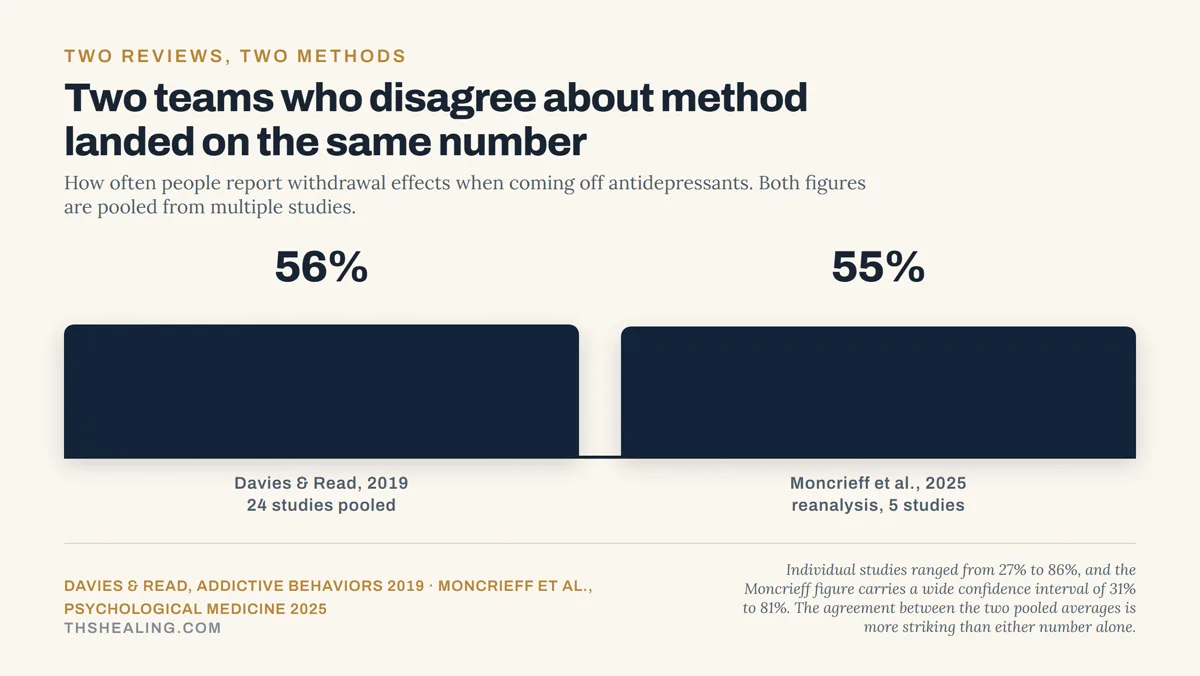
Two teams, different methods, an open disagreement about how to measure this, and they land one point apart. When people who are arguing arrive at the same number, that number is usually worth taking seriously.
The part that should make you angry
Read what the review authors concluded, because they say the thing plainly.
The guidelines, they wrote, “are probably leading to the widespread misdiagnosing of withdrawal, the consequent lengthening of antidepressant use, much unnecessary antidepressant prescribing and higher rates of antidepressant prescriptions overall.”
Sit with the machinery in that sentence. Someone stops. They feel terrible. The reaction gets read as the illness returning rather than as the body adjusting. The medication is restarted, often at a higher dose. And the episode becomes permanent evidence, to them and to their chart, that they are someone who cannot manage without it.
Nobody in that chain acted in bad faith. The prescriber followed the guideline. The patient reported real suffering. The suffering was real. It was just mislabeled, and the label is what set the course.
Why this hits hardest with anxiety medication
Benzodiazepines are worth naming separately, because the trap closes faster.
A 2025 consensus statement on deprescribing described the main difficulty in stopping these drugs as “the occurrence of rebound effects and withdrawal syndrome,” alongside physical and psychological dependence and progressive tolerance that pushes doses upward over time (Melcarne et al., Panminerva Medica, 2025).
We will flag the evidence honestly: that is an expert consensus document, not a randomized trial, so it carries less weight than the antidepressant numbers above. The antidepressant data is the stronger half of this article and we would rather say so than let the two blur together.
But the shape it describes is the one worth bracing for: someone goes on a medication for moderate anxiety, and the anxiety they meet on the way out is more severe than the anxiety they went in with. Tolerance is part of why. If the dose has been climbing to keep doing the same job, the gap left when it stops is wider than the one the first prescription filled.
What to actually do with this
Not stop your medication. Please read that sentence twice.
Bring it to your provider before you change anything. The whole value of knowing what rebound is shows up in that conversation, not in acting alone.

Ask about the taper specifically. How slowly, over what timeline, and what should be expected on the way. A plan made in advance is very different from a decision made in week two when everything feels awful.
Ask what rebound should look like for this particular drug, and how long. Then you have something to measure against instead of guessing.
Write down where you started. If you cannot remember how bad the anxiety was before the prescription, you have no baseline to compare to, and the comparison is the whole question.
Give it more time than feels reasonable before drawing conclusions. Rebound that is going to settle needs room to settle.
Where the design shows up
The body’s habit of pushing back toward level is not a defect. It is the same machinery that closes a wound, drops a fever, and rebuilds a muscle you tore.
Rebound is that machinery working correctly, in a situation it was not built for. The overshoot is evidence the system is still trying to find its footing, not evidence that the system is broken.
“I will give thanks to You, for I am fearfully and wonderfully made; wonderful are Your works, and my soul knows it very well.” Psalm 139:14, NASB
The verse carries the conviction. The 24 studies carry the evidence.
What to do this week
If you are on something and have wondered about coming off it, do not act. Ask.
Take one question to your next appointment: if I were ever to come off this, what would the taper look like, and what should I expect on the way? You are not committing to anything by asking. You are refusing to be surprised.
And if you have already tried to stop something and it went badly, that episode may not have told you what you concluded it told you. It is worth raising again, with this vocabulary in hand.
Read this next: the drug class where the stopping story was soft-pedalled longest, and what the trials actually found: what the antidepressant trials found, and what they left out about stopping. Anxiety and sleep are wound together, and the cheapest intervention for the sleep half happens in the first hour of your day: morning daylight worked as well as melatonin. For the fundamentals that sit underneath all of this, start at the 5 free habits that shape your health most.
Sources
- Davies J, Read J. “A systematic review into the incidence, severity and duration of antidepressant withdrawal effects: Are guidelines evidence-based?” Addictive Behaviors, 2019;97:111-121. https://pubmed.ncbi.nlm.nih.gov/30292574/
- Moncrieff J, Hobday H, Sørensen A, et al. “Evidence on antidepressant withdrawal: an appraisal and reanalysis of a recent systematic review.” Psychological Medicine, 2025;55:e191. https://pubmed.ncbi.nlm.nih.gov/40692314/
- Hengartner MP, Davies J, Read J. “Antidepressant withdrawal, the tide is finally turning.” Epidemiology and Psychiatric Sciences, 2019;29:e52. https://pubmed.ncbi.nlm.nih.gov/31434594/
- Melcarne R, Bernasconi S, Del Prete M, et al. “Deprescription of benzodiazepines and its management according to an overlapping strategy with a low-dose multicomponent medication: a Delphi consensus.” Panminerva Medica, 2025;67(1):14-26. https://pubmed.ncbi.nlm.nih.gov/40369963/
Article metadata retrieved from PubMed. Scripture quoted from the New American Standard Bible.
Educational content from True Health Solutions. We do not diagnose or prescribe, and nothing here is a substitute for care from someone who knows your history. Never start, stop, or change a prescription based on an article. The body heals. We write about what supports that design.
Questions people ask
- What is the rebound effect?
- Rebound is when the symptom a drug was controlling returns more intensely than it was before the drug started, because the body adapted to the drug being there. It is different from relapse, which is the original condition returning at its own level, and it is usually temporary.
- How is rebound different from withdrawal?
- Withdrawal is a set of new symptoms caused by the absence of the drug, things like dizziness, electric-shock sensations or flu-like feelings. Rebound is specifically the original symptom coming back louder. They often happen at the same time and get lumped together.
- How common are withdrawal effects from antidepressants?
- A systematic review of 24 studies found a weighted average incidence of 56%, with individual studies ranging from 27% to 86%. Of those who experienced withdrawal, a weighted average of 46% endorsed the most extreme severity rating offered.
- Does this mean antidepressants do not work?
- No, and that is not the argument. This is about what happens when someone stops, which is a separate question from whether the drug helped while they took it. Plenty of people are helped by medication and still deserve to know what stopping may feel like.
- Should I stop my medication?
- That is not a question an article can answer, and we are not suggesting it. Stopping or changing a prescription is a medical decision that belongs with a provider who knows your history. The point here is to go into that conversation informed.
