
education · fundamentals · sleep ·
Can't Fall Asleep? Morning Daylight Worked As Well As Melatonin
Researchers put people in a room with no clocks and no windows, then tested light against melatonin head to head. Light held its own.
Your body keeps time whether you participate or not.
Somewhere in your brain, a cluster of cells runs a clock that decides when you get sleepy, when your temperature drops, when cortisol rises to get you out of bed. Left entirely alone in a cave, that clock drifts. What keeps it aligned with the actual day is light.
The question is how much that is worth in practice. Researchers in Colorado built an experiment to find out.
The experiment
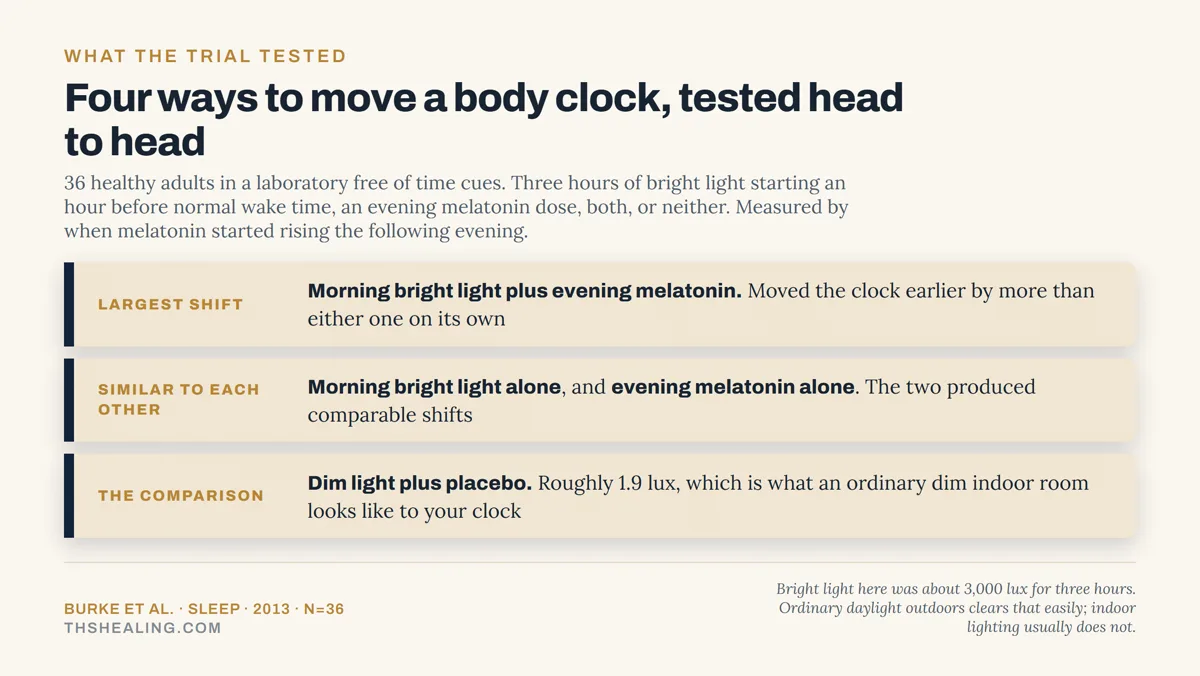
Thirty-six healthy adults, average age 22, in a laboratory deliberately stripped of time cues: no clocks, no windows, no way to know what time it was (Burke et al., Sleep, 2013).
They were randomized, double-blind, into four conditions. Dim light with a placebo. Dim light with 5 mg of melatonin in the early evening. Bright light with a placebo. Bright light with melatonin.
The bright light was about 3,000 lux, delivered for three hours starting one hour before each person’s habitual wake time. The melatonin went in about six hours before habitual bedtime.
Then they measured the outcome that actually matters for a body clock: dim light melatonin onset, meaning the moment in the evening when your body starts producing melatonin. That is the most reliable marker of where your internal clock is sitting.
What came out of it
Morning bright light combined with early evening melatonin advanced the clock more than either treatment alone.
And this is the line worth sitting with: bright light alone and melatonin alone induced similar phase advances.
Melatonin is the thing people buy. Light is the thing that is free and falls on your yard every morning. In this trial, they performed comparably.
The authors’ conclusion was that information from light and melatonin appears to be combined by the human circadian clock, which is a mechanistic finding, not a recommendation to take anything.
The number nobody tells you
Here is where most morning light advice quietly falls apart: brightness.
The trial used roughly 3,000 lux. The dim comparison condition was about 1.9 lux.
For scale, ordinary indoor lighting sits somewhere around 100 to 500 lux. An overcast day outdoors runs into the thousands. Direct sunlight goes far beyond that.
Which means the thing your clock responds to is not “light.” It is a quantity of light that indoor rooms essentially never produce. Sitting by a bright window with your coffee is closer to the dim condition than to the treatment.
You have to go outside. That is the whole mechanism in one sentence.
The number we are not going to give you
You will hear that morning light sets your melatonin release for a specific number of hours later. Sometimes it is fourteen. Sometimes it is sixteen.
That variation is the tell. It circulates as a teaching device, a way of making the mechanism memorable when someone is explaining circadian rhythm out loud, and it is a reasonable one. It is not a measurement anybody took, and we are not going to repeat it as though it were.
This is a different case from the ten-minute garlic rest, where the popular explanation was wrong but a real experiment sat underneath the number. Here there is no underlying experiment we can point you to, so there is no number to restore.
What the research supports is directional and still useful: morning bright light moves your clock earlier, by an amount comparable to what a melatonin dose does, and the effect is real enough to measure in a controlled laboratory.
We also cannot tell you the minimum effective dose from this study, because it tested three hours and did not test shorter. Most practical recommendations are shorter than that, and they are reasonable extrapolations rather than findings.
Where the design shows up
The first thing recorded as being made was light, and the first thing it did was separate a day from a night.
You are built to run on that separation. Not on a schedule you decide, but on a signal that arrives from outside you, at the same time, every morning, free.
“God called the light day, and the darkness He called night. And there was evening and there was morning, one day.” Genesis 1:5, NASB
The verse carries the conviction. The 36 people in that windowless lab carry the evidence. We keep those jobs separate, and we notice they keep agreeing.
What to do this week
Go outside in the first hour you are awake. Every day, whatever the weather.
Not by a window. Outside, where the lux is. Overcast still works and beats any room in your house.
Ten or fifteen minutes is the common recommendation and it is what we do. Be aware that this is shorter than what the trial tested, so treat it as a sensible floor rather than a proven dose. Longer is presumably better, and the difference between zero and fifteen minutes is almost certainly larger than the difference between fifteen and thirty.
Pair it with something you already do. Walk the dog. Drink the coffee on the step. Take the trash out slowly. The habit that survives is the one attached to a habit you already have.
And do the other end too. Bright light late at night pushes the clock the opposite way, which is worth knowing before you read your phone in a dark room at midnight.
Read this next: the other end of the same day, and what light in the bedroom tracked with: light in the bedroom at night tracked with worse metabolic markers. Why any of this matters beyond feeling rested: four short nights made fat cells three times less responsive to insulin. Sleep is pillar one in The Five Pillars of Owning Your Health, and if you want another free intervention with an outsized effect, three-minute walks cut post-meal blood sugar by 39%.
Sources
- Burke TM, Markwald RR, Chinoy ED, Snider JA, Bessman SC, Jung CM, Wright KP. “Combination of light and melatonin time cues for phase advancing the human circadian clock.” Sleep, 2013;36(11):1617-1624. https://pubmed.ncbi.nlm.nih.gov/24179293/
- Broussard JL, Ehrmann DA, Van Cauter E, Tasali E, Brady MJ. “Impaired insulin signaling in human adipocytes after experimental sleep restriction: a randomized, crossover study.” Annals of Internal Medicine, 2012;157(8):549-557. https://pubmed.ncbi.nlm.nih.gov/23070488/
- Spiegel K, Leproult R, Van Cauter E. “Impact of sleep debt on metabolic and endocrine function.” The Lancet, 1999;354(9188):1435-1439. https://pubmed.ncbi.nlm.nih.gov/10543671/
Article metadata retrieved from PubMed. Scripture quoted from the New American Standard Bible.
Educational content from True Health Solutions. We do not diagnose or prescribe, and nothing here is a substitute for care from someone who knows your history. The body heals. We write about what supports that design.
Questions people ask
- Does morning light really help you sleep at night?
- In a randomized controlled trial, three hours of bright light starting an hour before normal wake time shifted participants' clocks earlier, measured by when melatonin began rising the next evening. The shift was comparable to what an evening dose of melatonin produced.
- How bright does the light need to be?
- The trial used about 3,000 lux. An overcast day outdoors is roughly 1,000 to 10,000 lux and direct sun is far more. Typical indoor lighting is around 100 to 500 lux, which is why going outside works and sitting by a lamp usually does not.
- How long do I need to be outside?
- The trial used three hours, which is not a realistic daily habit for most people. Shorter exposures are widely recommended and we could not source a specific minimum from this study. Our practical answer is to get outside early for as long as you reasonably can, and to treat the three hours as the study's ceiling rather than the target.
- Does light work as well as taking melatonin?
- In this trial, bright light alone and melatonin alone produced similar phase advances. The two together produced a larger shift than either alone, which suggests the body combines the signals.
- Why does this matter for anything besides sleep?
- Because sleep timing affects sleep quantity, and short sleep has measurable metabolic effects within days. The companion article covers a study where four short nights left fat cells needing nearly three times as much insulin.
