
education · fundamentals · sleep ·
Why A Few Bad Nights Of Sleep Throw Off Your Blood Sugar
Researchers took fat biopsies after four nights of 4.5 hours in bed and tested the cells directly. The change was measurable inside a single week.
Most sleep advice asks you to take it on faith that being tired is bad for you.
A team at the University of Chicago decided to stop asking. They restricted healthy young adults to four and a half hours in bed for four nights, then took biopsies of their body fat and tested the cells in a dish to see how well they still responded to insulin.
They did not have to look hard.
What they found in the cells
Seven healthy adults, average age 23.7, normal body mass index. Randomized crossover design, so each person served as their own comparison: four nights at 4.5 hours in bed, and four nights at 8.5 hours, with calories and physical activity controlled throughout (Broussard et al., Annals of Internal Medicine, 2012).
Then fat biopsies, and a direct test: how much insulin does it take to get these cells to respond?
After the short nights, it took nearly three times as much. The insulin concentration needed for a half-maximal response went from 0.24 nanomolar to 0.71.
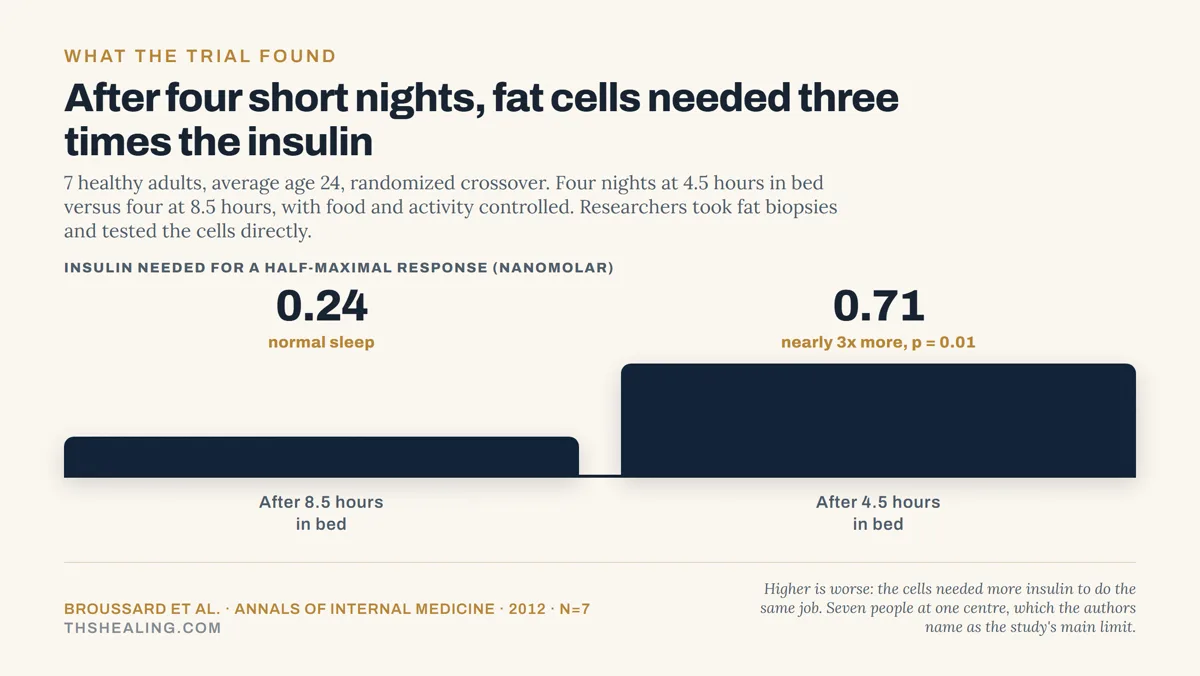
The total response was 30% lower. And whole-body insulin sensitivity, measured separately with a glucose tolerance test, moved in the same direction.
This was the first study to show a direct link between sleep restriction and molecular metabolic changes in a human peripheral tissue. Not a survey. Not an association across a population. Cells, in a dish, from people who had slept badly for four nights.
Why that number should stop you
Insulin resistance is usually discussed as something that develops over years, driven by weight and diet and genetics.
These were healthy, lean, young people. The only thing that changed was time in bed. And the change was visible in under a week.
It is worth being precise about what this does and does not mean. Insulin sensitivity is a marker, not a diagnosis. Reduced insulin sensitivity is associated with later metabolic disease in population studies, but nobody in this experiment developed anything. Four days of a laboratory condition is not a life.
What it does establish is speed. Whatever short sleep is doing, it is not waiting for years to start.
The older study that pointed the same way
This was not an isolated result.
More than a decade earlier, researchers restricted eleven healthy young men to four hours in bed for six nights, then compared them against themselves after six nights of twelve hours (Spiegel, Leproult and Van Cauter, The Lancet, 1999).
Glucose tolerance dropped. Evening cortisol rose. Sympathetic nervous system activity increased. The authors noted that the changes resembled what they see in normal ageing, which is a sentence worth reading twice.
Two studies, thirteen years apart, different methods, same direction.
The honest limits
Seven people in the 2012 study. Eleven in the 1999 one. These are small.
The authors of the newer paper name it themselves as the main limitation: single centre, small sample size. We are repeating that rather than letting the three-fold figure do work it cannot support on its own.
What makes them more convincing than their size suggests is the design. Both were within-person comparisons, where each participant is measured against their own baseline under both conditions. That removes most of the variation between people, which is the thing that usually forces studies to be large. It is a legitimate way to learn something real from a small group.
Neither study tested recovery. We do not know from these how fast it comes back.
Where the design shows up
Sleep is the one pillar you cannot outsource, buy, or substitute.
There is no supplement that does what the fourth hour of deep sleep does. No therapy at any price replaces it. And it is free, which is the part that makes it easy to treat as optional.
We find it striking that repair was built to require unconsciousness. You do not get to supervise it. You have to stop, and let something else run.
“It is vain for you to rise up early, to retire late, to eat the bread of painful labors; for He gives to His beloved even in his sleep.” Psalm 127:2, NASB
The verse carries the conviction. The cells in that dish carry the evidence. Separate jobs, same direction.
What to do this week
Pick a bedtime and defend it for seven nights.
Not a routine. A defended time. Most people know roughly when they should be asleep and treat it as the most negotiable thing in their day.
Two practical notes from the studies themselves. The comparison condition was 8.5 hours in bed, not 8.5 hours asleep, and the gap between those two numbers is usually 30 to 45 minutes. If you are aiming for eight hours of sleep, you need more than eight hours of opportunity.
And the effect here came from four consecutive short nights. Not one bad night. The thing to protect is the pattern, which means a rough Tuesday matters much less than a habit of rough Tuesdays.
If you take medication for blood sugar, a real change in your sleep can change how that medication behaves, which is a conversation worth having rather than a surprise worth discovering.
Read this next: the companion to this piece is the cheapest intervention for the sleep side, and it happens in the first hour of your day: what three hours of morning light did to 36 people’s body clocks. Sleep is pillar one of The Five Pillars of Owning Your Health, and for the food side of the same blood sugar story, see how three-minute walks cut post-meal glucose by 39%.
Sources
- Broussard JL, Ehrmann DA, Van Cauter E, Tasali E, Brady MJ. “Impaired insulin signaling in human adipocytes after experimental sleep restriction: a randomized, crossover study.” Annals of Internal Medicine, 2012;157(8):549-557. https://pubmed.ncbi.nlm.nih.gov/23070488/
- Spiegel K, Leproult R, Van Cauter E. “Impact of sleep debt on metabolic and endocrine function.” The Lancet, 1999;354(9188):1435-1439. https://pubmed.ncbi.nlm.nih.gov/10543671/
- Burke TM, Markwald RR, Chinoy ED, et al. “Combination of light and melatonin time cues for phase advancing the human circadian clock.” Sleep, 2013;36(11):1617-1624. https://pubmed.ncbi.nlm.nih.gov/24179293/
Article metadata retrieved from PubMed. Scripture quoted from the New American Standard Bible.
Educational content from True Health Solutions. We do not diagnose or prescribe, and nothing here is a substitute for care from someone who knows your history. The body heals. We write about what supports that design.
Questions people ask
- How quickly does short sleep affect blood sugar?
- Fast. In a randomized crossover study, four nights at 4.5 hours in bed left fat cells needing nearly three times as much insulin to produce the same response, compared with four nights at 8.5 hours in the same people.
- Does this happen to healthy people or only to people already at risk?
- The participants were healthy young adults with an average age of 24 and a normal body mass index. No existing condition was required for the effect to show up.
- Is this the same as developing diabetes?
- No, and we do not claim that. These studies measure insulin sensitivity, which is a marker. Reduced insulin sensitivity is associated with later disease risk in population research, but a four-night experiment does not establish disease.
- How much sleep is enough?
- The comparison condition in these studies is 8.5 hours in bed, which usually produces somewhere around seven and a half to eight hours of actual sleep. Time in bed and time asleep are not the same number.
- Does recovery sleep fix it?
- These particular studies did not test recovery, so we cannot tell you. What they establish is how quickly the change appears, not how quickly it reverses.
