
food · education ·
Vinegar Before A Meal Cut The Glucose Spike 31%. The Tablets Did Nothing
A small crossover trial tested liquid vinegar against vinegar pills before the same meal. One of them worked, and it was not the convenient one.
Somebody in the last year has told you to drink vinegar before dinner. Somebody else has told you to buy it as a capsule, because drinking it is unpleasant.
A trial tested both against the same meal, and the result is worth knowing before you spend money.
What they did
Twelve healthy young men and women each ate the same test meal, 64 grams of carbohydrate, on four separate occasions a week apart (Feise and Johnston, Journal of Nutrition and Metabolism, 2020).
Immediately before each meal they took one of four things:
- 60g of plain water, as the control
- 25g of liquid vinegar, about five teaspoons at 5% acidity, diluted in water
- four vinegar tablets swallowed whole, carrying more acetic acid than the liquid
- the same four tablets crushed and dissolved in water
Then capillary blood glucose at 30 and 60 minutes.
What happened
Liquid vinegar cut the 60 minute glucose excursion by about 31% compared with water.
The whole tablets did nothing. Their result was effectively identical to plain water, despite containing more acetic acid than the liquid dose that worked.
The crushed tablets landed in between, better than whole but still short of liquid.
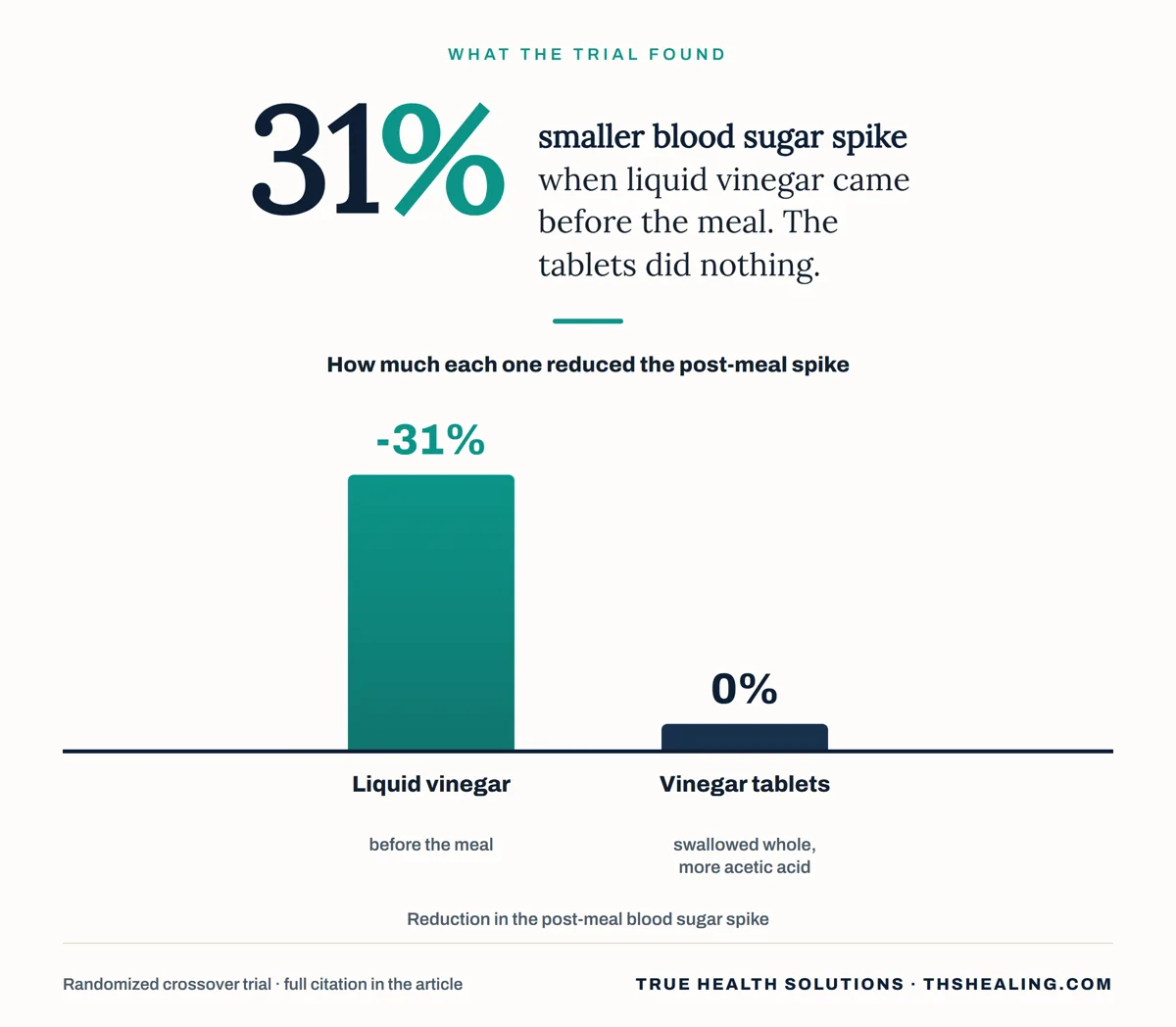
That pattern is the point. The active compound was present in the pills. It just was not arriving in the same form, at the same time, in the same place. A capsule that dissolves somewhere past the moment the meal is being digested is not the same intervention as a diluted acid taken with the first bite.
Why this keeps happening
This is the fourth time on this site we have run into the same shape. Whole broccoli beats steamed because of an enzyme. Whole foods beat their own purified extracts on blood pressure across 46 trials. Turmeric needs a partner compound. Brazil nuts, the exception, work at one nut precisely because of how concentrated the real food is.
The pattern is not that supplements are evil. It is that the form and the timing are frequently part of the mechanism, and the convenient version quietly drops them.
Does it hold up when the trials are pooled
Twelve people is twelve people, so the fair question is what happens when somebody gathers all the trials.
Pooled across clinical trials, vinegar reduced both the glucose and the insulin area under the curve after a meal, with a standardised effect of -0.60 for glucose (Shishehbor, Mansoori and Shirani, Diabetes Research and Clinical Practice, 2017).
A larger and more recent review looked at short-chain fatty acids generally and found vinegar was the one that did something. It lowered the acute glucose response in people with impaired glucose tolerance or type 2 diabetes, and more weakly in healthy volunteers, while acetate, propionate and butyrate on their own did nothing (Cherta-Murillo et al., American Journal of Clinical Nutrition, 2022).
Now the part we are obliged to tell you. That same review reports significant heterogeneity, risks of bias, and publication bias in the acute vinegar glucose category, and the authors say plainly that the evidence is very uncertain and urge caution in interpreting it. In the healthy-volunteer group the confidence interval reaches 0.00, which means the effect there is borderline rather than established.
So the honest grade is: a real, repeated, short-term effect, strongest in people whose glucose control is already impaired, sitting on a literature with known publication bias. That is better than most things in the wellness aisle and it is not a settled fact.
What the older work found
The line of research goes back further. An earlier study in people with insulin resistance or type 2 diabetes reported improved insulin sensitivity to a high-carbohydrate meal after vinegar (Johnston, Kim and Buller, Diabetes Care, 2004). We grade that one carefully too: it is published as a Letter rather than a full paper, and it is small.
None of this tells you what happens to anybody’s long-term blood sugar control. These are one-meal measurements.
So: a cheap, low-risk thing with a plausible mechanism and a measurable short-term effect. Not a treatment, and not a reason to change anything you have been told by someone who knows your history.
Where the design shows up
There is an ordinary honesty in the fact that the effective version is the one nobody wants to take.
The bottle in the cupboard, diluted in water, taken before the plate. No packaging, no proprietary blend, no subscription. It costs almost nothing, and the reason the capsule exists at all is that the working version is mildly unpleasant.
“Better is a dish of vegetables where love is than a fattened ox served with hatred.” Proverbs 15:17, NASB
The verse carries the conviction. Twelve people over four weeks carry the number.
What to do this week
If you want to test it, use the liquid, dilute it, and take it with the first bite.
Five teaspoons in a glass of water, before a meal you already know spikes you. Never neat: vinegar is an acid and straight shots are hard on tooth enamel and the throat.
And if you own vinegar capsules bought for this purpose, this trial suggests they are not doing the job you bought them for.
Read this next: how we decided what grade to give that evidence, including why publication bias matters: should you really trust the science. The broader version of the same lesson, where whole foods beat their own purified extracts across 46 trials: whole foods beat their own supplements. For another free way to flatten the same curve, a 3-minute walk after meals cut spikes by 39%.
Sources
- Shishehbor F, Mansoori A, Shirani F. “Vinegar consumption can attenuate postprandial glucose and insulin responses; a systematic review and meta-analysis of clinical trials.” Diabetes Research and Clinical Practice, 2017;127:1-9. https://pubmed.ncbi.nlm.nih.gov/28292654/
- Cherta-Murillo A, Pugh JE, Alaraj-Alshehhi S, Hajjar D, Chambers ES, Frost GS. “The effects of SCFAs on glycemic control in humans: a systematic review and meta-analysis.” The American Journal of Clinical Nutrition, 2022;116(2):335-361. https://pubmed.ncbi.nlm.nih.gov/35388874/
- Feise NK, Johnston CS. “Commercial Vinegar Tablets Do Not Display the Same Physiological Benefits for Managing Postprandial Glucose Concentrations as Liquid Vinegar.” Journal of Nutrition and Metabolism, 2020;2020:9098739. https://pubmed.ncbi.nlm.nih.gov/33489366/
- Johnston CS, Kim CM, Buller AJ. “Vinegar improves insulin sensitivity to a high-carbohydrate meal in subjects with insulin resistance or type 2 diabetes.” Diabetes Care, 2004;27(1):281-282. https://pubmed.ncbi.nlm.nih.gov/14694010/
Article metadata retrieved from PubMed. Photograph from Pexels. Scripture quoted from the New American Standard Bible.
Educational content from True Health Solutions. We do not diagnose or prescribe, and nothing here is a substitute for care from someone who knows your history. The body heals. We write about what supports that design.
Questions people ask
- Does vinegar before a meal lower blood sugar?
- In a crossover trial in twelve healthy young adults, 25g of liquid vinegar taken at the start of a 64g carbohydrate meal cut the 60 minute glucose excursion by about 31% compared with water. That is one small trial, but it is a controlled one, and the direction matches earlier work.
- Do vinegar tablets work the same way?
- No, and that is the most useful finding in the study. Four vinegar tablets swallowed whole, carrying more acetic acid than the liquid dose, produced no meaningful difference from plain water. Crushed and dissolved they did a little better, but still not as well as liquid.
- How much vinegar was used?
- 25 grams of ordinary 5% vinegar, which is about five teaspoons, diluted in 35g of water and taken immediately before the meal. That works out to roughly 1.25 grams of acetic acid.
- Is this a treatment for diabetes?
- No. These trials measure what happens to blood glucose over the hour after one meal. That is a real measurement and it is not a treatment for any condition. Nothing here replaces the care of whoever manages your health.
- Does it matter which vinegar?
- The trials used ordinary vinegar at about 5% acidity. There is no evidence in this literature that expensive varieties do anything the cheap bottle does not. Acetic acid is the part being studied.
