
food · education ·
Chia Before A Carb Meal Flattened The Glucose Curve. The Mechanism Is Thickness
Two small trials, a dose response, and a head-to-head against flax that explains why it works. The answer has less to do with nutrition than with viscosity.
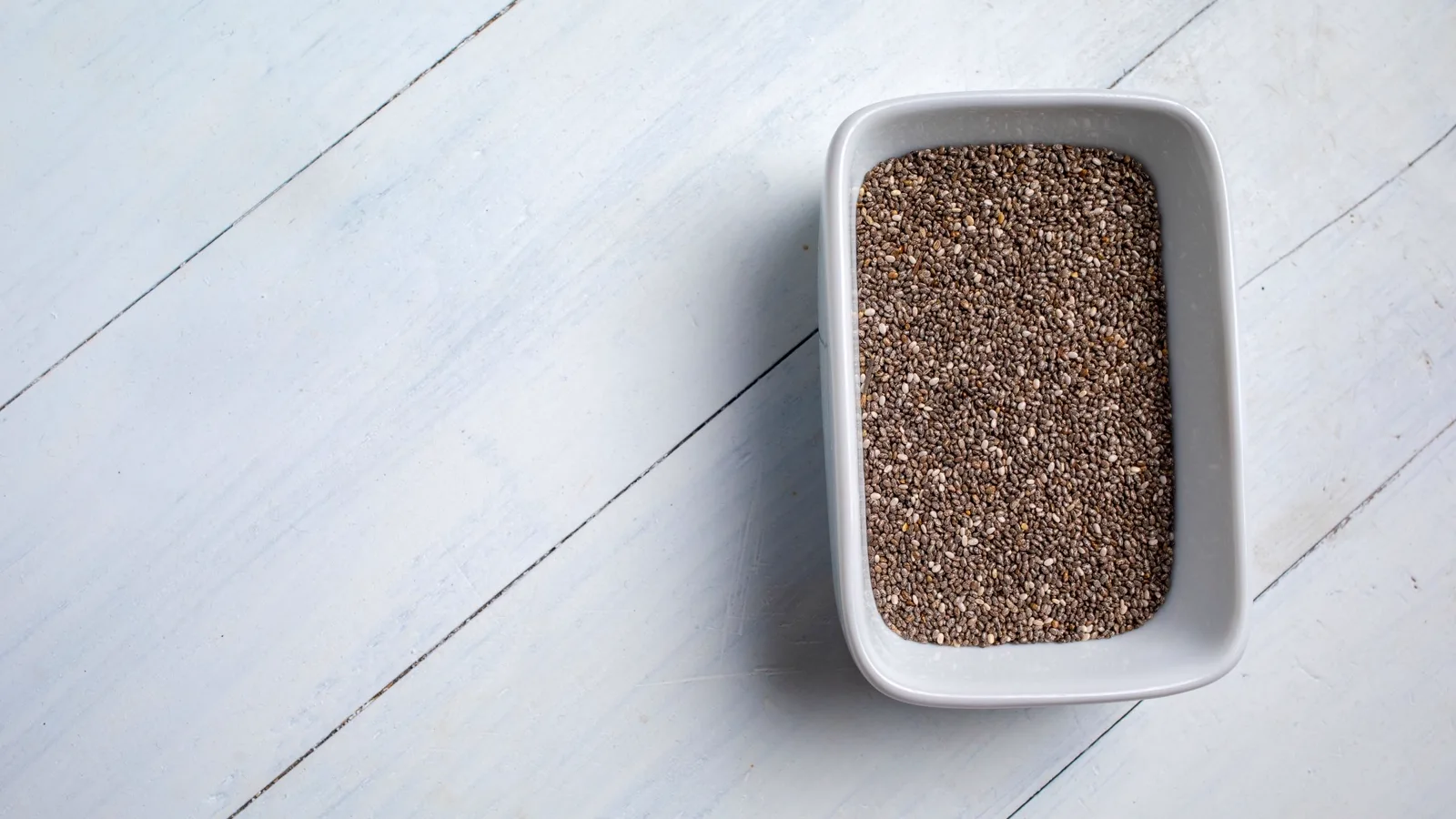
Most foods that blunt a blood sugar spike do it through something nutritional. Chia does it through something closer to engineering, and the trials that worked it out are small, old and unusually clean.
The dose response
Eleven healthy adults, six men and five women with an average BMI of 22.3, ate white bread baked with 0, 7, 15 or 24 grams of whole-grain chia on separate occasions, in a randomised, double-blind, controlled design. Capillary blood and appetite ratings were taken over the two hours afterwards (Vuksan et al., European Journal of Clinical Nutrition, 2010).
All three doses reduced the glucose rise, in a dose-dependent pattern (P = 0.002), lowering both the incremental area under the curve and the readings at individual time points. Appetite ratings fell too, at 60 minutes for the high dose, at 90 minutes for the high and intermediate doses, and at 120 minutes for all of them.
White bread is the point of that design. It is close to the worst-case carbohydrate, and adding a seed to it changed the curve without changing the bread.
Why it works, demonstrated against flax
The second trial is the one that explains the first, because it put chia next to a seed with a very similar nutritional profile.
Fifteen healthy adults drank a 50 gram glucose challenge alone, or with 25 grams of ground chia, or with 31.5 grams of flax, on three separate occasions (Vuksan et al., European Journal of Clinical Nutrition, 2016).
Both seeds beat the plain glucose drink, reducing the area under the curve by 82.5 mmol/l for chia (P < 0.001) and 60.0 for flax (P = 0.014). But against each other, chia reduced the peak glucose by a further 0.64 mmol/l (P = 0.030) and pushed the peak 11 minutes later (P = 0.015), while also scoring better on desire to eat, prospective consumption and overall appetite.
Then the researchers measured the drinks themselves, and the answer falls out:
| Drink | Viscosity, pascal-seconds |
|---|---|
| Control | 0.002 |
| Flax | 2.5 |
| Chia | 49.9 |
Twenty times thicker than flax and roughly twenty-five thousand times thicker than the control. The authors conclude that chia appears to have the ability to convert glucose into a slow-release carbohydrate, probably through that higher fibre viscosity.
Despite the similarities in nutritional composition, Salba-chia appears to have the ability to convert glucose into a slow-release carbohydrate and affect satiety to a greater extent than flax, possibly due to the higher fiber viscosity.
Vuksan et al., European Journal of Clinical Nutrition, 2016
The same sugar went in. It just arrived more slowly.
The honest limits
These are small acute studies: 11 people and 15 people, measured over two hours, in healthy young adults with normal BMIs. Nothing here followed anybody for a year or measured HbA1c.
Both trials come from the same research group, using a specific commercial chia cultivar branded Salba, which is also how the papers name it. Independent replication by a different lab with ordinary supermarket chia would strengthen this considerably, and we have not found it.
And a flattened post-meal curve is a real measurement that predicts things, not an outcome in itself. The same caution applies here as to the vinegar and walking results we have covered.
The omega-3 question, answered carefully
Chia is sold hard on omega-3, and the human data is more specific than the marketing.
Ten postmenopausal women took 25 grams of milled chia daily for seven weeks, acting as their own controls with repeated blood sampling (Jin et al., Plant Foods for Human Nutrition, 2012). Plasma ALA rose 138% (P < 0.001) and EPA rose 30% (P = 0.019), with the two correlated across time.
But DPA did not change significantly, and DHA fell slightly (P = 0.030). So the conversion runs part of the way along the chain and then stops. Chia raises the plant omega-3 and some of the first marine-type one, and does nothing good for DHA, which is the one most associated with the brain and the eye.
Anyone using chia as a substitute for a marine or algal source should know that is what the trial found.
What we are and are not saying
| Claim | Our line |
|---|---|
| Chia treats, cures or prevents diabetes | Never |
| Chia reduced the post-meal glucose rise | Yes, dose-dependently, in 11 healthy adults |
| It beat flax at the same job | Yes, on peak glucose, timing and appetite |
| The mechanism is viscosity | Strongly suggested. 49.9 against 2.5 pascal-seconds |
| These are large or long trials | No. Eleven and fifteen people, two hours each |
| The research is independent | Not yet. Both trials are from one group using one branded cultivar |
| Chia replaces fish oil | No. ALA and EPA rose, DHA did not |
Where the design shows up
The interesting thing is that chia is not doing anything chemical to the sugar.
It is not blocking an enzyme, or occupying a receptor, or signalling anything. It absorbs water, turns the contents of your stomach into a gel, and the gel takes longer to empty and longer to break down. The whole effect is physical, and you can reproduce it on a worktop with a spoon and a glass of water in about ten minutes.
Which is a decent argument for the shape of food mattering as much as its content. The same grams of carbohydrate, the same calories, the same everything, arriving at a different speed, and the body responds differently because speed was always part of what it was reading.
“Better is a dry morsel and quietness with it than a house full of feasting with strife.” Proverbs 17:1, NASB
The verse carries the conviction. Twenty-six people across two small trials carry the curve.
What to do this week
Stir a tablespoon of chia into a glass of water, leave it ten minutes until it thickens, and drink it just before the meal you already know spikes you. That is the protocol these trials are closest to, and the gel is the active part, so giving it time to form is not optional.
If you would rather eat it than drink it, baking it into something or soaking it overnight does the same job, and the bread trial used whole seeds rather than ground. Start with a tablespoon, since a sudden jump in viscous fibre is a well-known route to an uncomfortable afternoon.
Do not buy it for the omega-3 unless ALA and EPA are what you are after, and keep it dry and sealed, because the same fats that make it interesting are the ones that go rancid.
Read this next: the same job done by something already in your cupboard: vinegar before a meal cut the glucose spike 31%. The free version with no food involved: a 3-minute walk after meals cut spikes by 39%. And why a healthy breakfast can still spike you: why blood sugar spikes after a healthy breakfast.
Sources
- Vuksan V, Jenkins AL, Dias AG, et al. “Reduction in postprandial glucose excursion and prolongation of satiety: possible explanation of the long-term effects of whole grain Salba (Salvia Hispanica L.).” European Journal of Clinical Nutrition, 2010;64(4):436-438. https://pubmed.ncbi.nlm.nih.gov/20087375/
- Vuksan V, Choleva L, Jovanovski E, et al. “Comparison of flax (Linum usitatissimum) and Salba-chia (Salvia hispanica L.) seeds on postprandial glycemia and satiety in healthy individuals: a randomized, controlled, crossover study.” European Journal of Clinical Nutrition, 2017;71(2):234-238. https://pubmed.ncbi.nlm.nih.gov/28000689/
- Jin F, Nieman DC, Sha W, Xie G, Qiu Y, Jia W. “Supplementation of milled chia seeds increases plasma ALA and EPA in postmenopausal women.” Plant Foods for Human Nutrition, 2012;67(2):105-110. https://pubmed.ncbi.nlm.nih.gov/22538527/
Article metadata retrieved from PubMed. Photograph from Pexels. Scripture quoted from the New American Standard Bible.
Educational content from True Health Solutions. We do not diagnose or prescribe, and nothing here is a substitute for care from someone who knows your history. The body heals. We write about what supports that design.
Questions people ask
- Does chia lower blood sugar after a meal?
- In an acute randomised double-blind study, 11 healthy adults ate white bread baked with 0, 7, 15 or 24 grams of whole-grain chia. All three doses produced a dose-dependent reduction in the glucose rise afterwards, with lower area under the curve and lower readings at individual time points.
- How does it work?
- Viscosity. In a head-to-head against flax, the chia drink measured 49.9 pascal-seconds against 2.5 for flax and 0.002 for the control. That thickness slows how fast the meal leaves the stomach and is absorbed, which spreads the same carbohydrate over more time.
- Is chia better than flax?
- For this specific job it did better. Both reduced glucose area under the curve against a glucose control, but chia also reduced peak glucose and pushed the peak about 11 minutes later compared with flax, and scored better on appetite measures.
- Does chia give you omega-3?
- It raises some of them. In postmenopausal women taking 25 grams of milled chia daily for seven weeks, plasma ALA rose 138% and EPA rose 30%. DHA did not rise and in fact fell slightly, so chia is not a replacement for a marine source.
- Whole seeds or ground?
- The glucose trials used whole-grain chia baked into bread and ground chia in a drink, and both worked. The omega-3 trial used milled seed. Chia is unusual among seeds in that whole seeds still gel, because the gel forms on the outside of the husk.
