
education · food · fundamentals ·
Healthy Breakfast, Blood Sugar Still Spiking? 2 Things To Look At
Most breakfast advice looks at what is in the bowl. The research says the bowl is only half the story, and the other half already happened.

You did what you were told. Whole grain toast instead of white. Oatmeal instead of the sugary cereal. Fruit instead of juice.
And if you have ever worn a glucose monitor, you already know what happened next.
There are two reasons, and the second one is genuinely strange.
Reason one: most breakfast food has been through a mill
The research on what makes a carbohydrate behave well is not mainly about which grain it is. It is about what has been done to it.
The review that covers this effect is blunt about the conditions under which it disappears: the effect is lost upon milling, processing, and cooking at high temperatures (Higgins, Journal of Nutrition and Metabolism, 2012).
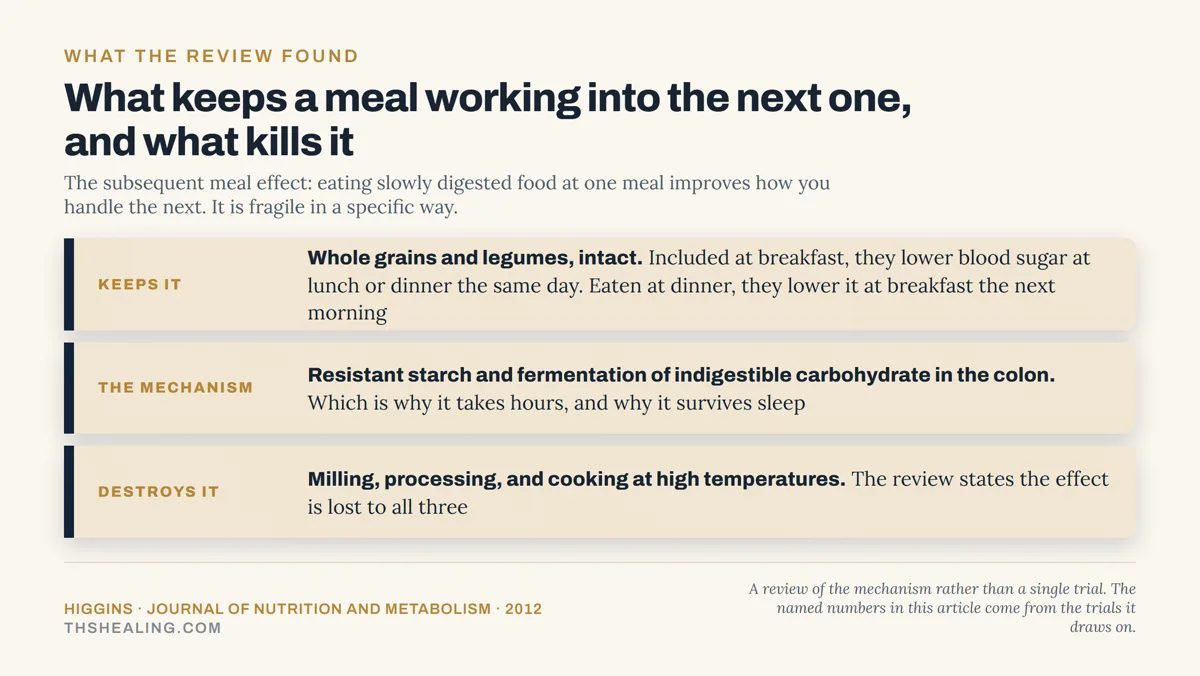
Now look at a typical healthy breakfast. Whole grain bread is flour, which is a milled grain. Instant oats are rolled thin and steamed so they cook in ninety seconds. A smoothie is fruit that has had its structure destroyed on purpose.
Every one of those is nominally a whole food, and every one has been through the exact process the research says removes the benefit. “Whole grain” on a package describes which parts of the grain are present. It says nothing about whether the grain is still intact, and intact is the part that matters here.
Reason two: the meal before it
This is the part almost nobody tells you, and it is the reason we wrote this article.
In a randomized crossover trial, 16 healthy adults ate either brown beans or white wheat bread as an evening meal, then came back for a standardized breakfast the next day (Nilsson et al., PLoS One, 2013).
At that breakfast, eleven to fourteen hours after dinner, the bean group’s blood glucose response was 15% lower. Insulin was 16% lower. Hunger was 15% lower.
Same breakfast. Everyone ate the identical meal that morning. The only thing that differed was the night before.
So when your blood sugar spikes after a reasonable breakfast, part of what you are seeing is not the breakfast. It is the state you arrived at breakfast in, and that state was set by a meal you have already forgotten about.
Why a dinner can reach the next morning
Because the work is not happening in your stomach.
Intact beans and grains carry carbohydrate your small intestine cannot break down. It travels to your colon, where bacteria ferment it over hours, producing short-chain fatty acids that get absorbed into your blood.
The same trial measured it directly: breath hydrogen, the standard marker of that fermentation, was up 141% the next morning, and propionate was up 16%.
That is a process with a long runway. It is still going while you sleep, and its products are circulating when you sit down to eat again. Which is exactly why it can cross from one meal to another, and exactly why milling breaks it: milled flour gets absorbed in the small intestine and never reaches the bacteria at all.
What this changes about breakfast advice
Most of it is aimed at the wrong variable.
The standard advice is to swap items within breakfast: this cereal not that one, this bread not that bread. Useful at the margins. But the two things with the clearest measured effects are the physical state of the food and the meal twelve hours earlier, and neither appears on a breakfast list.
It also explains a frustration we hear constantly. People make genuinely better breakfast choices, see no change on a monitor, and conclude the advice is nonsense. Often the advice was fine and the intervention was too small, because the milled version of a good food is doing much less than the intact version, and dinner was never part of the plan.
Where the design shows up
Your body treats a meal as a continuous process rather than an event with a start and an end.
There is no moment where breakfast is finished being handled. The bacteria are still working, the products are still arriving, and the next meal lands in the middle of all that rather than on a clean slate.
That is a more forgiving system than the one implied by counting individual meals, and a more demanding one, because it means consistency matters more than any single choice.
“Then God said, ‘Behold, I have given you every plant yielding seed that is on the surface of all the earth, and every tree which has fruit yielding seed; it shall be food for you.’” Genesis 1:29, NASB
The verse carries the conviction. The sixteen people in Lund carry the evidence.
What to do this week
Fix dinner, then fix breakfast.
Put half a cup of beans or lentils at dinner. That is the intervention with the clearest measured effect on tomorrow morning, and it is the cheapest thing on this page.
Then, at breakfast, move one step toward intact. Steel-cut oats instead of instant. Whole oat groats if you have a slow cooker. Beans at breakfast, which is normal in most of the world and strange only here.
And the move that does not involve food at all: a ten-minute walk after you eat cut post-meal glucose exposure substantially in trials, and it works on whatever you happened to eat.
If you take medication for blood sugar, changes of this size are real enough to matter to your dosing, which makes it a conversation rather than an experiment.
Read this next: the practical companion, three breakfasts built on this research: three plant breakfasts that hold until lunch. The dinner half of the story is what you eat at dinner is still working at breakfast the next morning, and the number behind all of it is in why fiber advice always skips what your colon actually does.
Sources
- Nilsson A, Johansson E, Ekström L, Björck I. “Effects of a brown beans evening meal on metabolic risk markers and appetite regulating hormones at a subsequent standardized breakfast: a randomized cross-over study.” PLoS One, 2013;8(4):e59985. https://pubmed.ncbi.nlm.nih.gov/23577078/
- Higgins JA. “Whole grains, legumes, and the subsequent meal effect: implications for blood glucose control and the role of fermentation.” Journal of Nutrition and Metabolism, 2012;2012:829238. https://pubmed.ncbi.nlm.nih.gov/22132324/
- Reynolds A, Mann J, Cummings J, Winter N, Mete E, Te Morenga L. “Carbohydrate quality and human health: a series of systematic reviews and meta-analyses.” The Lancet, 2019;393(10170):434-445. https://pubmed.ncbi.nlm.nih.gov/30638909/
- Dempsey PC, Larsen RN, Sethi P, et al. “Benefits for Type 2 Diabetes of Interrupting Prolonged Sitting With Brief Bouts of Light Walking or Simple Resistance Activities.” Diabetes Care, 2016;39(6):964-972. https://doi.org/10.2337/dc15-2336
Article metadata retrieved from PubMed.
Educational content from True Health Solutions. We do not diagnose or prescribe, and nothing here is a substitute for care from someone who knows your history, especially if you take medication for blood sugar. The body heals. We write about what supports that design.
Questions people ask
- Why does my blood sugar spike after a healthy breakfast?
- Two reasons the usual advice misses. Most breakfast staples are milled, and milling destroys the second-meal effect that intact grains and legumes produce. And your response to breakfast is partly set by what you ate the night before, which nobody tells you.
- What is the second-meal effect?
- Eating a slowly digested food at one meal improves how your body handles the next one. Described in 1988 and studied since. A bean dinner lowered the blood glucose response at a standardized breakfast 11 to 14 hours later by 15%.
- Does oatmeal count as a whole grain?
- Steel-cut and rolled oats are far less processed than instant. The review on this effect states plainly that it is lost to milling, processing, and cooking at high temperatures, so the more intact the grain, the better it holds.
- Is protein at breakfast the answer?
- It helps with fullness, but it is not the mechanism described here. The second-meal effect runs on fermentation of indigestible carbohydrate in your colon, which means fibre and intact starch rather than protein.
- What is the single highest-leverage change?
- Put beans or lentils at dinner. It is the intervention with the clearest measured effect on the following morning, and it costs less than any breakfast product.
