
education · food · fundamentals ·
Most People Miss The Daily Fiber Target. Here's The Number & How To Hit It
Researchers pooled 135 million person-years of data to find the number. It is 25 to 29 grams, and the reason has almost nothing to do with regularity.
Fiber gets sold to you as plumbing. Keeps things moving. That is the whole pitch, and it is the reason most people treat it as optional.
It is also the least interesting thing fiber does.
What happens to the part you cannot digest?
Your small intestine breaks down and absorbs most of what you eat. Fiber is defined by the fact that it does not cooperate with that process.
So it keeps going, into your large intestine, where roughly a hundred trillion bacteria are waiting. They can do what your enzymes cannot. They ferment it.
What comes out of that fermentation is a family of compounds called short-chain fatty acids, and one of them is the point of this article. Butyrate is produced by microbial fermentation of dietary fiber in the lower intestine, and it is absorbed by the cells lining your colon (Liu et al., Advances in Nutrition, 2018).
Those cells use it. Butyrate enhances intestinal barrier function and mucosal immunity, and it has anti-inflammatory properties. It also acts as a signaling molecule, both by inhibiting an enzyme class called histone deacetylases and through receptors on cell surfaces.
Put plainly: the part of your food you cannot use is feeding the lining of your own gut, and the byproducts of that arrangement are talking to the rest of you.
That is what the plumbing story leaves out.
So how much do you actually need?
Here is where the evidence gets unusually good for a nutrition question.
A team pooled a series of systematic reviews and meta-analyses covering 185 prospective studies and 58 clinical trials with 4,635 adults, amounting to just under 135 million person-years of data (Reynolds et al., The Lancet, 2019).
Comparing the highest fiber consumers with the lowest, the observational data showed a 15 to 30% decrease in all-cause mortality, cardiovascular mortality, coronary heart disease incidence, stroke incidence and mortality, type 2 diabetes, and colorectal cancer.
The clinical trials, which can show cause where observation cannot, found significantly lower body weight, systolic blood pressure and total cholesterol at higher fiber intakes.
And the number, the one nobody puts in the headline: risk reduction was greatest when daily fiber intake was between 25 and 29 grams. The dose-response curves suggested going higher could help more still.
Which is where most fiber advice quietly gets it wrong
The same review tested three different ways of judging carbohydrate quality, and they did not come out equal.
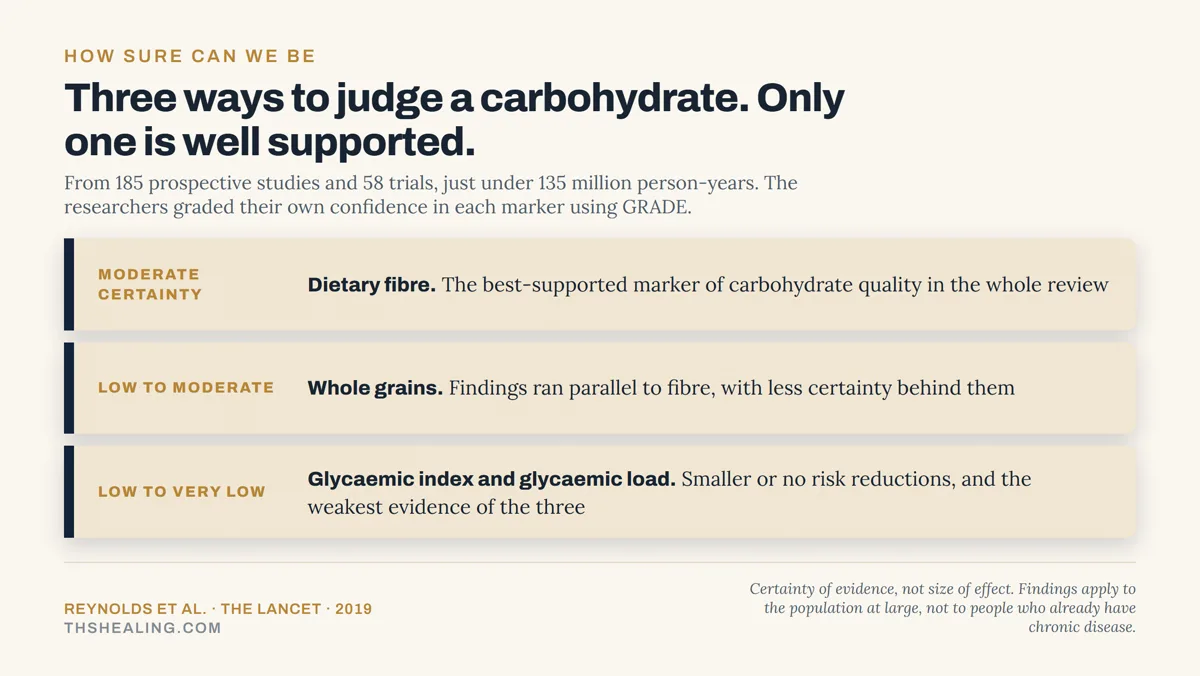
Dietary fiber: moderate certainty. Whole grains: low to moderate. Glycemic index and glycemic load: low to very low, with smaller or no risk reductions in the observational data.
Glycemic index is the one that built an industry. It is also the one the biggest review of carbohydrate quality found the least support for.
We are not telling you glycemic index is worthless. We are telling you that if you have been sorting your food by it while ignoring how many grams of fiber you eat, you have been optimizing the weaker variable.
One honest limit the authors set on their own work: these findings apply to risk reduction in the population at large, not to people who already have a chronic disease. And the observational half is observational. What they said, precisely, is that the striking dose-response evidence indicates the relationships to several diseases could be causal. That is a carefully chosen phrase and we are going to leave it as they wrote it.
What 25 grams looks like on a plate
Not a supplement. The reviews specifically excluded trials involving supplements, so nothing here is evidence for a powder.
Rough, practical arithmetic for a day:
- A cup of cooked beans or lentils: around 15 grams. This is why we keep coming back to them.
- A cup of raspberries or blackberries: around 8 grams.
- A medium apple or pear, eaten with the skin: 4 to 5 grams.
- A cup of cooked oats: around 4 grams.
- A cup of broccoli, Brussels sprouts or most cooked greens: 3 to 5 grams.
Beans and a bowl of berries is most of the day handled. That is the whole reason a half-cup of beans keeps showing up in our writing: it is the single cheapest way to move this number.
Where the design shows up
You were not built as a sealed system. You were built as a household.
There is an entire population living in you that eats what you cannot, and pays rent in compounds your own cells run on. The waste of one party is the food of the other, and the arrangement is not an accident of biology we are still apologizing for. It looks like provision.
“Then God said, ‘Behold, I have given you every plant yielding seed that is on the surface of all the earth, and every tree which has fruit yielding seed; it shall be food for you.’” Genesis 1:29, NASB
The verse carries the conviction. The 135 million person-years carry the evidence. Different jobs, same direction.
What to do this week
Count fiber for three days. Just count.
Not forever. Three days is enough to find out whether you are near 25 grams or nowhere close, and almost everyone is surprised in the same direction.
Then add one thing rather than redesigning your diet. Half a cup of beans at dinner is the highest-leverage single move, because it is worth more grams than anything else on the list and it is cheap.
Go slowly. Fiber that arrives suddenly gets fermented enthusiastically, which you will notice. Build over a couple of weeks, not a couple of days.
Read this next: the fermentation described here is the same process behind a genuinely strange finding, where what you eat at dinner is still working at breakfast the next morning. If you are going to add beans, the companion piece on doing it comfortably is in the bean studies, even the control group reported gas. Fiber lives inside pillar two of The Five Pillars of Owning Your Health.
Sources
- Reynolds A, Mann J, Cummings J, Winter N, Mete E, Te Morenga L. “Carbohydrate quality and human health: a series of systematic reviews and meta-analyses.” The Lancet, 2019;393(10170):434-445. https://pubmed.ncbi.nlm.nih.gov/30638909/
- Liu H, Wang J, He T, Becker S, Zhang G, Li D, Ma X. “Butyrate: A Double-Edged Sword for Health?” Advances in Nutrition, 2018;9(1):21-29. https://pubmed.ncbi.nlm.nih.gov/29438462/
- Nilsson A, Johansson E, Ekström L, Björck I. “Effects of a brown beans evening meal on metabolic risk markers and appetite regulating hormones at a subsequent standardized breakfast: a randomized cross-over study.” PLoS One, 2013;8(4):e59985. https://pubmed.ncbi.nlm.nih.gov/23577078/
- Higgins JA. “Whole grains, legumes, and the subsequent meal effect: implications for blood glucose control and the role of fermentation.” Journal of Nutrition and Metabolism, 2012;2012:829238. https://pubmed.ncbi.nlm.nih.gov/22132324/
Article metadata retrieved from PubMed.
Educational content from True Health Solutions. We do not diagnose or prescribe, and nothing here is a substitute for care from someone who knows your history. The body heals. We write about what supports that design.
Questions people ask
- How much fiber should I eat a day?
- In a series of reviews covering 185 prospective studies and 58 trials, risk reduction across critical outcomes was greatest when daily fiber intake was between 25 and 29 grams. The dose-response curves suggested more could be better still.
- What does fiber actually do besides keeping you regular?
- The part your small intestine cannot digest reaches your colon, where bacteria ferment it into short-chain fatty acids including butyrate. Butyrate feeds the cells lining your colon, supports the gut barrier, and acts as a signaling molecule.
- Is glycemic index a good way to judge carbohydrates?
- It is the weakest of the three markers studied. The same review graded the evidence for dietary fiber as moderate certainty, whole grains as low to moderate, and glycemic index and load as low to very low, with smaller or no risk reductions.
- Can I just take a fiber supplement?
- The evidence here is about dietary fiber from food, and the reviews specifically excluded supplement trials. We would not read it as support for a powder.
- Does fiber treat or prevent disease?
- We do not make treatment or prevention claims. The observational findings are associations. The authors did note that the strength of the dose-response evidence indicates the relationships could be causal, which is a carefully worded statement worth reading exactly as written.
