
education · food ·
People Ate 508 More Calories A Day On Ultra-Processed Food Without Noticing
Same calories offered, same fat, same sugar, same fibre. One group ate 508 calories a day more anyway, and gained weight doing it.
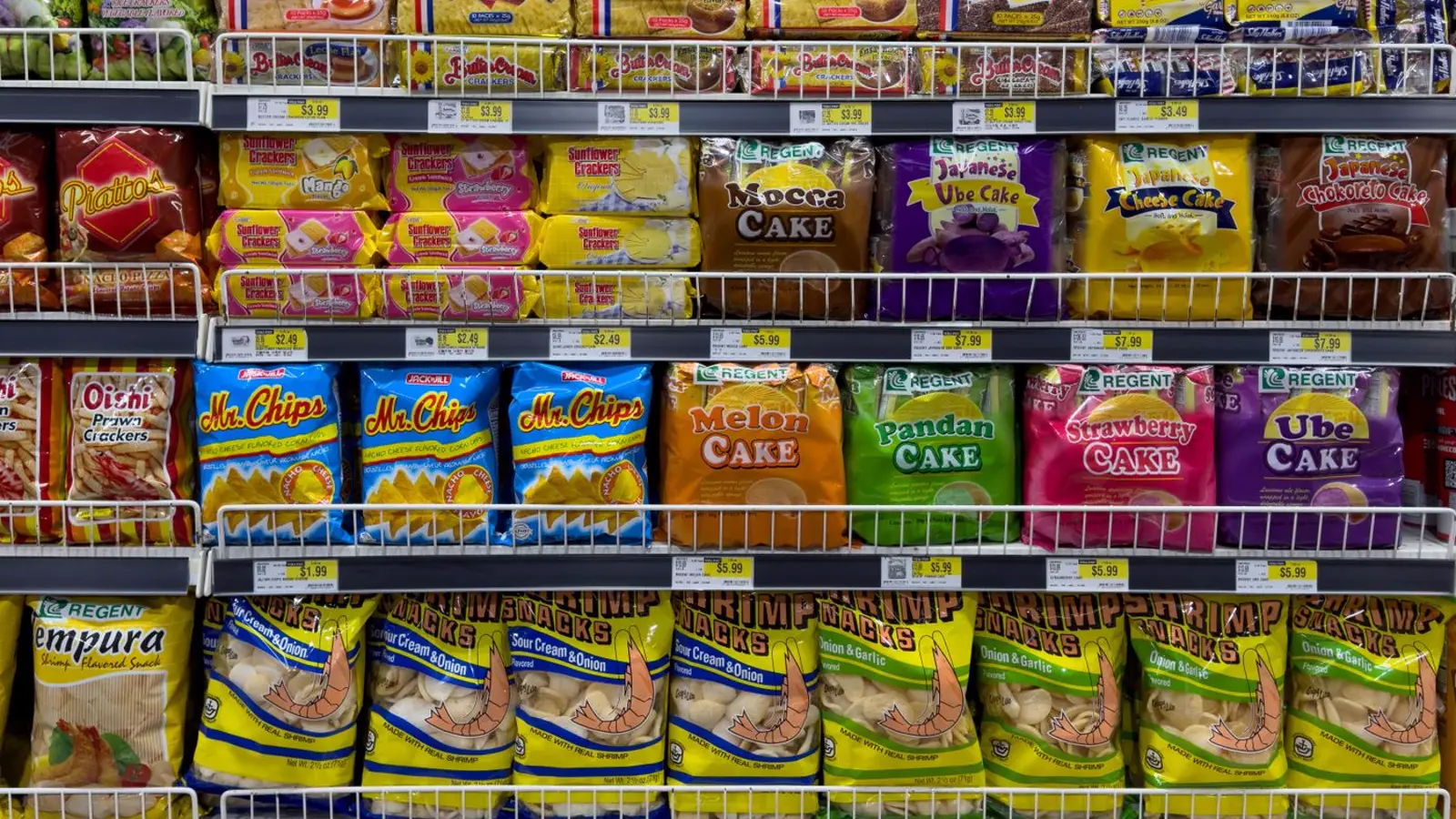
Almost everything you read about ultra-processed food comes from observational research: ask a large group what they eat, follow them for years, see who gets sick. That kind of study can never quite rule out the possibility that people who eat more packaged food differ in some other way that is doing the damage.
So researchers at the National Institutes of Health did something much harder and much more expensive. They moved twenty adults into a hospital research ward and fed them.
What they controlled for
This is the part that makes the study matter.
Twenty weight-stable adults, average age 31, were randomized to two weeks of an ultra-processed diet or two weeks of an unprocessed one, then immediately switched to the other (Hall et al., Cell Metabolism, 2019). Every participant ate both, so each person is their own comparison.
The meals were designed to match on calories presented, energy density, macronutrients, sugar, sodium and fibre.
Read that list again. The usual explanations for why processed food makes people gain weight are all on it. More sugar: matched. More fat: matched. Less fibre: matched. More calories on the plate: matched.
Then they told people to eat as much or as little as they wanted.
What happened
On the ultra-processed diet, people ate 508 more calories a day. The p-value was 0.0001.
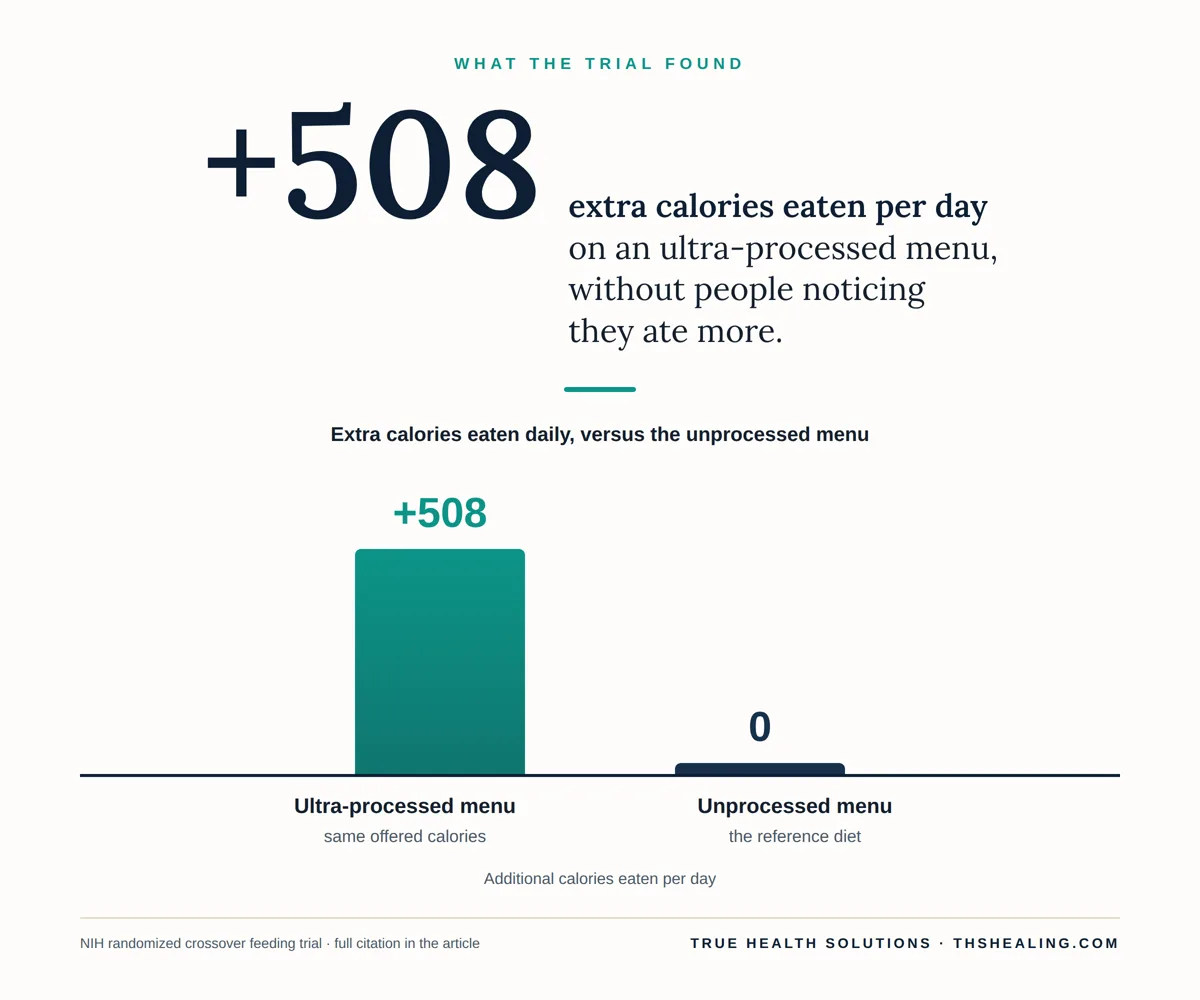
Carbohydrate accounted for 280 of those calories and fat for 230. Protein did not move at all: minus 2 calories, which is statistically nothing.
Weight tracked almost perfectly with intake. Participants gained about 0.9 kg during the ultra-processed fortnight and lost about 0.9 kg during the unprocessed one. Two weeks each way.
Nobody was told to eat more. Nobody was on a diet. The food was matched on every variable anybody usually blames, and people still ate half a thousand calories a day more without noticing.
What that means, and what it does not
This is a randomized controlled trial, which puts it in a different category from almost everything else written about processed food. When people say the evidence on ultra-processed food is only observational, this study is the answer.
Within its limits, it demonstrates cause. Something about ultra-processed food itself, not its sugar or fat or fibre content, led people to eat more of it.
The limits are real and worth stating. Twenty people. Four weeks. A research ward, which is not a life. And the study cannot tell you which property of ultra-processed food did it. The authors and others have since pointed at eating rate, texture, and how quickly these foods can be chewed and swallowed, but the trial itself does not settle the mechanism.
One more thing we have written about before and will keep repeating: ultra-processed is not a moral category, and it does not behave as one thing. When a separate analysis of three US cohorts broke the category apart, sugary drinks and processed meats carried the cardiovascular risk while bread, cereals and yoghurt went the other way. Read that alongside this trial, not instead of it.
Why we think this is the most useful food study of the decade
Because it removes an excuse.
Most nutrition advice can be argued with, because most nutrition evidence is people reporting what they ate and researchers adjusting for everything they can think of. There is always another variable.
Here there was not. Everybody got the same calories offered, the same macros, the same fibre. The only thing that differed was how the food was made. And the difference showed up in two weeks, on the scale, in twenty out of twenty people’s own bodies compared against themselves.
You do not have to believe anyone’s theory to act on that.
Where the design shows up
Your appetite is a control system. It worked well enough, for long enough, that nobody needed to count anything.
What this trial suggests is that the system can be fooled, and that the fooling is a property of how food is manufactured rather than what is nominally in it. The signal that says enough is real, and it can be bypassed.
“Then God said, ‘Behold, I have given you every plant yielding seed that is on the surface of all the earth, and every tree which has fruit yielding seed; it shall be food for you.’” Genesis 1:29, NASB
The verse carries the conviction. The twenty people in that ward carry the evidence. Different jobs, same direction.
What to do this week
Change what is in the house, not what is on the plate.
The people in this trial were not weak. They were healthy adults who ate more because the food was built to be eaten more of, and they did not notice it happening. Willpower was never the variable, which means willpower is not the fix.
The single highest-leverage move, and the one the cohort data points at hardest, is the sweet drinks. Swap one a day for water. After that, cook one more meal a week at home than you did last week.
Not a reset. Not a Whole30. One notch, held.
Read this next: the other half of this story is what to eat instead, which starts at what most food as medicine advice never mentions. For the cheapest single upgrade, half a cup of beans at dinner was still working at breakfast, and the fibre number almost nobody hits is in why fiber advice always skips what your colon actually does.
Sources
- Hall KD, Ayuketah A, Brychta R, et al. “Ultra-Processed Diets Cause Excess Calorie Intake and Weight Gain: An Inpatient Randomized Controlled Trial of Ad Libitum Food Intake.” Cell Metabolism, 2019;30(1):67-77.e3. https://pubmed.ncbi.nlm.nih.gov/31105044/
- Mendoza K, Smith-Warner SA, Rossato SL, et al. “Ultra-processed foods and cardiovascular disease: analysis of three large US prospective cohorts and a systematic review and meta-analysis of prospective cohort studies.” Lancet Regional Health Americas, 2024;37:100859. https://pubmed.ncbi.nlm.nih.gov/39286398/
- Vitale M, Costabile G, Testa R, et al. “Ultra-Processed Foods and Human Health: A Systematic Review and Meta-Analysis of Prospective Cohort Studies.” Advances in Nutrition, 2023;15(1):100121. https://pubmed.ncbi.nlm.nih.gov/38245358/
Article metadata retrieved from PubMed.
Educational content from True Health Solutions. We do not diagnose or prescribe, and nothing here is a substitute for care from someone who knows your history. The body heals. We write about what supports that design.
Questions people ask
- What did the NIH ultra-processed food trial actually find?
- Twenty adults lived at the NIH Clinical Center and ate two diets for two weeks each, matched for calories offered, energy density, protein, carbohydrate, fat, sugar, sodium and fibre. On the ultra-processed diet they ate 508 more calories a day and gained about 0.9 kg. On the unprocessed diet they lost about 0.9 kg.
- Is this an association or a cause?
- A cause, within the limits of the study. It was a randomized controlled crossover trial where every participant ate both diets, so this is not observational research about what people report eating.
- Where did the extra calories come from?
- Carbohydrate accounted for 280 of them and fat for 230. Protein intake did not change at all, which is one of the more interesting details in the paper.
- Does this mean all processed food is bad?
- No. Ultra-processed is a specific category, and other research shows it does not behave as one thing: sugary drinks and processed meats track with harm while bread, cereals and yoghurt often do not.
- How big was the study?
- Twenty people for four weeks in a research ward. That is small, and the control is the trade-off that makes it valuable. Nobody has run a bigger version because feeding people under observation for a month is extraordinarily expensive.
