
education · fundamentals · movement ·
What Your Grip Strength Says About Your Health (& How To Test It At Home)
139,691 people across 17 countries squeezed a device once. Four years later the number predicted more than the cuff on your arm.
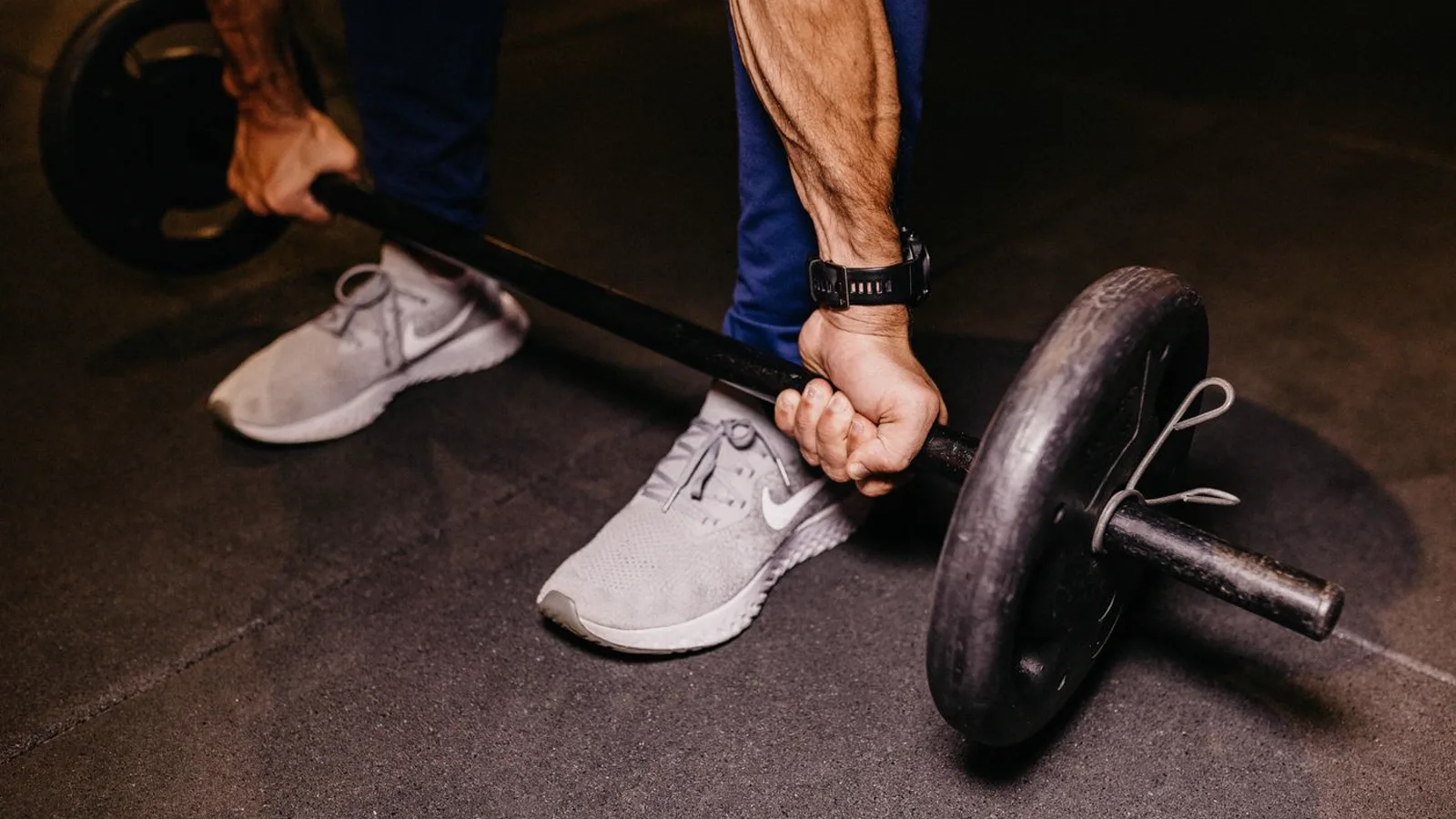
There is a test that costs almost nothing, takes ten seconds, requires no lab, and in one of the largest studies ever run on it, outperformed the blood pressure cuff at predicting who would die.
Almost nobody has ever had it done.
The study
The Prospective Urban Rural Epidemiology study enrolled 142,861 people across 17 countries at every income level, from Canada and Sweden to Zimbabwe and Bangladesh. Each one squeezed a handheld dynamometer (Leong et al., The Lancet, 2015).
Then researchers followed 139,691 of them for a median of four years. During that time 3,379 died.
Every 5 kilogram reduction in grip strength was associated with a 16% higher risk of death from any cause, and a 17% higher risk of cardiovascular death. Heart attack and stroke moved too, more modestly.
And then the sentence that made this study famous: grip strength was a stronger predictor of all-cause and cardiovascular mortality than systolic blood pressure.
Blood pressure gets measured at every appointment you have ever had. Grip strength gets measured almost never.
Be careful with what that means
We are going to slow down here, because this finding is regularly oversold and the oversell is the interesting part.
Grip strength predicting death does not mean weak hands cause death. It almost certainly means grip strength is a cheap readout of something larger: total muscle mass, nutritional status, nervous system function, how much physical work your life still contains, whether something is quietly wrong.
The authors are explicit about the gap. Their own closing line calls for research to identify what determines muscular strength and to test whether improvement in strength reduces mortality. As of that paper, nobody had.
So the honest framing is: this is an unusually good thermometer. It is not established as a thermostat.
What it did not predict
The parts that failed are as useful as the parts that worked, and they almost never get quoted.
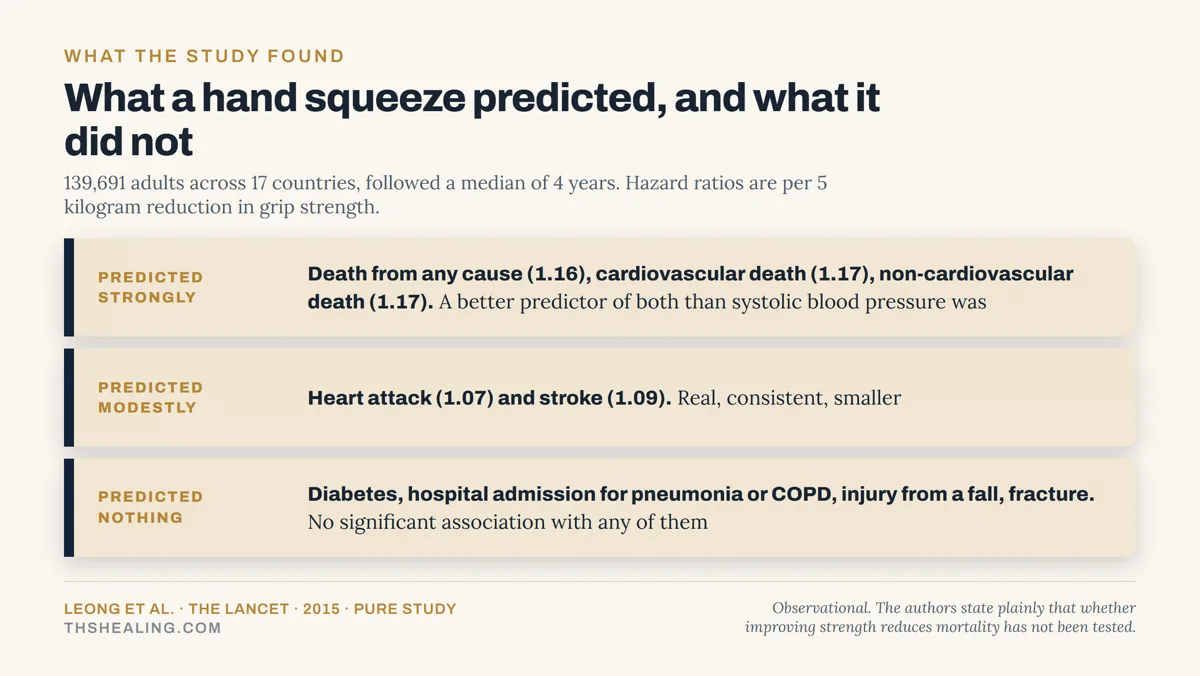
No significant association with developing diabetes. None with hospital admission for pneumonia or COPD. And none with injury from a fall or with fracture, which is genuinely surprising given how often grip strength gets discussed as a frailty and falls measure.
In high-income countries, grip strength and cancer were associated in the opposite direction from everything else, and that pattern did not appear in middle- and low-income countries. The authors report it without explaining it, which is the correct thing to do with a result nobody understands yet.
A site that only told you the blood pressure line would be selling you something. The full table is more interesting and less tidy.
Why we are writing about it anyway
Because of what it implies about where to spend effort.
Most people treat strength as a vanity project and cardiovascular risk as a medical one. This study, in 139,691 people across seventeen countries, suggests the thing you can measure in your hand carries more information about your next four years than the number your doctor writes down every visit.
It also fits a pattern we keep running into. In the Finnish sauna data, fitness did more than the therapy. Here, strength outpredicts a clinical measurement. The unglamorous, effortful, free things keep winning.
Where the design shows up
You were built to carry things.
Not to lift for aesthetics, and not to sit. To pick up what needs moving and put it where it goes, repeatedly, for a working life. Grip is where that whole capacity terminates, which may be exactly why squeezing a device says so much about the rest of you.
“She girds herself with strength and makes her arms strong.” Proverbs 31:17, NASB
The verse carries the conviction. The 139,691 people carry the evidence. Separate jobs.
What to do this week
Pick up heavy things and carry them.
Not a grip trainer. Those train the gadget. The strength that showed up in this study is whole-body strength reading out through the hand, so train the body.
The simplest version, free, no gym: carry your groceries in from the car in one trip and make it hard. Pick the heavy end. Hold it longer than is comfortable. Add a farmer’s carry, which is picking up something heavy in each hand and walking until you want to put it down.
If you do lift, stop using straps for everything and let your hands do the work sometimes.
And if you want the measurement: a hand dynamometer costs about what a large pizza does. Best of three, each hand, written down once a year. The number itself means little. The direction it moves over five years means a great deal.
Read this next: the same lesson about effort beating equipment is in is a hot bath doing what the sauna studies keep finding?, where fitness beat the therapy. For the cheapest movement intervention with the best evidence, three-minute walks cut post-meal blood sugar by 39%. Movement is pillar three of The Five Pillars of Owning Your Health.
Sources
- Leong DP, Teo KK, Rangarajan S, et al. “Prognostic value of grip strength: findings from the Prospective Urban Rural Epidemiology (PURE) study.” The Lancet, 2015;386(9990):266-273. https://pubmed.ncbi.nlm.nih.gov/25982160/
- Ekelund U, Steene-Johannessen J, Brown WJ, et al. “Does physical activity attenuate, or even eliminate, the detrimental association of sitting time with mortality? A harmonised meta-analysis of data from more than 1 million men and women.” The Lancet, 2016;388(10051):1302-1310. https://pubmed.ncbi.nlm.nih.gov/27475271/
- Kunutsor SK, Khan H, Laukkanen T, Laukkanen JA. “Joint associations of sauna bathing and cardiorespiratory fitness on cardiovascular and all-cause mortality risk: a long-term prospective cohort study.” Annals of Medicine, 2017;50(2):139-146. https://pubmed.ncbi.nlm.nih.gov/28972808/
Article metadata retrieved from PubMed. Scripture quoted from the New American Standard Bible.
Educational content from True Health Solutions. We do not diagnose or prescribe, and nothing here is a substitute for care from someone who knows your history. The body heals. We write about what supports that design.
Questions people ask
- What does grip strength predict?
- In 139,691 adults across 17 countries, each 5 kilogram reduction in grip strength was associated with a 16% higher risk of death from any cause, 17% higher cardiovascular death, and smaller increases for heart attack and stroke. It predicted all-cause and cardiovascular death better than systolic blood pressure did.
- Does that mean getting stronger makes you live longer?
- Nobody has shown that. The authors say so directly: further research is needed to test whether improving strength reduces mortality. Grip strength is almost certainly a readout of overall condition rather than the thing itself.
- What did grip strength fail to predict?
- There was no significant association with developing diabetes, hospital admission for pneumonia or COPD, injury from a fall, or fracture. That last pair surprises people.
- How do I measure my own grip strength?
- A hand dynamometer costs about the price of a large pizza. Squeeze it as hard as you can, best of three, each hand. The absolute number matters less than whether it is going up or down over years.
- How do you train grip strength?
- Mostly by carrying and holding heavy things rather than by squeezing a gadget. Loaded carries, deadlifts, hanging from a bar. Grip tends to improve as a side effect of getting generally stronger, which is the point.
