
education · fundamentals · movement ·
Worried You Sit Too Much? Here's What Actually Offsets It
Sitting is the new smoking, they said. Then researchers pooled a million people and found the people who sat least were dying faster than people who sat most.

For about a decade you have been told that sitting is the new smoking, and that no amount of exercise undoes a day at a desk.
Researchers pooled the data from sixteen studies covering more than a million adults to test exactly that claim.
The people who sat the least and moved the least were dying faster than the people who sat the most and moved the most. By a lot.
What they did
Sixteen prospective cohort studies, reanalysed under one harmonised protocol so the categories actually matched across studies, which is the hard part and the reason this paper matters (Ekelund et al., The Lancet, 2016).
Thirteen of those studies had both sitting time and mortality: 1,005,791 people, followed between 2 and 18 years, during which 84,609 died.
Everyone was sorted two ways at once. Daily sitting time into four bands. Physical activity into quartiles. Then every combination was compared against the same reference group: people who sat under four hours a day and were in the most active quarter.
What came out
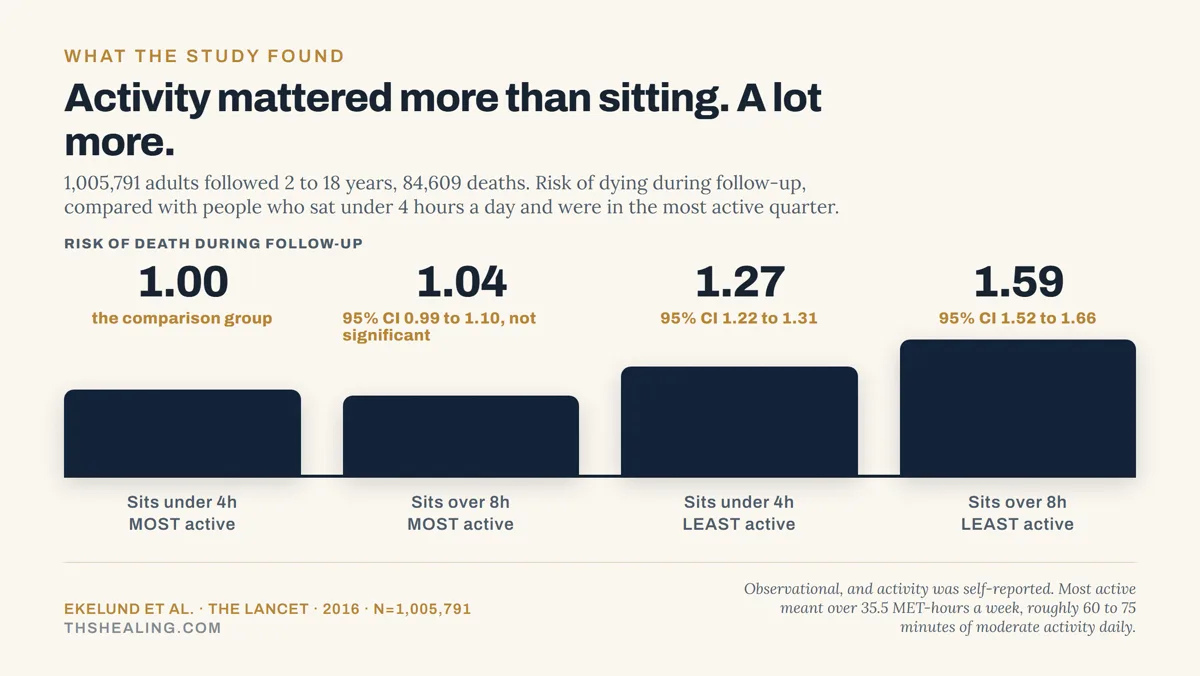
Sitting more than 8 hours a day, while in the most active quartile: hazard ratio 1.04, confidence interval 0.99 to 1.10. That interval crosses 1. No significant increase in risk.
Sitting less than 4 hours a day, while in the least active quartile: hazard ratio 1.27, confidence interval 1.22 to 1.31. Significantly worse.
Read those two rows against each other. The people sitting twice as long had less excess risk than the people sitting half as long, because the sitting was not the variable doing the work.
The worst group, unsurprisingly, was both: sitting over 8 hours and least active, at 1.59.
The authors’ own conclusion is that high levels of moderate intensity activity, about 60 to 75 minutes a day, seem to eliminate the increased risk of death associated with high sitting time.
The honest version of “sitting is the new smoking”
It is not that sitting is fine. Within every activity level below the top one, more sitting tracked with more risk. If you are averagely active, the hours in the chair still show up.
It is that inactivity was the larger problem, and it was being blamed on furniture.
That distinction matters because it changes what you do about it. If sitting were the poison, a standing desk would be the antidote. If inactivity is the poison, a standing desk does very little and an hour of real movement does almost everything.
We have now written three articles that land on the same finding from three directions. Fitness beat frequent sauna use on cardiovascular death. Grip strength outpredicted blood pressure. And here, activity swamped the variable everyone was worried about. None of this was planned. It just keeps happening.
The exception, and it is a real one
Television did not behave like other sitting.
In the six studies with TV data, covering 465,450 people and 43,740 deaths, watching three or more hours a day was associated with increased mortality regardless of physical activity. Even in the most active quartile, five hours or more still carried significantly increased risk.
The authors are careful not to over-explain that, and so are we. TV time may be a marker for other things: when you watch, what you eat while watching, who is watching that much and why. But whatever is going on, exercise did not clear it the way it cleared ordinary sitting.
What this study cannot tell you
It is observational. Sixteen cohorts, pooled carefully, but nobody was randomized to a chair.
Both sitting time and physical activity were self-reported, and people are famously unreliable about both, generally in the flattering direction. Reverse causation is a live worry too: people who are already unwell sit more and move less, and some of them die during follow-up.
What makes it worth your attention despite all that is the size, the harmonisation, and the fact that the result went against the prevailing story rather than confirming it.
Where the design shows up
The body does not appear to keep a ledger of hours seated. It keeps one of demands met.
Sit all day and then genuinely work, and the demand gets met. Stand all day and never raise your heart rate, and it does not. That is a more forgiving arrangement than the headlines suggested, and a less convenient one, because it cannot be solved by buying furniture.
“Whatever you do, do your work heartily, as for the Lord and not for people.” Colossians 3:23, NASB
The verse carries the conviction. The million people carry the evidence.
What to do this week
Stop worrying about the chair. Start counting the movement.
The number in this study was 60 to 75 minutes of moderate activity a day to fully clear the sitting risk. That is more than most guidelines say, and more than most people do, and we are not going to pretend it is 15 minutes.
But look at the shape of the curve before you despair. The largest single jump in risk is between the least active quartile and the next one up, not between the top two. Going from nothing to something buys you far more than going from a lot to slightly more.
So: a walk that makes you breathe harder, most days. Anything that qualifies as work. A ten-minute walk after your biggest meal is the highest-return ten minutes we know of and it counts toward this.
And the one specific thing this study supports that nothing else does: cap the television. Three hours a day was the line, and exercise did not rescue it.
Read this next: a hand squeeze predicted death better than blood pressure did is the strength half of the same story. Movement is pillar three in The Five Pillars of Owning Your Health.
Sources
- Ekelund U, Steene-Johannessen J, Brown WJ, Fagerland MW, Owen N, Powell KE, Bauman A, Lee IM. “Does physical activity attenuate, or even eliminate, the detrimental association of sitting time with mortality? A harmonised meta-analysis of data from more than 1 million men and women.” The Lancet, 2016;388(10051):1302-1310. https://pubmed.ncbi.nlm.nih.gov/27475271/
- Leong DP, Teo KK, Rangarajan S, et al. “Prognostic value of grip strength: findings from the Prospective Urban Rural Epidemiology (PURE) study.” The Lancet, 2015;386(9990):266-273. https://pubmed.ncbi.nlm.nih.gov/25982160/
- Dempsey PC, Larsen RN, Sethi P, et al. “Benefits for Type 2 Diabetes of Interrupting Prolonged Sitting With Brief Bouts of Light Walking or Simple Resistance Activities.” Diabetes Care, 2016;39(6):964-972. https://doi.org/10.2337/dc15-2336
Article metadata retrieved from PubMed. Scripture quoted from the New American Standard Bible.
Educational content from True Health Solutions. We do not diagnose or prescribe, and nothing here is a substitute for care from someone who knows your history. The body heals. We write about what supports that design.
Questions people ask
- Does exercise cancel out the harm from sitting all day?
- In a harmonised meta-analysis of over a million adults, it largely did. People who sat more than 8 hours a day but were in the most active quarter had a hazard ratio of 1.04, with a confidence interval crossing 1, meaning no significant increase in risk.
- How much activity did that take?
- The most active quartile did more than 35.5 MET-hours a week, which the authors describe as roughly 60 to 75 minutes of moderate intensity activity per day. That is a lot more than most guidelines ask for.
- Is sitting still bad for you?
- Sitting more was associated with higher risk at every activity level except the top one. The finding is not that sitting is harmless. It is that inactivity was the stronger variable of the two.
- What about watching TV?
- TV behaved differently and worse. Watching 3 or more hours a day was associated with increased mortality regardless of activity, and even in the most active group, 5 hours or more still carried increased risk.
- Is this study proof?
- No. It pooled prospective cohort studies, so it shows association rather than cause, and both sitting time and activity were self-reported. It is the largest and most carefully harmonised look at the question that exists.
